Skip to main content


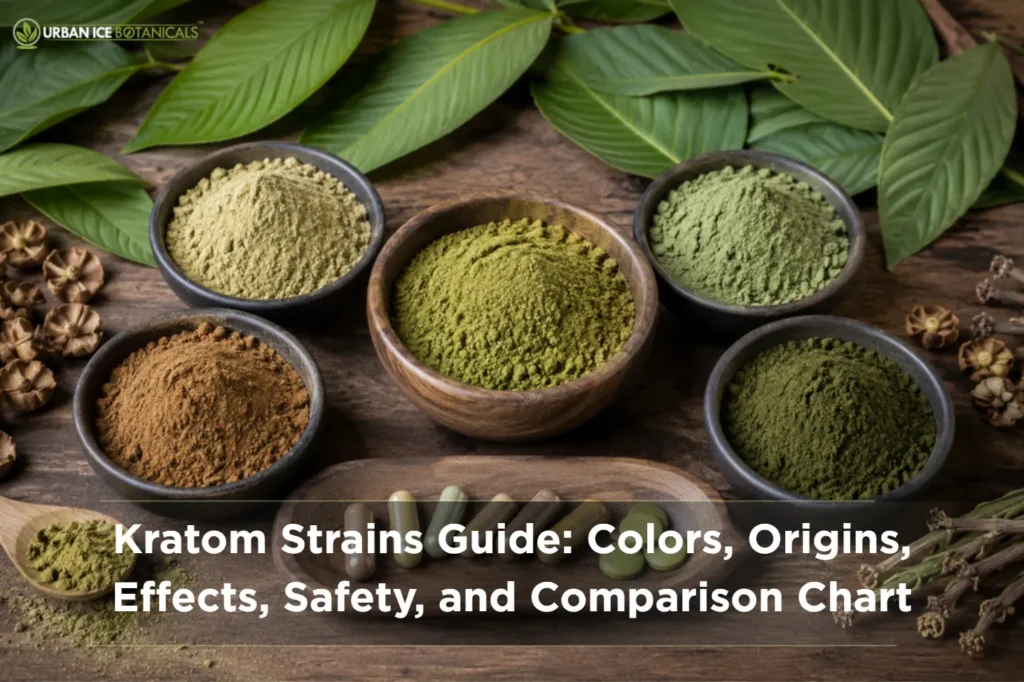
Kratom strains are the primary way commercial Mitragyna speciosa products are categorized and compared. Names such as Red Bali, Green Malay, White Maeng Da, Borneo, Thai, and Sumatra are typically based on vein color, geographic origin, post-harvest processing, or vendor-specific formulations rather than genetically distinct plant varieties. Since alkaloid composition, cultivation conditions, drying methods, and manufacturing practices vary between batches, products with the same strain name may differ in their chemical profile and overall characteristics.
This guide provides a comprehensive overview of kratom strain classifications, including vein colors, regional varieties, alkaloids, processing methods, comparison charts, safety considerations, product forms, and quality indicators such as Certificates of Analysis (COAs). It also explains what current research says about commercial strain names, helping you evaluate kratom products using laboratory-tested data and transparent manufacturing practices instead of marketing claims alone.
Understanding the Evidence in This Guide
Kratom research is still evolving, and not all information about commercial strains is supported by the same level of scientific evidence. Throughout this guide, information is interpreted using four complementary evidence sources to distinguish established findings from traditional knowledge and marketplace terminology.
| Evidence Source | What It Includes |
| Scientific Research | Peer-reviewed laboratory studies, pharmacology, toxicology, and human or animal research on Mitragyna speciosa and its alkaloids. |
| Laboratory Analysis | Third-party testing, Certificates of Analysis (COAs), alkaloid profiling, and contaminant screening for commercial products. |
| Traditional Use | Historical use of kratom leaves in Southeast Asia, including Thailand, Malaysia, and Indonesia. |
| Consumer Reports & Industry Practice | Commercial strain classifications, vendor terminology, and commonly reported user experiences that have not been consistently confirmed by clinical research. |
What Are Kratom Strains?
Kratom strains are commercial classifications used to identify products made from the leaves of Mitragyna speciosa, a tropical tree native to Thailand, Indonesia, and Malaysia. Rather than representing genetically distinct plant varieties, a strain name reflects a combination of vein color, geographic origin, post-harvest processing, and vendor branding.
What defines a strain goes deeper than the label. The two primary active alkaloids, mitragynine and 7-hydroxymitragynine, vary in concentration depending on leaf maturity, growing conditions, drying method, and fermentation. A red vein strain, for instance, typically comes from mature leaves that have undergone extended drying or fermentation, producing a different alkaloid ratio than a white vein product harvested earlier and dried indoors. Processing differences, not genetics, are what distinguish one strain from another.
Because no industry-wide naming standard exists, Certificates of Analysis (COAs) remain the most reliable way to verify what a product actually contains.
Do Kratom Strains Really Exist?
No, kratom strains do not exist as a botanical fact. Names like Maeng Da, Bali, Malay, and Borneo are commercial designations reflecting geographic origin, processing method, or vendor branding rather than genetically distinct varieties of Mitragyna speciosa.
What actually determines a product’s characteristics is its alkaloid profile, harvest timing, leaf maturity, and drying or fermentation process, which is why two products sharing the same strain name can differ significantly in mitragynine and 7-hydroxymitragynine concentration. Strain names serve as useful shopping shorthand, but Certificates of Analysis remain the only reliable way to confirm what a product contains.
What Determines Kratom Effects?
Kratom effects are primarily influenced by alkaloid composition, vein color, post-harvest processing, serving size, product quality, and individual physiology rather than the strain name alone. Cultivation conditions, leaf maturity, harvest timing, drying methods, and fermentation shape the concentrations of mitragynine, 7-hydroxymitragynine, and other alkaloids, while metabolism, tolerance, and product form influence how those compounds are experienced. Together, these factors explain why two products marketed under the same strain name can differ in both chemical composition and consumer-reported characteristics.
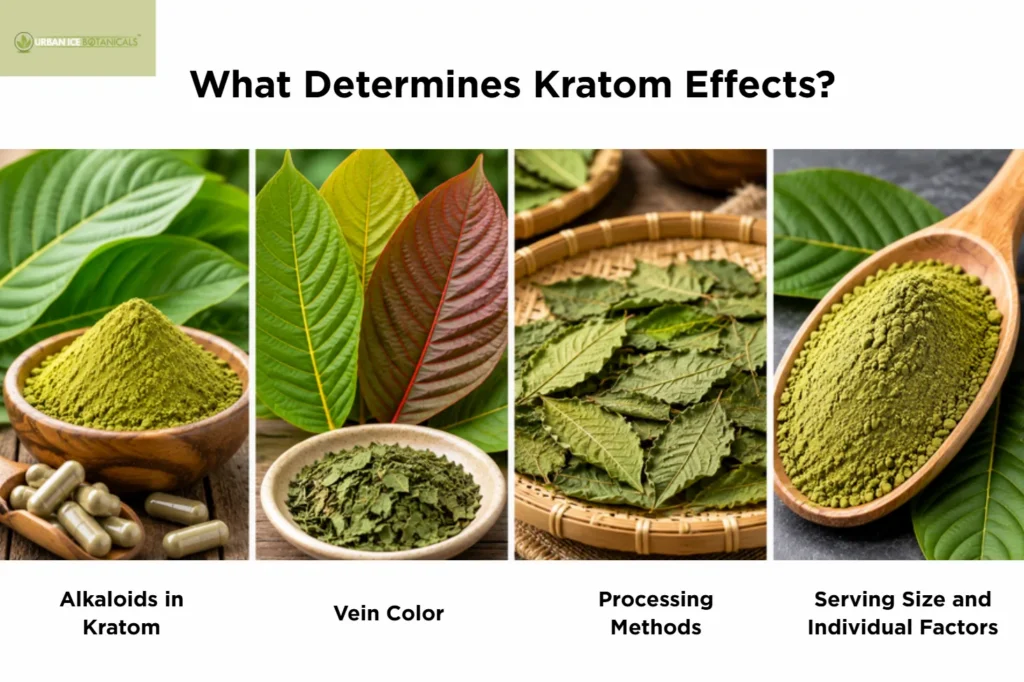
Alkaloids in Kratom
Alkaloids define the chemical composition of Mitragyna speciosa and contribute to differences between commercial kratom products. Cultivation conditions, soil composition, leaf maturity, harvest season, and post-harvest processing influence the concentrations of more than 40 identified alkaloids, including mitragynine, 7-hydroxymitragynine, paynantheine, speciogynine, and speciociliatine. These changing alkaloid ratios create measurable variation between batches, making laboratory-tested alkaloid content a more meaningful comparison than commercial strain names.
Vein Color
Vendors use vein color to classify commercial kratom products, but the color designation alone does not determine a product’s chemical composition. Cultivation practices, harvest timing, drying methods, and fermentation influence alkaloid ratios more directly than vein color. A 2023 study of 644 kratom users found no significant differences in alkaloid content across red, green, and white products despite users reporting distinct strain-specific effects, suggesting those differences reflect expectation rather than pharmacology (Huisman et al., 2023). As a result, vein color serves as a useful product classification, whereas alkaloid analysis provides a more accurate representation of product composition.
Processing Methods
Post-harvest processing directly influences the chemical composition of commercial kratom products. Drying, fermentation, oxidation, curing, and blending alter alkaloid ratios, transforming harvested leaves into commercially recognized categories such as Gold, Yellow, and Bentuangie kratom. Research analyzing commercially available kratom supplements found multiple products containing 7-hydroxymitragynine at levels exceeding those found in naturally occurring plant material by up to 500%, a figure researchers attributed to deliberate processing or adulteration rather than natural variation (Lydecker et al., 2016). Because manufacturers apply these processes differently, batch-specific laboratory analysis is essential for accurate product comparison.
Serving Size and Individual Factors
Individual physiology plays a significant role in how a kratom product is experienced. Body weight, metabolism, tolerance, and frequency of use all contribute to variability between users. A systematic review of mitragynine pharmacokinetics reported rapid oral absorption, with peak plasma concentration at around 1.5 hours, a half-life of 3 to 9 hours, and a bioavailability estimated at just 21%, all of which vary with individual metabolic rate and hepatic function (Ya et al., 2019). Because these factors differ widely, consumer-reported effects should not be considered universal, making laboratory-verified product quality essential when comparing kratom products.
Kratom Strains by Color
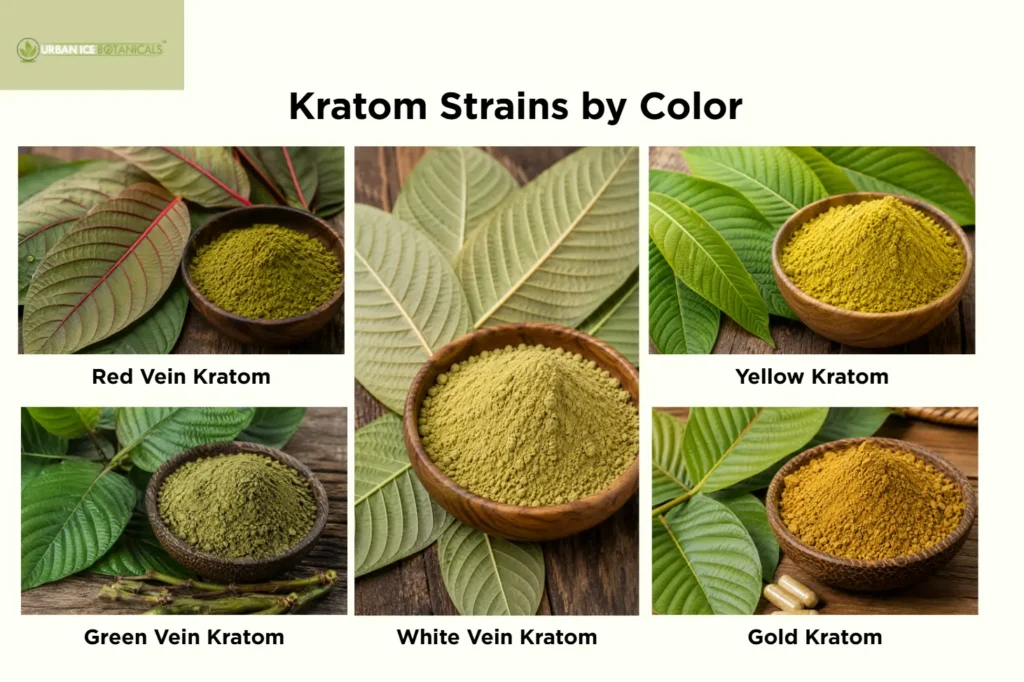
Kratom products are most commonly classified by vein color, with red, green, white, yellow, and gold representing the primary commercial categories. While vein color provides a practical framework for organizing products, it does not guarantee a specific alkaloid profile or predictable characteristic. Processing method, cultivation region, leaf maturity, and manufacturer practices ultimately determine what a finished product contains more reliably than color classification alone.
Red Vein Kratom
Red vein kratom is one of the most widely available commercial kratom categories and includes products such as Red Bali, Red Maeng Da, Red Borneo, and Red Malay. Industry practice generally associates red vein products with mature leaves and extended drying or fermentation methods, although production techniques vary between manufacturers. Research has not confirmed that all red vein products share a consistent alkaloid profile or produce uniform characteristics, as cultivation conditions, processing methods, and batch-specific alkaloid composition differ across commercial products.
Green Vein Kratom
Sitting between red and white on the commercial spectrum, green vein kratom is harvested and processed to preserve a mid-maturity leaf profile. Popular examples include Green Malay, Green Maeng Da, Green Borneo, and Green Sumatra. These products are frequently marketed as a balanced option, though current evidence suggests their characteristics depend more on alkaloid composition, harvest timing, and post-harvest processing than on color classification alone. Mitragynine concentration in green vein products has been shown to vary widely across commercial samples, reinforcing that laboratory-tested alkaloid content remains a more reliable indicator than the strain name or color designation.
White Vein Kratom
White vein products include White Maeng Da, White Borneo, White Thai, and White Sumatra, typically produced from younger leaves dried indoors or under controlled conditions to preserve a lighter vein profile. Consumer reports commonly describe white vein kratom differently from red and green varieties, and these products tend to have a distinct alkaloid ratio linked to earlier harvest timing and shorter drying periods. That said, scientific evidence does not establish a consistent relationship between vein color and specific effects, and differences in cultivation practices and manufacturing standards contribute to significant product variability across vendors.
Yellow Kratom
Unlike red, green, and white varieties, yellow kratom does not correspond to a naturally occurring vein color. Manufacturers produce yellow varieties through extended drying, specialized curing techniques, or by blending different vein colors, resulting in products such as Yellow Vietnam, Yellow Borneo, and Yellow Maeng Da. Because production methods are not standardized across the industry, yellow kratom can vary considerably in alkaloid profile, appearance, and composition between vendors. Consumers evaluating yellow kratom products should prioritize quality control over color designation.
Gold Kratom
Gold kratom is another commercially processed category created through fermentation, oxidation, or proprietary multi-stage processing techniques. Industry practice uses the Gold designation to identify products such as Gold Bali, Gold Borneo, and Gold Maeng Da, although manufacturing methods differ widely between vendors. Research does not recognize Gold Kratom as a standardized classification, making laboratory-tested alkaloid profiles and transparent manufacturing practices more informative than the product label itself.
Kratom Strains by Origin
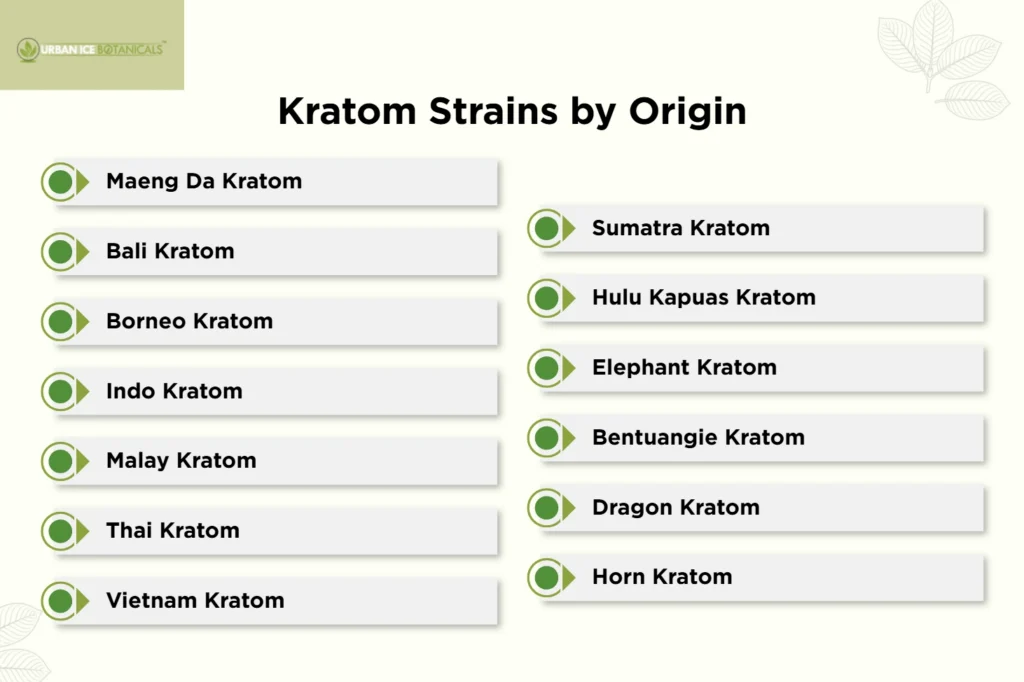
Kratom strain names frequently reference geographic origins across Southeast Asia, but regional labeling rarely guarantees consistent alkaloid composition. Growing conditions, harvest timing, and post-harvest processing vary widely within a given region, meaning two products sharing the same origin name can differ substantially in their chemical profiles. Geographic designations are best understood as general identifiers rather than quality or composition benchmarks.
Maeng Da Kratom
Manufacturers use Maeng Da as one of the most recognized commercial kratom classifications, offering products in red, green, white, yellow, and gold varieties. Industry practice treats Maeng Da as a premium commercial designation, while current research has not identified it as a genetically distinct variety of Mitragyna speciosa. Instead, cultivation practices, post-harvest processing, and alkaloid composition determine the chemical profile of each batch, which explains why products marketed as Maeng Da can differ significantly between manufacturers.
Bali Kratom
Despite its name, most commercial Bali kratom is sourced from Indonesia rather than the island of Bali itself. Available as Red Bali, Green Bali, White Bali, and Gold Bali, the label primarily identifies a commercial product category. Differences in composition are largely driven by cultivation practices, drying and processing methods, and alkaloid content instead of geographic origin, making Certificates of Analysis a more informative reference point than the regional name.
Borneo Kratom
Borneo kratom refers to products sourced from or associated with the island of Borneo, one of the largest and most established kratom-producing regions in Southeast Asia. Commercial varieties include Red Borneo, Green Borneo, White Borneo, and Yellow Borneo. As with other regional strains, Borneo kratom product characteristics depend on harvesting practices, drying methods, and laboratory-tested alkaloid composition rather than the regional designation alone.
Indo Kratom
Indo kratom is a broad commercial category describing products originating from Indonesia, the world’s largest supplier of kratom. Available across multiple vein colors, Indo strains encompass leaves harvested from different islands, farms, and growing environments. Because of this wide geographic range, alkaloid profiles and product characteristics can vary considerably between batches and manufacturers, making Indo one of the least specific regional designations in the market.
Malay Kratom
Malay kratom is historically associated with Malaysia and is most commonly marketed as Green Malay, Red Malay, or White Malay. While the regional name indicates historical sourcing, many commercial Malay kratom products are now cultivated and processed elsewhere in Southeast Asia. Product quality is influenced more by cultivation practices, drying techniques, and verified alkaloid composition than by the Malay designation itself.
Thai Kratom
Thai kratom originates from Thailand, the native habitat of Mitragyna speciosa, and popular varieties include Red Thai, Green Thai, and White Thai. Commercial availability has expanded in recent years following regulatory changes within Thailand. Modern Thai strain names function primarily as commercial identifiers, and laboratory testing provides a more reliable measure of product composition than geographic labeling alone.
Vietnam Kratom
Vietnam kratom is a regional strain marketed in red, green, and white vein varieties, with the name generally indicating cultivation or sourcing associated with Vietnam. Supply chains often involve processing in neighboring countries, adding further distance between the label and the actual origin. As with other regional strains, growing conditions, harvest timing, and manufacturing practices ultimately shape the final alkaloid profile more than the geographic name.
Sumatra Kratom
Sumatra kratom refers to products associated with the Indonesian island of Sumatra, a major kratom-growing region offering Red Sumatra, Green Sumatra, White Sumatra, and Gold Sumatra varieties. The regional designation provides general sourcing context, but Sumatra kratom products do not have a standardized chemical composition. Alkaloid content and product quality depend on cultivation, processing, and laboratory verification rather than the island name alone.
Hulu Kapuas Kratom
Hulu Kapuas kratom is named after the Kapuas River region in West Kalimantan, Indonesia, an area with an established history of kratom cultivation. Red, Green, and White Hulu Kapuas products are commonly available, though production methods vary among suppliers. As with other regional strains, alkaloid content and consistency depend on cultivation practices, processing techniques, and third-party laboratory testing instead of geographic association.
Elephant Kratom
Elephant kratom is a commercial strain named after the unusually large, elephant-ear-shaped leaves found on certain Mitragyna speciosa trees, not a distinct botanical variety. Available in red, green, and white vein varieties, it is marketed on the premise that larger leaves produce stronger or more distinctive effects. No peer-reviewed research currently supports a consistent link between leaf size and alkaloid profile, and as with all commercial kratom strain names, product composition is determined by growing conditions, harvest timing, and post-harvest processing.
Bentuangie Kratom
Unlike most regional strains, Bentuangie kratom is distinguished primarily by its post-harvest fermentation process. Fermentation alters both the appearance and chemical composition of the dried leaves, producing a product category separate from traditional red, green, or white processing methods. Because fermentation techniques vary between producers, Bentuangie products may differ substantially in alkaloid content, and independent laboratory verification is particularly important when evaluating this category.
Dragon Kratom
Dragon kratom is a proprietary commercial strain name referring to blends or specially processed products, including Red Dragon, Green Dragon, and White Dragon varieties. No standardized definition for Dragon strains exists across the industry, making formulation and alkaloid composition highly vendor-dependent. Consumers should treat Dragon kratom as a branded product category and rely on the COA rather than the strain name when assessing composition.
Horn Kratom
Horn kratom takes its name from the distinctive horn-like serrations observed along the leaf edges of certain Mitragyna speciosa trees. Commonly sold as Red Horn, Green Horn, and White Horn, the leaf morphology distinguishes this category visually but does not determine its chemical profile. Product characteristics continue to depend on alkaloid content, cultivation practices, processing methods, and manufacturing quality rather than leaf shape alone.
Kratom Strains Comparison Chart
No single kratom strain is universally better than another because differences in alkaloid composition, cultivation, processing, product quality, and individual physiology can all influence the final product. Comparing strains by vein color, regional origin, and processing method provides a more practical way to understand their similarities and distinctions than relying on strain names alone.
| Kratom Strain | Common Colors | Primary Classification | Notable Characteristic |
| Maeng Da | Red, Green, White | Commercial strain | Widely available, vendor-specific formulation |
| Bali | Red, Green, White, Gold | Regional strain | One of the most common commercial varieties |
| Borneo | Red, Green, White, Yellow | Regional strain | Sourced from Borneo-growing regions |
| Malay | Green, Red, White | Regional strain | Associated with Malaysian-origin varieties |
| Thai | Red, Green, White | Regional strain | Native Mitragyna speciosa region |
| Sumatra | Red, Green, White | Regional strain | Indonesian regional classification |
| Hulu Kapuas | Red, Green, White | Regional strain | Named after the Kapuas River region |
| Bentuangie | Usually Red | Processed strain | Produced using fermentation techniques |
| Dragon | Red, Green, White | Proprietary blend | Vendor-defined formulation |
| Horn | Red, Green, White | Leaf morphology | Identified by horn-shaped leaf edges |
| Yellow Kratom | Yellow | Processed category | Produced through specialized drying or blending |
| Gold Kratom | Gold | Processed category | Created through fermentation, oxidation, or proprietary processing |
Key takeaway: While comparison charts simplify product categories, laboratory-tested alkaloid content, Certificates of Analysis (COAs), manufacturing standards, and transparent sourcing provide a more reliable basis for evaluating kratom products than strain names, colors, or regional labels alone.
Red vs Green vs White Kratom
Red, green, and white kratom refer to the three primary vein-color categories used to classify commercial Mitragyna speciosa products, with each carrying distinct marketing associations for energy, mood, and relaxation. While these categories are widely used by vendors and consumers alike, current research does not confirm that vein color alone determines a product’s characteristics. Alkaloid composition, harvest timing, post-harvest processing, and laboratory-tested quality ultimately shape what a finished product contains.
| Feature | Red Vein Kratom | Green Vein Kratom | White Vein Kratom |
| Vein Color | Red | Green | White |
| Primary Classification | Natural vein color | Natural vein color | Natural vein color |
| Common Regional Strains | Bali, Borneo, Maeng Da, Thai | Malay, Maeng Da, Borneo, Sumatra | Maeng Da, Thai, Borneo, Sumatra |
| Processing | Standard drying with vendor-specific curing | Standard drying to preserve the green leaf profile | Harvested and dried to preserve a lighter vein profile |
| Major Alkaloids | Mitragynine, 7-hydroxymitragynine, Paynantheine | Mitragynine, Speciogynine, Paynantheine | Mitragynine, Speciociliatine, Paynantheine |
| Product Variability | Moderate to High | Moderate to High | Moderate to High |
| Standardized Industry Definition | No | No | No |
| Laboratory Testing Recommended | Yes | Yes | Yes |
Red vs Green Kratom
Red kratom is a mature-leaf product processed through extended sun drying or fermentation, which oxidizes alkaloid compounds and shifts the mitragynine-to-other-alkaloid ratio, while green kratom is harvested at mid-maturity and dried under controlled conditions to preserve a broader, less oxidized alkaloid profile. Red varieties such as Red Bali and Red Borneo undergo longer post-harvest cycles than green varieties like Green Malay and Green Maeng Da, making processing method and harvest maturity the primary distinctions between the two rather than vein color alone.
Green vs White Kratom
Green kratom is harvested at mid-maturity and dried moderately to preserve natural leaf coloration and a mid-range alkaloid profile, while white kratom is produced from younger leaves dried indoors under low-light or climate-controlled conditions. Earlier harvest timing in white varieties such as White Maeng Da and White Borneo results in different mitragynine concentrations relative to supporting alkaloids like paynantheine and speciogynine compared with green varieties like Green Malay and Green Sumatra.
Red vs White Kratom
Red kratom is a fully matured, heavily processed product in which extended drying or fermentation oxidizes alkaloids and alters the final chemical ratio, while white kratom is produced from younger leaves with minimal processing under controlled drying conditions, preserving an earlier-stage alkaloid profile. Harvest timing and post-harvest processing drive the primary compositional differences between the two, with red varieties like Red Maeng Da and white varieties like White Borneo representing opposite ends of the maturity and processing spectrum despite originating from the same species.
Yellow vs Gold Kratom
Yellow kratom is typically created through extended outdoor drying, specialized curing, or blending of red, green, and white vein materials, while gold kratom is generally produced through fermentation, oxidation, or proprietary multi-stage processing that more significantly alters the base alkaloid composition. Products like Yellow Vietnam and Yellow Maeng Da tend to reflect differences in blending or curing, whereas Gold Bali and Gold Borneo are more commonly associated with fermentation-driven processing. Because no industry-wide production standard governs either category, alkaloid composition and appearance can vary considerably between manufacturers.
Strongest Kratom Strains: What “Strong” Really Means
The word “strong” in kratom refers to a product’s alkaloid concentration, particularly its mitragynine content, rather than any standardized scientific measure of potency. Perceived strength depends on mitragynine concentration, post-harvest processing, product form, serving size, and individual factors such as tolerance and metabolism. As a result, no single strain can be universally classified as the strongest, and alkaloid content verified through laboratory testing remains a more reliable indicator of potency than strain name or marketing claims.
| Factor | Why It Matters |
| Alkaloid Content | Higher concentrations of mitragynine and other alkaloids generally have a greater influence on product potency than the strain name. |
| Product Form | Extracts and enhanced products are typically more concentrated than traditional powder or capsules. |
| Processing Method | Drying, fermentation, and blending can alter alkaloid composition between batches. |
| Laboratory Testing | A Certificate of Analysis (COA) provides the most reliable measure of alkaloid content and product quality. |
| Individual Factors | Body weight, metabolism, tolerance, frequency of use, and serving size all influence consumer-reported experiences. |
Which Kratom Strains Are Commonly Considered Strong?
Industry practice frequently markets products such as Maeng Da, Red Maeng Da, Green Maeng Da, White Maeng Da, Bentuangie, and certain extracts as stronger kratom options. Laboratory analysis, however, shows that potency depends on batch-specific alkaloid concentrations, particularly mitragynine content, rather than the commercial strain name. For this reason, third-party Certificates of Analysis provide a more reliable indication of product potency than marketing terminology.
Does Stronger Mean Better?
Stronger kratom is not inherently better kratom, since a product with elevated mitragynine concentration but poor manufacturing standards, unverified sourcing, or contaminant issues presents more risk than a moderately concentrated product that is pure, consistently processed, and third-party tested. Freshness, purity, contaminant testing, transparent sourcing, and consistent manufacturing practices all contribute to overall product quality as much as alkaloid content does. Choosing a lab-tested product with a verified Certificate of Analysis is a more reliable approach than selecting one based solely on marketing terms like “strongest” or “most potent”.
Best Kratom Strains by Goal
People often search for the best kratom strain based on goals such as energy, focus, relaxation, or evening use. Consumer reports and industry practice commonly associate specific vein colors and commercial strains with these purposes, while current research has not confirmed that any commercial strain consistently produces a particular outcome. Instead, alkaloid composition, product quality, post-harvest processing, serving size, and individual physiology collectively influence the characteristics of a finished kratom product.
| Goal | Commonly Associated Strains* | Common Commercial Examples |
| Energy & Alertness | White and Green Vein | White Maeng Da, White Thai, Green Malay |
| Focus & Productivity | White and Green Vein | White Borneo, Green Maeng Da, Green Thai |
| Balanced Daily Use | Green Vein | Green Malay, Green Borneo, Green Sumatra |
| Relaxation | Red Vein | Red Bali, Red Borneo, Red Malay |
| Evening Use | Red Vein | Red Maeng Da, Red Sumatra, Bentuangie |
These associations are based on commercial classifications and consumer-reported experiences rather than established clinical evidence.
Best Kratom Strains for Energy
White vein and green vein kratom products, including White Maeng Da, White Thai, Green Malay, and Green Maeng Da, are commonly marketed as the best kratom for energy and alertness. Their characteristics depend on alkaloid composition, processing methods, and product quality rather than the strain name alone.
Best Kratom Strains for Focus
Products such as White Borneo, White Maeng Da, Green Thai, and Green Borneo are frequently associated with focus and mental clarity in commercial product descriptions. Individual experiences vary, and laboratory-tested alkaloid content provides a more reliable basis for product comparison than marketing claims.
Best Kratom Strains for Relaxation
Red vein varieties, including Red Bali, Red Borneo, Red Malay, and Red Sumatra, are commonly associated with relaxation in consumer reports. Differences between these products are influenced more by alkaloid profiles, cultivation, and post-harvest processing than by the regional strain name itself.
Best Kratom Strains for Evening Use
Red Maeng Da, Bentuangie, and Red Bali are among the products frequently selected for evening use due to their commercial classification. Since product composition varies between manufacturers, reviewing laboratory testing, Certificates of Analysis (COAs), and sourcing practices is recommended before comparing products.
Kratom Dosage and Serving Size Safety
Kratom has no universally recommended dosage because no human dose-response curves for mitragynine or 7-hydroxymitragynine have yet been published, and alkaloid content varies widely across commercial products ranging from standard dried leaf powders to concentrated extracts. Powders suggest a serving of 3 to 5 grams, while concentrated liquid extracts may require as little as 1 to 2 drops, reflecting the significant impact of product form on the alkaloid load delivered (University of Florida College of Pharmacy). Because no regulatory standards for kratom product purity, labeling, or serving guidance currently exist, product-specific Certificate of Analysis data remains more reliable than any generalized dosage recommendation.
| Factor | Why It Affects Serving Size |
| Product Form | Powders, capsules, extracts, and gummies can differ significantly in alkaloid concentration. |
| Alkaloid Content | Mitragynine and other alkaloid levels vary between batches and manufacturers. |
| Product Quality | Laboratory-tested products provide more reliable consistency than unlabeled products. |
| Individual Tolerance | Previous kratom use can influence individual response. |
| Body Weight & Metabolism | Individual physiology contributes to variation in consumer-reported experiences. |
| Processing Method | Fermentation, drying, and extraction may affect product composition. |
Safety Considerations Before Using Kratom
Before using any kratom product, confirm that a current Certificate of Analysis from an accredited third-party laboratory is available, since no federal regulatory standard governs kratom product purity, labeling, or alkaloid content. Identify whether the formulation is a standard powder, capsule, extract, or enhanced concentrate, as each carries a meaningfully different alkaloid load. Individuals who are pregnant, breastfeeding, have liver or kidney disease, or take prescription medications including opioids, antidepressants, or benzodiazepines should consult a qualified healthcare professional before use.
Kratom Product Forms
Kratom is available in several product forms, each differing in preparation, alkaloid concentration, convenience, and intended use. While the source material comes from the leaves of Mitragyna speciosa, manufacturing methods can significantly affect the final product. Understanding these differences helps consumers compare products beyond strain names and choose options that match their preferences and quality expectations.
| Product Form | Description | Typical Use | Considerations |
| Kratom Powder | Finely ground dried leaves | Most common form | Allows flexible serving sizes and is commonly used for tea or mixing. |
| Kratom Capsules | Powder enclosed in capsules | Convenient and portable | Offers pre-measured servings but may contain different amounts per capsule. |
| Kratom Tea | Powder or crushed leaves brewed in water | Traditional preparation | Alkaloid extraction depends on the brewing method and duration. |
| Kratom Extracts | Concentrated kratom alkaloids | Higher-potency products | More concentrated than traditional leaf products and should be used with caution. |
| Kratom Gummies | Infused edible products | Alternative consumption method | Potency varies by manufacturer and formulation. |
| Kratom Shots | Liquid kratom extracts | Ready-to-use products | Often contain concentrated alkaloids and additional ingredients. |
| 7-OH Products | Products containing concentrated 7-hydroxymitragynine | High-potency formulations | Differ significantly from traditional kratom leaf products and should not be considered equivalent to powder or capsules. |
Traditional Leaf Products vs. Concentrated Products
Traditional kratom powder, capsules, and tea deliver alkaloids directly from dried Mitragyna speciosa leaf material with minimal processing, while extracts, shots, and concentrated 7-hydroxymitragynine products undergo additional refinement that can increase alkaloid concentration well beyond what whole-leaf preparations contain. Because concentrated products can differ substantially from natural leaf preparations in both potency and alkaloid ratio, consumers should review product labels, verify laboratory testing, and confirm alkaloid content before comparing products or adjusting serving sizes.
Kratom Safety, Side Effects, and Who Should Avoid It
Kratom is widely available but not risk-free. Reported side effects include nausea, constipation, dizziness, drowsiness, dry mouth, and vomiting, while regular or high-frequency use may lead to tolerance, dependence, and withdrawal symptoms in some individuals. Because alkaloid concentration and contaminant levels vary significantly between manufacturers, independent laboratory testing and a verified Certificate of Analysis are important considerations when evaluating any kratom product.
| Safety Consideration | What to Know |
| Common Side Effects | Nausea, constipation, dizziness, dry mouth, drowsiness, vomiting, and loss of appetite have been reported. |
| Tolerance & Dependence | Frequent use may increase tolerance and contribute to physical dependence. |
| Drug Interactions | Kratom may interact with opioids, benzodiazepines, antidepressants, stimulants, alcohol, and other medications. |
| Pregnancy & Breastfeeding | Use is generally not recommended due to limited safety data. |
| Liver Disease | Individuals with liver conditions should consult a healthcare professional before use. |
| Product Quality | Select products that provide third-party laboratory testing and a recent COA. |
Who Should Avoid Kratom?
Certain individuals should avoid kratom or consult a qualified healthcare professional before use, including:
- Individuals who are pregnant or breastfeeding
- Those under the legal age in their jurisdiction
- People with liver disease, kidney conditions, or other significant medical conditions
- Those taking prescription medications, including opioids, antidepressants, benzodiazepines, or stimulants
- Individuals with a history of substance use disorder
- Those considering combining kratom with alcohol or other psychoactive substances
How to Read a Kratom Certificate of Analysis
To read a kratom Certificate of Analysis, first locate the alkaloid panel and confirm that mitragynine and 7-hydroxymitragynine concentrations are clearly listed as percentages of dry weight. Then check the contaminant sections for heavy metals, pesticides, microbial agents, and residual solvents. A Certificate of Analysis is a third-party laboratory document that verifies a kratom product’s alkaloid content, purity, and safety before it reaches the consumer, and reviewing a current one allows meaningful product comparison using verified data rather than strain names or marketing claims.
| COA Component | Why It Matters |
| Mitragynine Content | Indicates the concentration of the primary kratom alkaloid. |
| 7-Hydroxymitragynine | Verifies the level of this naturally occurring alkaloid and helps identify unusually concentrated products. |
| Heavy Metals | Confirms testing for contaminants such as lead, arsenic, cadmium, and mercury. |
| Microbial Testing | Screens for bacteria, yeast, mold, and pathogens such as Salmonella and E. coli. |
| Residual Solvents | Relevant for extracts to ensure manufacturing solvents remain within acceptable limits. |
| Batch or Lot Number | Confirms the laboratory report matches the purchased product. |
| Testing Date | Indicates whether the analysis reflects the current production batch. |
| Third-Party Laboratory | Demonstrates that testing was performed by an independent accredited laboratory. |
What Makes a Reliable COA?
A reliable Certificate of Analysis connects a specific kratom batch to independently verified laboratory results. Third-party laboratories measure alkaloid concentrations, screen for heavy metals, microbial contaminants, pesticides, and residual solvents, and link those findings to a batch or lot number for traceability. This relationship between laboratory testing, batch verification, and product transparency allows consumers to compare kratom products using measurable quality data instead of commercial strain names or marketing claims.
How to Choose a Kratom Strain Safely
Choosing a kratom strain safely begins with evaluating measurable product quality rather than relying solely on commercial classifications. Third-party laboratory testing verifies alkaloid content, contaminant screening, and batch identity, while transparent sourcing, manufacturing standards, and accessible Certificates of Analysis help consumers compare products using objective data. Together, these quality indicators provide a more reliable basis for evaluation because products sharing the same strain name may differ significantly in chemical composition between manufacturers.
| Factor | Why It Matters |
| Third-Party Laboratory Testing | Confirms product identity, alkaloid content, and contaminant screening through an independent Certificate of Analysis (COA). |
| Alkaloid Profile | Mitragynine and other alkaloid concentrations provide a more meaningful comparison than the strain name alone. |
| Product Form | Powder, capsules, tea, extracts, gummies, and shots differ in concentration and manufacturing methods. |
| Manufacturing Standards | Reputable vendors follow quality control practices, batch testing, and transparent production processes. |
| Product Transparency | Clear ingredient labeling, batch numbers, sourcing information, and accessible COAs indicate greater accountability. |
| Legal Compliance | Kratom laws vary across U.S. states and local jurisdictions, making it important to verify local regulations before purchasing. |
What to Look for Before Buying
Before purchasing a kratom product, prioritize verified quality indicators over strain names or marketing claims. Key factors to check include:
- A current third-party Certificate of Analysis with batch or lot identification
- Quantitative alkaloid testing reporting mitragynine and 7-hydroxymitragynine as a percentage of dry weight
- Contaminant screening for heavy metals, microbial organisms, and pesticides
- GMP-compliant manufacturing standards
- Transparent sourcing information and accessible laboratory reports
Where to Buy Kratom Products
Kratom products are available through online retailers, specialty botanical stores, vape shops, smoke shops, and select local supplement stores. Product availability, quality standards, and testing practices can vary considerably between sellers, making it important to evaluate the manufacturer rather than relying solely on the strain name or price. Choosing trusted kratom vendors that prioritize transparency and independent laboratory testing can help consumers compare products more confidently.
| What to Evaluate | Why It Matters |
| Third-Party COA | Confirms alkaloid content and contaminant testing for each batch. |
| Batch or Lot Number | Links the product to its corresponding laboratory report. |
| Manufacturing Standards | Indicates consistent production and quality control practices. |
| Product Transparency | Includes ingredient lists, sourcing information, and alkaloid content when available. |
| Customer Reviews | May provide insights into product consistency and vendor reliability. |
| Return & Support Policies | Reflect the company’s customer service and accountability. |
What to Avoid When Buying Kratom
When buying kratom, avoid vendors that cannot provide current third-party laboratory documentation or make unverified medical claims. Specific red flags include:
- No Certificate of Analysis or outdated COA without batch identification
- Missing contaminant screening for heavy metals, microbes, or pesticides
- Claims that a product treats, cures, or addresses specific medical conditions
- Marketing based solely on potency, strain name, or consumer testimonials without supporting laboratory data
- Lack of transparent sourcing or manufacturer contact information
FAQs About Kratom Strains
What is the best kratom strain?
There is no single best kratom strain because product characteristics depend on alkaloid composition, processing methods, manufacturing standards, and individual physiology rather than the strain name itself. Laboratory-tested quality and a current Certificate of Analysis provide more meaningful product information than commercial designations like Maeng Da, Bali, or Borneo.
What is the strongest kratom strain?
No kratom strain is scientifically verified as the strongest. Perceived potency depends on mitragynine concentration, product form, processing method, and batch-specific laboratory results rather than the strain name, meaning a product marketed as potent may not reflect its actual alkaloid content without COA verification.
Are red strains stronger than green strains?
Not necessarily, because red and green kratom are commercial color classifications rather than indicators of potency. Alkaloid profiles vary with harvest timing and processing, but laboratory analysis is a more reliable indicator of product composition than vein color alone.
Is yellow kratom natural?
No, yellow kratom is a processed product created through specialized drying, curing, fermentation, or blending of different vein colors rather than a naturally occurring leaf classification. Unlike red, green, and white vein kratom, yellow does not correspond to a distinct vein color at harvest.
Why do kratom products vary between vendors?
Kratom products vary between vendors because cultivation conditions, leaf maturity, harvest timing, drying methods, fermentation, and manufacturing practices all differ between producers. Products sharing the same strain name can therefore differ significantly in alkaloid composition, making independent laboratory testing a more reliable comparison tool than the strain name alone.
Are kratom strains scientifically proven?
No, current research has not confirmed that commercial kratom strain names represent genetically distinct varieties or consistently produce unique pharmacological characteristics. Industry practice continues to classify products by vein color, regional origin, and processing method, while many strain-related descriptions originate from consumer reports rather than controlled clinical studies. As a result, laboratory-tested alkaloid composition provides a more objective basis for comparing kratom products than commercial strain names alone.
What is the safest way to compare kratom products?
The safest way to compare kratom products is to evaluate third-party Certificates of Analysis that report mitragynine and 7-hydroxymitragynine concentrations, contaminant screening results, and batch identification rather than relying on strain names, color classifications, or marketing claims.
Is kratom legal in the USA?
Kratom is federally legal in the United States but is subject to varying regulations at the state and local level, with some jurisdictions having enacted restrictions or bans. Because laws can change, consumers should verify current regulations in their state or locality before purchasing or possessing kratom products.