Skip to main content


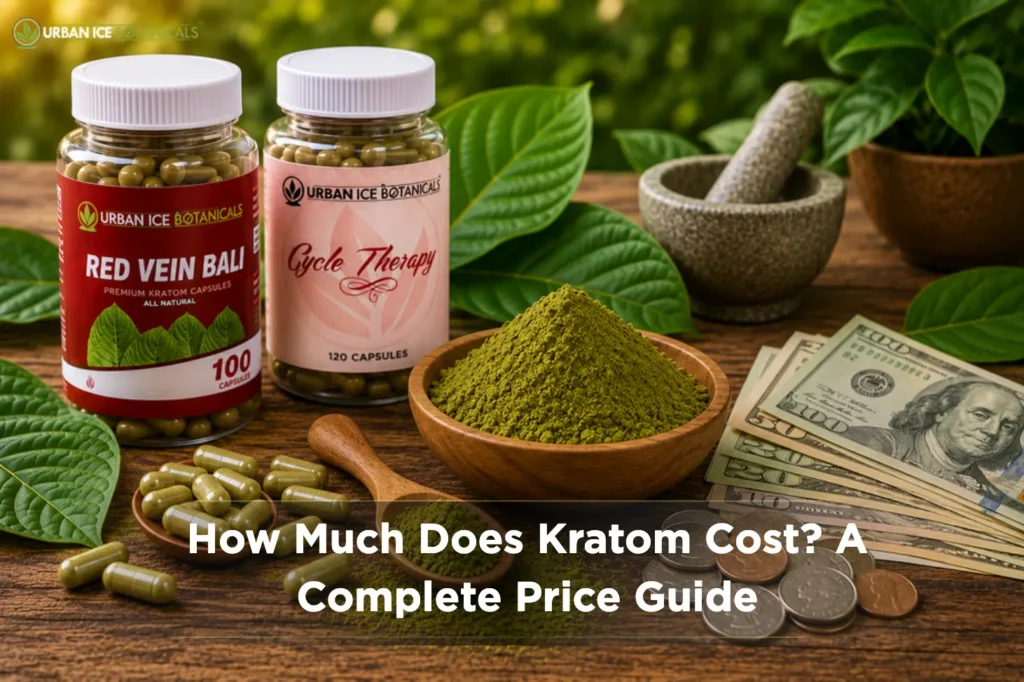
Kratom costs anywhere from about $8 to $15 per ounce for standard powder, $20 to $40 per bottle for capsules, $15 to $70 or more for concentrated extracts, $20 to $50 per package for gummies, and $12 to $30 per bottle for ready-to-drink products. The final price depends on the product form, package size, alkaloid concentration, third-party laboratory testing, vendor reputation, shipping costs, and state regulations. Comparing products by cost per gram or cost per serving provides a more accurate measure of value than comparing package prices alone.
Understanding kratom pricing requires looking beyond the advertised retail price. Product form, manufacturing complexity, laboratory testing, vendor transparency, and state regulations all affect what buyers pay, and the same strain can vary considerably in price depending on where and how it is sold. The sections below cover pricing by product form, explain what drives cost differences between vendors, compare online and local retail pricing, and outline practical methods for identifying the best overall value using standardized comparison factors.
What Is the Average Cost of Kratom?
The average cost of kratom ranges from $8 to $15 per ounce for standard powder, with capsules, extracts, and specialty products priced higher depending on form and manufacturing. In the United States, standard kratom powder typically offers the lowest cost per gram, while capsules cost more because of additional manufacturing and packaging. Concentrated kratom extracts generally have the highest price because they require extra processing and contain higher concentrations of naturally occurring alkaloids.
Although retail prices vary across vendors, comparing products by cost per gram, per serving, or per dose provides a more accurate picture than comparing package prices alone. This approach allows buyers to evaluate products with different serving counts, concentrations, and package sizes using the same pricing standard.
Kratom Cost Calculator
Compare kratom prices by cost per gram, cost per serving, and estimated monthly spend.
How Much Does Kratom Cost Per Gram?
Standard kratom powder costs $0.50 to $1.00 per gram when purchased in small quantities online, making it the most affordable form available in the United States. Premium strains such as Maeng Da can push toward the higher end of that range or slightly exceed it. Bulk purchases, typically 500 grams or more, can bring the per-gram cost down to $0.20 to $0.50, making larger packages considerably more economical for regular buyers.
Capsules usually have a higher price per gram because manufacturers incur additional costs for encapsulation, materials, and labor. Extracts cannot be compared solely by gram weight because their concentration varies considerably. Instead, buyers should compare extracts by the manufacturer’s stated serving size and verified alkaloid content whenever laboratory data is available.
How Much Does Kratom Cost Per Serving?
A single serving of standard kratom powder costs $0.50 to $2.00, making it the lowest cost per serving of any commercially available product form, while extracts typically carry the highest per-serving cost due to concentration. The cost per serving depends on the product form and the manufacturer’s recommended serving size.
Comparing products by serving cost helps standardize different package formats, particularly when evaluating capsules, gummies, beverages, or extracts. Buyers should review the total number of servings listed on the product label before comparing prices between brands.
How Much Should You Expect to Spend Per Month?
Most kratom buyers spend between $30 and $150 per month, depending on product form, package size, purchase frequency, cost per serving, cost per gram, shipping expenses, and bulk purchasing habits. Powder users typically fall at the lower end of that range, at $30 to $80 per month, while capsule and extract users can expect to spend $80 to $150 or more, depending on usage frequency and product concentration.
Buyers can calculate total monthly cost using a simple formula:
Monthly Cost = Cost per Serving × Average Servings Purchased Per Month
This method allows buyers to compare products consistently, regardless of package size, formulation, or retailer pricing strategies.
How We Evaluated Kratom Prices
The pricing information presented in this guide is intended to help readers compare commercially available kratom products using consistent measurement standards. Because kratom prices change over time, the figures shown throughout this article represent general retail estimates rather than fixed or guaranteed prices.
To improve consistency and accuracy, price comparisons were evaluated using a standardized methodology instead of relying on a single retailer or product listing.
Pricing Methodology
The price ranges in this guide were developed by reviewing publicly available retail pricing across multiple U.S. online vendors and specialty retailers. Products were compared using equivalent package sizes and standardized measurement units whenever possible.
During the review process, we evaluated:
- Retail price by product form, including powder, capsules, extracts, gummies, beverages, and tea products.
- Cost per gram for powdered kratom.
- Cost per serving for capsules, extracts, edibles, and beverages.
- Common package sizes available to U.S. consumers.
- Bulk pricing compared with smaller retail packages.
- Shipping costs and their impact on the final purchase price.
- Publicly available product specifications and labeling information.
How Products Were Compared
Whenever possible, products were compared using cost per gram or cost per serving rather than package price alone. This approach creates a more meaningful comparison because different manufacturers use different package sizes, serving counts, and product formats.
For example, a bottle containing 60 capsules cannot be fairly compared with a 250-gram powder package unless both products are converted into a common pricing metric.
What Can Influence Retail Prices?
Several market factors can affect the prices shown in this guide, including:
- Vendor pricing strategies.
- Promotional discounts.
- Subscription pricing.
- Package size.
- Product form.
- Third-party laboratory testing.
- Shipping and handling costs.
- State taxes and regulatory requirements.
- Product availability.
Because these factors change over time, actual retail prices may differ from the estimates presented in this article.
Our Editorial Standards
This guide is written for informational and price comparison purposes. Product prices are not sponsored rankings or endorsements, and no product receives preferential placement based on commercial relationships. The goal of this guide is to help readers compare kratom products using transparent pricing, objective quality indicators, and standardized comparison units, rather than relying solely on advertised retail prices.
Readers should verify current pricing, shipping costs, product availability, and third-party laboratory documentation directly with the retailer before making a purchasing decision, as these factors may change without notice.
How Much Does Kratom Cost by Form?
Kratom powder is the most affordable product form available, with capsules, extracts, gummies, and ready-to-consume products priced progressively higher based on manufacturing complexity and convenience. Standard kratom powder costs $8 to $15 per ounce and has the lowest cost per gram because it undergoes minimal processing after harvesting and milling. Capsules usually run $20 to $40 per bottle and cost more per gram because manufacturers fill, package, and enclose individual servings. Extracts command the highest prices, often $15 to $70 or more per unit, because they contain concentrated alkaloids and require additional production steps.
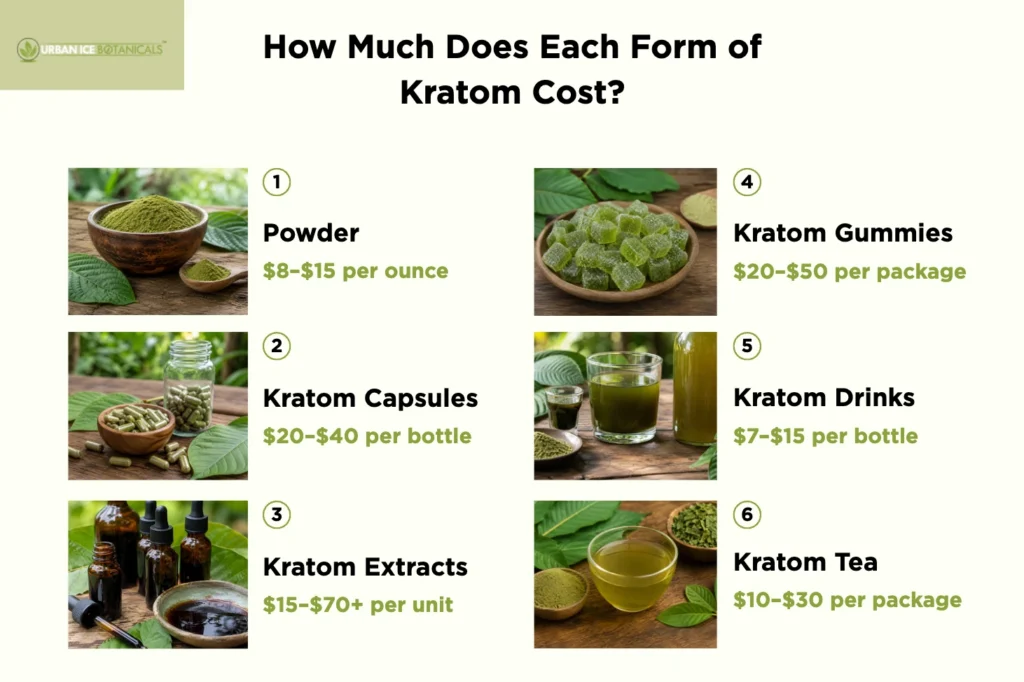
| Kratom Product | Typical Retail Price* | Best Comparison Method | Typical Value |
| Kratom Powder | $8–$15 per ounce | Cost per gram | Lowest cost per gram |
| Kratom Capsules | $20–$40 per bottle | Cost per serving | Higher than powder because of encapsulation |
| Kratom Extracts | $15–$70+ per unit | Cost per serving or alkaloid content | Highest cost due to concentration |
| Kratom Gummies | $20–$50 per package | Cost per serving | Premium convenience product |
| Kratom Drinks | $7–$15 per bottle | Cost per bottle or serving | Ready-to-consume product |
| Kratom Tea | $10–$30 per package | Cost per cup or serving | Varies by preparation method |
*These price ranges represent general retail estimates observed across U.S. online vendors and specialty retailers. Actual kratom prices vary based on package size, vendor pricing, laboratory testing, shipping charges, product availability, and state regulations.
How Much Does Kratom Powder Cost?
Kratom powder costs between $8 and $15 per ounce online, making it the most affordable product category available in the United States. Most vendors sell kratom powder in quantities ranging from one ounce to one kilogram, with larger packages reducing the overall cost per gram.
| Powder Size | Typical Price Range | Approximate Cost per Gram |
| 1 ounce (28 g) | $8–$15 | $0.29–$0.54 |
| 100 grams | $20–$35 | $0.20–$0.35 |
| 250 grams | $40–$70 | $0.16–$0.28 |
| 500 grams | $70–$120 | $0.14–$0.24 |
| 1 kilogram | $110–$180 | $0.11–$0.18 |
Prices vary based on leaf quality, sourcing, laboratory testing, vendor reputation, and shipping costs. Premium lab-tested kratom may cost more because manufacturers invest in contaminant screening, Certificate of Analysis (COA) documentation, and quality assurance procedures.
How Much Do Kratom Capsules Cost?
Kratom capsules cost between $20 and $40 per bottle online, with prices varying based on capsule count, strain, and vendor. Capsule products generally cost more than loose powder because manufacturers process, encapsulate, package, and label each serving individually, adding a convenience premium of roughly 30 to 50% over equivalent powder.
| Capsule Count | Typical Price Range |
| 60 Capsules | $18-$28 |
| 120 Capsules | $25-$40 |
| 240 Capsules | $45-$70 |
When comparing capsule products, buyers should calculate both the cost per serving and the total grams contained in the bottle rather than comparing capsule count alone.
How Much Do Kratom Extracts Cost?
Kratom extracts range from $15 to $70 or more per unit, depending on the product type, making them the most expensive category available. Liquid shots fall between $15 and $35 each, while concentrated extract products range from $25 to $70 or more per unit. Products differ widely in concentration, serving size, and extraction methods, making direct price comparisons more difficult than with powder or capsules.
| Extract Type | Typical Price Range |
| Liquid Shot | $15-$30 |
| Extract Tablets | $20-$50 |
| Resin or Paste | $25-$60 |
| Premium Concentrated Extracts | $40-$70+ |
Instead of comparing extracts by bottle size, buyers should evaluate the manufacturer’s stated serving size, concentration, and available laboratory testing. A higher retail price does not automatically indicate higher product quality if testing documentation and ingredient transparency are unavailable.
How Much Do Kratom Gummies Cost?
Kratom gummies retail between $20 and $50 per package, usually containing 10 to 30 gummies, with pricing varying based on serving count, ingredient formulation, and third-party laboratory testing. Gummies combine botanical ingredients with flavoring and additional manufacturing steps, which increases production costs compared with standard powder products. Comparing cost per serving provides a more meaningful assessment of value than comparing package prices.
How Much Do Kratom Drinks Cost?
Ready-to-drink kratom beverages retail between $12 and $30 per bottle, with single-serve concentrated shots typically coming in 2 oz (60ml) bottles and ranging from $15 to $35 depending on potency. Pricing depends on serving size, ingredient formulation, extract concentration, packaging, and distribution costs. Because beverages vary in volume and formulation, buyers should compare the stated serving count and product concentration rather than package price alone.
How Much Does Kratom Tea Cost?
Kratom tea products retail between $10 and $30 per package, typically containing 12 to 15 tea bags with each bag holding 2 to 5 grams of kratom leaf or powder. Products are available as loose powder, tea bags, and ready-to-brew formulations. Retail prices vary based on package size and preparation format. Comparing products by cost per serving or cost per cup provides a more consistent measurement than comparing package prices.
How Much Do Kratom-Infused Chocolate Products Cost?
Kratom-infused chocolate products are a specialty category, with prices ranging from $20 to $50 per package. Chocolate bars typically contain 8 to 10 squares per bar, while mini chocolate formats are sold in multi-piece packages, with each piece serving as a single portion.
These products are less common than powders or capsules and typically cost more because they combine botanical ingredients with confectionery manufacturing. Buyers should review the product label carefully to understand the number of servings included before comparing prices with other product forms.
Which Kratom Product Offers the Best Value?
Kratom powder offers the best overall value for most buyers, delivering the lowest cost per gram and the lowest long-term purchase cost among commercially available product forms. Capsules provide greater convenience but typically increase the overall price because of additional manufacturing. Extracts, gummies, beverages, and specialty products command higher prices due to their concentration, formulation, processing, and packaging.
The best value is not always the lowest retail price. Buyers should compare products using consistent measurement units, verify that a current Certificate of Analysis (COA) is available, review laboratory test results, and consider the total delivered cost, including shipping, taxes, and promotional discounts.
Kratom Price Comparison
Comparing kratom by cost per gram or cost per serving is the only reliable way to evaluate products fairly, since powder, capsules, extracts, and beverages all use different pricing models. Powder is usually sold by weight, capsules by bottle count, extracts by concentration, and beverages or gummies by individual servings.
Kratom Powder vs. Capsules
Powder and capsules often contain the same botanical ingredient, but capsules generally cost 30 to 50% more because manufacturers must encapsulate, package, and label individual servings.
| Comparison Factor | Kratom Powder | Kratom Capsules |
| Typical Retail Cost | Lower | Higher |
| Cost per Gram | Lowest | Higher |
| Cost per Serving | Lower | Higher |
| Packaging Costs | Minimal | Higher |
| Convenience | Requires measuring | Ready to use |
| Best For | Buyers prioritizing value | Buyers prioritizing convenience |
For buyers focused on affordability, kratom powder usually delivers the lowest long-term cost per gram. Capsules may justify their higher price for individuals who prefer pre-measured servings and portable packaging.
Kratom Powders vs. Extracts
Powder consists of processed kratom leaves, while extracts undergo additional concentration processes that significantly increase production costs.
| Comparison Factor | Kratom Powder | Kratom Extracts |
| Typical Retail Cost | Lower | Highest |
| Cost per Gram | Lowest | Not directly comparable |
| Cost per Serving | Lower | Higher |
| Manufacturing Process | Standard milling | Concentration and extraction |
| Price Driver | Package size | Alkaloid concentration |
Extracts should not be evaluated by weight alone, as different manufacturers use varying extraction methods and concentrations. Comparing the stated serving size, concentration, and available laboratory documentation yields a more accurate assessment of the value.
Kratom Capsules vs. Extracts
Capsules and extracts both offer convenience, but they differ considerably in formulation and pricing.
| Comparison Factor | Kratom Capsules | Kratom Extracts |
| Typical Retail Cost | Moderate | Highest |
| Comparison Method | Cost per serving | Cost per serving and concentration |
| Manufacturing Complexity | Encapsulation | Extraction and concentration |
| Price Consistency | More standardized | Varies significantly |
Extract pricing varies more widely than capsule pricing because concentration levels differ between manufacturers. Buyers should review product specifications and current Certificates of Analysis (COAs) whenever they are available.
Which Kratom Form Offers the Lowest Cost Per Serving?
Standard kratom powder offers the lowest cost per serving and the lowest cost per gram, particularly when purchased in larger quantities. Capsules generally increase the overall purchase price because of additional manufacturing and packaging. Extracts, gummies, beverages, and specialty formulations often command premium prices due to processing, convenience, and formulation.
The best value is determined by more than the lowest retail price. Buyers should evaluate:
- Cost per gram.
- Cost per serving.
- Total package size.
- Third-party laboratory testing.
- Certificate of Analysis (COA) availability.
- Shipping charges and taxes.
- Vendor transparency and labeling practices.
Comparing products using these standardized criteria allows buyers to estimate the true cost of kratom rather than relying solely on package pricing. Products with verified laboratory testing, transparent labeling, and consistent quality assurance may cost more upfront while providing greater purchasing confidence than products with limited manufacturing information.
Why Does Kratom Cost Vary?
Kratom prices vary because of differences in product form, package size, sourcing, laboratory testing, manufacturing standards, shipping expenses, and regulatory compliance rather than the botanical ingredient alone. Understanding these pricing factors helps buyers compare products more accurately and determine whether a higher price reflects additional quality assurance or simply a different retail strategy.
Product Form
The type of kratom product is one of the largest pricing factors. Standard powder requires relatively little processing after harvesting and milling, making it the most economical option for many buyers. Capsules require additional manufacturing to fill and package individual servings, while extracts undergo concentration processes that increase production costs. Ready-to-consume products, such as gummies and beverages, include extra ingredients, packaging, and production steps that contribute to higher retail prices.
Package Size
Package size directly affects the cost per gram. Smaller packages usually have a higher unit price because packaging, handling, and distribution costs are spread across fewer grams of product. Larger purchases often reduce the average cost per gram, making bulk quantities more cost-effective than multiple small purchases. For example, a one-ounce package may appear inexpensive at checkout, but a 500-gram or one-kilogram package often offers a significantly lower unit cost per weight.
Quality of Kratom Leaves
The quality of harvested kratom leaves can influence retail pricing. Factors such as harvesting practices, post-harvest processing, drying methods, storage conditions, and quality control procedures all contribute to the final product cost. Manufacturers that follow standardized processing methods and quality assurance programs generally incur higher production expenses than suppliers with limited quality control.
Source and Growing Region
Commercial kratom originates primarily from Southeast Asia, including Indonesia, Malaysia, and Thailand. Differences in cultivation, harvesting practices, export availability, transportation routes, and supplier relationships can influence wholesale pricing before products reach U.S. retailers. Import logistics, seasonal availability, and international shipping conditions may also contribute to temporary price fluctuations.
Third-Party Laboratory Testing
Independent laboratory testing is one of the most significant factors affecting kratom pricing. Reputable manufacturers submit products for third-party analysis to verify identity, screen for contaminants such as heavy metals and microbial organisms, and confirm labeling accuracy, all of which require specialized equipment and ongoing quality control, thereby increasing retail prices. Products that include an accessible Certificate of Analysis (COA) provide buyers with greater transparency, making the price premium a meaningful indicator of quality rather than marketing alone.
Vendor Reputation
Established vendors often invest more heavily in product sourcing, customer support, quality assurance, inventory management, and regulatory compliance than smaller retailers. These operational costs may result in higher product prices, although they can also improve purchasing transparency.
When comparing vendors, buyers should evaluate:
- Current Certificates of Analysis (COAs).
- Batch identification information.
- Product labeling accuracy.
- Ingredient transparency.
- Customer support policies.
- Return and refund policies.
Vendor reputation should be assessed using objective information rather than price alone.
Import, Shipping, and Handling Costs
Import expenses, freight charges, warehousing, packaging materials, and delivery services all contribute to the final retail price. Shipping costs become particularly important for smaller purchases because delivery charges may represent a substantial portion of the total checkout price.
Before comparing vendors, buyers should calculate the total delivered cost, including:
- Product price.
- Shipping charges.
- Taxes.
- Handling fees.
- Promotional discounts.
The lowest advertised product price does not always produce the lowest final purchase cost.
Retail Pricing Strategy
Retailers use different pricing models based on inventory management, customer acquisition, and long-term purchasing behavior. Some vendors emphasize lower product prices with separate shipping charges, while others include shipping within the advertised price. Subscription programs, loyalty rewards, seasonal promotions, and bulk discounts can further influence the final amount paid.
Comparing the total checkout cost rather than the listed product price provides a more meaningful comparison between retailers.
Regulatory Compliance
State regulations and compliance requirements can affect product pricing throughout the United States. Some jurisdictions prohibit kratom sales, while others regulate manufacturing, labeling, testing, or retail distribution. Vendors operating in regulated markets may incur additional expenses related to compliance, product documentation, and quality assurance.
Legal restrictions can also influence product availability, shipping options, and regional pricing differences.
Why Can Similar Products Have Different Prices?
Two kratom products with similar package sizes may have different prices because manufacturers follow different production and quality standards. Price differences commonly result from variations in:
- Product form.
- Package size.
- Leaf sourcing.
- Manufacturing processes.
- Third-party laboratory testing.
- Certificate of Analysis (COA) availability.
- Shipping and fulfillment costs.
- Vendor reputation.
- Regulatory compliance.
Rather than assuming the lowest-priced product offers the best value, buyers should compare cost per gram, verify current laboratory testing, review product labeling, and calculate the total delivered cost.
What Makes Premium Kratom More Expensive?
Premium kratom costs more because of documented investments in third-party laboratory testing, higher-quality raw materials, manufacturing standards, product consistency, and packaging rather than branding alone. Buyers should evaluate why a product costs more before determining whether the additional expense is justified.
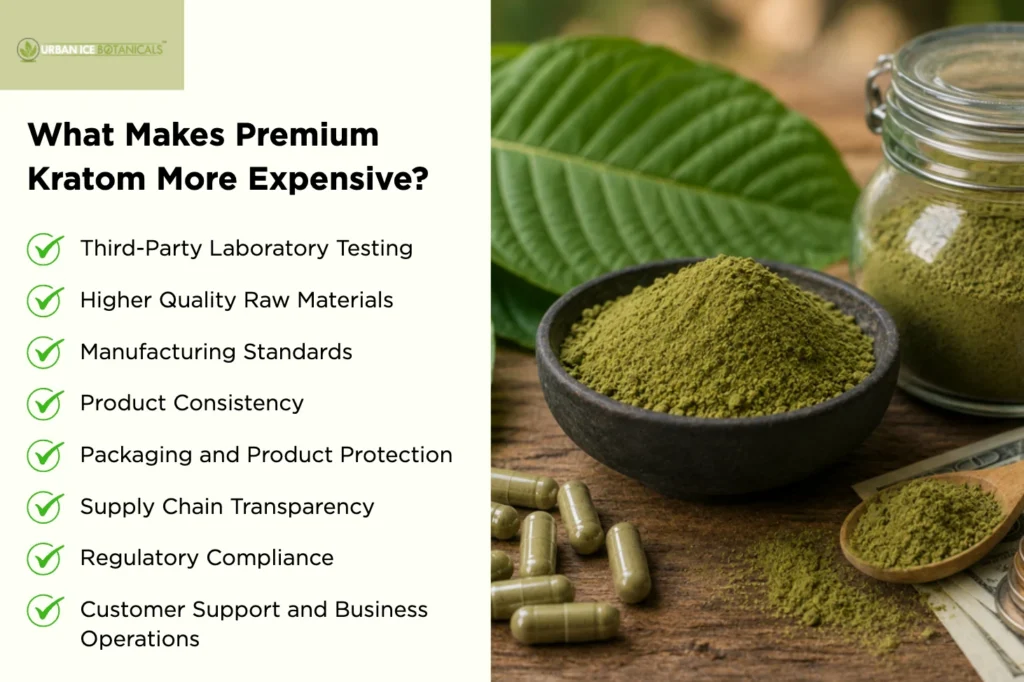
The factors below commonly contribute to higher kratom prices across the United States.
Third-Party Laboratory Testing
One of the most common reasons premium kratom products cost more is independent laboratory testing. Reputable manufacturers submit production batches to accredited laboratories to evaluate product identity and screen for contaminants, including heavy metals and microbial contamination. Many laboratories also verify alkaloid content and compare analytical results with product labeling.
Products accompanied by a current Certificate of Analysis (COA) generally incur additional testing expenses, documentation, and quality assurance procedures, thereby increasing production costs.
Higher Quality Raw Materials
Premium manufacturers often apply stricter sourcing standards before production begins. This includes evaluating harvested leaves for consistency, inspecting incoming raw materials, and rejecting batches that fail internal quality requirements.
Quality control at the sourcing stage increases operational costs but may improve manufacturing consistency across production batches.
Manufacturing Standards
Processing standards influence production costs long before a product reaches retail shelves. Manufacturers that operate under documented quality systems invest in equipment, employee training, sanitation procedures, batch tracking, and production controls.
These manufacturing practices increase operating expenses compared with facilities that perform only basic processing and packaging.
Product Consistency
Maintaining consistent production batches requires ongoing monitoring throughout the manufacturing process. Premium brands often document batch records, monitor processing conditions, and retain quality documentation for internal verification.
These procedures increase labor and operational costs while improving manufacturing consistency across multiple production runs.
Packaging and Product Protection
Packaging contributes to the final retail price more than many buyers realize. High-quality containers, moisture-resistant materials, tamper-evident seals, and clearly printed labels increase production expenses but also help protect product integrity during storage and transportation.
Premium packaging frequently includes:
- Lot or batch identification.
- Manufacturing information.
- Expiration or best-by information where applicable.
- Serving information.
- Storage recommendations.
- QR codes or links to laboratory reports.
Supply Chain Transparency
Premium vendors often maintain greater transparency throughout the supply chain. Buyers can frequently access information regarding product origin, manufacturing batches, laboratory reports, and quality control procedures.
Providing this level of documentation requires administrative oversight and record management that contribute to overall product cost.
Regulatory Compliance
Compliance with applicable state regulations may require manufacturers and retailers to implement additional labeling, testing, documentation, or distribution procedures. Businesses operating within regulated markets often incur higher compliance costs than vendors operating in jurisdictions with fewer requirements.
These compliance measures can increase retail prices while improving product transparency and consumer information.
Customer Support and Business Operations
Established vendors typically maintain customer service teams, inventory management systems, order tracking, return policies, educational resources, and technical support. Although these operational expenses are not part of the product itself, they contribute to the overall cost of doing business.
Higher retail pricing sometimes reflects these additional business investments rather than differences in the botanical ingredient alone.
Does a Higher Price Always Mean Better Quality?
No, more expensive kratom does not automatically mean better quality. A higher price alone does not guarantee higher product quality. Before paying a premium price, buyers should verify a current third-party COA, independent laboratory testing for contaminants, transparent ingredient labeling, batch or lot identification, clear serving information, responsive customer support, and published quality assurance practices.
When Is Paying More Worth It?
Paying more for kratom is worth it when the higher price reflects documented quality assurance, independent laboratory testing, transparent labeling, verified sourcing, and established quality control rather than marketing alone. The best purchasing decision balances price, product quality, laboratory verification, vendor transparency, and total delivered cost.
Quality vs. Price: What Cheap Kratom Can Cost You
The cheapest kratom on the market often lacks the third-party laboratory testing, transparent labeling, and quality documentation that allow buyers to verify what they are purchasing. Price should be considered alongside product quality, manufacturing practices, and available documentation. A product with a slightly higher purchase price may provide better long-term value if it includes documented quality assurance.
Low Price Does Not Always Mean Good Value
Some vendors reduce prices by limiting quality control, using basic packaging, purchasing lower-cost raw materials, or omitting third-party testing. While these practices may reduce production costs, they can also reduce the information available to buyers to verify product quality.
Before purchasing solely based on price, compare:
- Cost per gram.
- Cost per serving.
- Current Certificate of Analysis (COA).
- Product labeling.
- Batch identification.
- Vendor transparency.
- Shipping and total checkout cost.
A product with a slightly higher purchase price may provide better long-term value if it includes documented quality assurance and transparent manufacturing information.
Third-Party Laboratory Testing Matters
Independent laboratory testing is one of the most important quality indicators for commercially available kratom products. Testing helps manufacturers verify product identity and screen for contaminants before products reach consumers.
Depending on the laboratory and testing scope, reports may include:
- Heavy metals.
- Microbial contamination.
- Product identity.
- Alkaloid profile.
- Moisture content.
- Label verification.
Laboratory testing increases manufacturing costs, which explains why lab-tested kratom often has a higher retail price than products without published testing documentation.
Clear Product Labels Improve Transparency
Product labels should provide enough information for buyers to understand what they are purchasing. Transparent labeling also makes it easier to compare products between different vendors.
Look for labels that include:
- Product name.
- Net weight.
- Serving information.
- Ingredient list.
- Batch or lot number.
- Manufacturer or distributor information.
- Storage recommendations.
- Reference to an available Certificate of Analysis.
Incomplete or unclear labeling makes objective product comparisons more difficult.
Product Consistency Has Value
Consistent manufacturing practices help reduce variation between production batches. Vendors that monitor production quality, maintain batch records, and document quality control procedures often invest more resources throughout manufacturing than businesses with minimal oversight.
Although these practices increase production costs, they contribute to greater purchasing transparency and more consistent product information.
Consider the Total Purchase Cost
The advertised product price represents only part of the total expense. Buyers should calculate the final purchase cost, including:
- Product price.
- Shipping charges.
- Taxes.
- Handling fees.
- Promotional discounts.
- Subscription savings, when applicable.
A lower listed price can become more expensive after shipping and additional checkout charges are included.
Evaluate the Vendor, Not Just the Product
A vendor’s reliability plays an important role in purchasing decisions. Established retailers often publish product documentation, maintain customer support, update laboratory reports, and provide clearer purchasing information.
Before placing an order, review whether the vendor provides:
- Current third-party laboratory reports.
- Certificates of Analysis (COAs).
- Transparent product descriptions.
- Customer support contact information.
- Return or refund policies.
- Batch-specific documentation, when available.
These details help buyers evaluate product quality independently rather than relying solely on marketing claims.
How to Identify Better Value
The best value combines competitive pricing with verified laboratory testing, transparent labeling, and reliable vendor practices rather than the lowest retail price alone.
Use the following checklist before comparing products:
| Evaluation Factor | Why It Matters |
| Cost per gram | Standardizes price comparisons across package sizes. |
| Cost per serving | Helps fairly compare powders, capsules, extracts, and edibles. |
| Third-party laboratory testing | Confirms independent product analysis. |
| Certificate of Analysis (COA) | Provides documented testing information. |
| Transparent labeling | Improves product comparison and traceability. |
| Batch identification | Supports manufacturing transparency. |
| Total checkout cost | Includes shipping, taxes, and handling charges. |
| Vendor reputation | Reflects transparency in documentation, customer support, and purchasing. |
Evaluating these factors together provides a more complete picture of kratom value than comparing retail prices alone. Products supported by independent laboratory testing, transparent labeling, and documented quality assurance may justify a higher purchase price because buyers receive more verifiable information throughout the purchasing process.
How to Compare Kratom Prices Fairly
The most reliable way to compare kratom prices is by calculating cost per gram or cost per serving rather than comparing package prices alone, since products differ in package size, serving count, and concentration. A consistent comparison method helps buyers identify products that offer better overall value rather than simply the lowest purchase price.
Compare the Cost Per Gram
The cost per gram is one of the most useful pricing metrics for standard kratom powder. It allows buyers to compare products with different package sizes using the same unit of measurement.
The calculation is straightforward:
Cost Per Gram = Total Product Price ÷ Total Grams
For example:
- A 100-gram package priced at $30 costs $0.30 per gram.
- A 250-gram package priced at $60 costs $0.24 per gram.
Although the second package has a higher retail price, it offers a lower average cost per gram.
Compare the Cost Per Serving
Not every product is best compared by weight. Capsules, gummies, beverages, tea products, and extracts are often sold by serving count rather than by total grams.
Use the following formula:
Cost Per Serving = Total Product Price ÷ Number of Servings
Comparing cost per serving allows buyers to evaluate different package formats using a standardized pricing method.
Evaluate Extracts by Concentration
Unlike standard powder products, kratom extracts vary in concentration between manufacturers. Two extract products with similar bottle sizes may contain substantially different amounts of concentrated botanical material.
When comparing extracts, review:
- Manufacturer’s stated serving size.
- Product concentration.
- Available Certificate of Analysis (COA).
- Laboratory testing documentation.
- Total number of servings.
Comparing extracts by retail price alone rarely provides an accurate assessment of product value.
Include Shipping and Checkout Costs
The listed product price does not always represent the total purchase cost. Many retailers apply shipping charges, taxes, or handling fees during checkout.
Calculate the total delivered cost using:
Final Cost = Product Price + Shipping + Taxes + Handling Fees − Discounts
This calculation provides a more accurate comparison between retailers that use different pricing models.
Review Third-Party Laboratory Testing
Independent laboratory testing provides objective information that cannot be determined from pricing alone.
Before comparing products, verify whether the manufacturer provides:
- A current Certificate of Analysis (COA).
- Independent laboratory reports.
- Batch-specific documentation, when available.
- Product identification.
- Contaminant screening information.
Products supported by transparent laboratory documentation often justify higher retail prices because additional testing increases manufacturing expenses.
Verify Product Labels
Clear labeling improves price comparisons by helping buyers understand exactly what each package contains.
A complete product label should identify:
- Net weight.
- Serving size.
- Number of servings.
- Product ingredients.
- Batch or lot number.
- Manufacturer or distributor information.
- Storage recommendations.
Without this information, comparing products from different vendors becomes more difficult.
Compare Vendor Transparency
Vendor transparency is another important pricing consideration. A reputable retailer typically provides detailed product information before purchase.
Look for vendors that publish:
- Current laboratory reports.
- Certificates of Analysis.
- Clear pricing information.
- Shipping policies.
- Return policies.
- Customer support contact details.
These details help buyers evaluate products using documented information instead of marketing language.
Compare Bulk Pricing
Bulk purchases often reduce the overall cost per gram, making them more economical than multiple small orders.
For example:
| Package Size | Retail Price | Approximate Cost Per Gram |
| 100 grams | $30 | $0.30 |
| 250 grams | $60 | $0.24 |
| 500 grams | $95 | $0.19 |
| 1 kilogram | $150 | $0.15 |
Actual pricing varies across vendors, although larger package sizes often lower the average purchase cost.
Compare Subscription Discounts
Some online retailers provide subscription pricing or loyalty programs for repeat purchases. These programs may reduce the effective cost per serving or per gram, particularly for regular buyers.
When evaluating subscription offers, compare:
- Discount percentage.
- Shipping charges.
- Minimum purchase requirements.
- Cancellation policies.
- Final checkout cost.
A larger advertised discount does not always produce the lowest overall purchase price.
A Simple Checklist for Comparing Kratom Prices
Before purchasing any kratom product, review the following questions:
- Have you calculated the cost per gram or cost per serving?
- Have you included shipping and taxes in the final price?
- Does the product include a current Certificate of Analysis (COA)?
- Has the manufacturer published third-party laboratory testing?
- Does the label clearly identify weight, serving size, and batch information?
- Does the vendor provide transparent customer support and return policies?
- Are you comparing equivalent product forms rather than package prices alone?
Using the same evaluation criteria for every product allows buyers to make consistent price comparisons while considering quality assurance, transparency, and total purchase cost, rather than relying solely on the advertised retail price.
Online vs. Local Stores: Where Is Kratom Cheapest?
Online vendors typically offer lower kratom prices than local retailers, with online powder commonly priced at $8–$15 per ounce compared to $15–$30 per ounce at physical stores. While online stores often advertise lower product prices and larger inventories, local retailers may offer immediate availability without shipping delays. The most affordable option depends on the total delivered cost, product quality, available documentation, and the purchasing experience rather than the listed retail price alone.
Instead of comparing sticker prices, buyers should evaluate the total purchase cost, as well as product transparency and quality assurance.
Online Kratom Prices
Online vendors offer powder starting at $8 to $15 per ounce, with capsules ranging from $20 to $40 per bottle and bulk packages reducing the per-gram cost considerably. Because online businesses often operate with lower retail overhead than physical stores, they may offer more competitive pricing, especially for larger package sizes.
Common pricing advantages include:
- Lower cost per gram on bulk purchases.
- Larger package size options.
- Subscription discounts.
- Loyalty reward programs.
- Seasonal promotions.
- Wider product availability.
Many online retailers also publish Certificates of Analysis (COAs), laboratory reports, batch information, and detailed product specifications directly on product pages, making price comparisons easier. Buyers should still calculate the final checkout cost, including shipping charges, taxes, and any applicable handling fees, before deciding which retailer offers the best value.
Local Store Kratom Prices
Local smoke shops, vape stores, botanical retailers, and specialty supplement stores typically price kratom powder between $15 and $30 per ounce, reflecting higher operating expenses including rent, staffing, utilities, and inventory management. These retailers may provide the convenience of immediate purchase without waiting for shipping, which can be valuable when buyers need a product the same day.
Local purchases also allow buyers to:
- Inspect product packaging before purchase.
- Review labels directly.
- Ask store staff about available inventory.
- Avoid shipping fees on individual purchases.
Product selection may also be more limited than online vendors, particularly for bulk quantities or specialty formulations.
Online vs. Local Price Comparison
| Comparison Factor | Online Retailers | Local Retailers |
| Product Price | Often lower | Often higher |
| Bulk Discounts | Common | Less common |
| Subscription Pricing | Frequently available | Rare |
| Product Selection | Extensive | Limited by inventory |
| Immediate Availability | No | Yes |
| Shipping Costs | Additional unless included | None |
| COA Availability | Often published online | Varies by retailer |
| Product Comparison | Easier across multiple brands | Limited to in-store inventory |
The most affordable option depends on the total purchase cost, not just the advertised product price.
When Online Shopping Offers Better Value
Online purchasing may provide better overall value when buyers:
- Purchase larger package sizes.
- Compare multiple vendors before ordering.
- Take advantage of subscription pricing.
- Qualify for free shipping.
- Prioritize laboratory testing and transparent documentation.
- Compare cost per gram across several brands.
For repeat purchases, even a small reduction in cost per gram can lower the overall annual purchase cost.
When Local Stores May Be Worth the Higher Price
Paying more at a local retailer may be reasonable when immediate product availability is more important than obtaining the lowest possible price.
Local purchases may also benefit buyers who prefer to:
- Examine product packaging before purchasing.
- Avoid shipping delays.
- Purchase smaller quantities.
- Ask questions directly at the point of sale.
These convenience benefits may justify a higher retail price depending on individual purchasing priorities.
How to Determine Which Option Is Actually Cheaper
Before choosing between an online vendor and a local retailer, compare the total delivered cost rather than the advertised price alone.
Use this checklist:
- Calculate the cost per gram or cost per serving.
- Include shipping charges and taxes.
- Compare package sizes.
- Verify that a current Certificate of Analysis (COA) is available.
- Review third-party laboratory testing.
- Compare vendor transparency and customer support.
- Consider delivery time and immediate availability.
The lowest listed price does not always result in the lowest overall purchase cost. Evaluating pricing alongside laboratory documentation, product transparency, and total checkout costs provides a more accurate comparison and helps buyers identify the best overall value.
Does Kratom Strain Affect Price?
Kratom strain names have a relatively minor effect on retail pricing, with product form, package size, laboratory testing, and vendor reputation having a greater influence on cost than the strain designation itself. For example, a Maeng Da powder and a Red Vein powder sold in the same package size by the same vendor are often priced similarly. Larger price differences usually reflect product quality, processing standards, or branding rather than the strain designation alone.
How Much Does Maeng Da Kratom Cost?
Maeng Da kratom costs $10–$16 per ounce for powder and $18–$45 per bottle for capsules, slightly higher than standard strains due to its premium positioning and demand.
Typical retail estimates include:
| Product Form | Typical Price Range |
| Powder (1 oz) | $10–$16 |
| Capsules | $18–$45 per bottle |
| Extracts | $20–$70+ per unit |
Not every Maeng Da product carries a premium price. Buyers should compare cost per gram, available laboratory testing, and total package size before assuming that a higher price reflects higher quality.
How Much Does Red Vein Kratom Cost?
Red Vein kratom powder costs $8–$15 per ounce, in line with standard market rates for powder and capsules.
Typical retail estimates include:
| Product Form | Typical Price Range |
| Powder (1 oz) | $8–$15 |
| Capsules | $15–$40 per bottle |
| Extracts | $15–$60+ per unit |
Price differences between Red Vein products are usually associated with package size, manufacturing standards, and laboratory verification rather than the strain name itself.
How Much Does Green Vein Kratom Cost?
Green Vein kratom costs $8–$15 per ounce for powder, aligning with standard market pricing across U.S. retailers.
Typical retail estimates include:
| Product Form | Typical Price Range |
| Powder (1 oz) | $8–$15 |
| Capsules | $15–$40 per bottle |
| Extracts | $15–$65+ per unit |
As with other strains, comparing green vein kratom products by cost per serving and reviewing available Certificates of Analysis (COAs) provides a more meaningful comparison than looking only at the listed retail price.
How Much Does White Vein Kratom Cost?
White Vein kratom follows the same pricing structure as Red and Green Vein products, retailing at $8–$15 per ounce for powder.
Typical retail estimates include:
| Product Form | Typical Price Range |
| Powder (1 oz) | $8–$15 |
| Capsules | $15–$40 per bottle |
| Extracts | $15–$65+ per unit |
Retail prices of white vein kratom may increase for specialty formulations, limited-production batches, or concentrated-extract products.
Why Do Some Kratom Strains Cost More Than Others?
Kratom pricing differences are driven more by product form, laboratory testing, packaging standards, and vendor reputation than by strain name alone. Although strain names sometimes influence pricing, higher prices more commonly result from production and quality-related factors.
The most common pricing influences include:
- Product form, such as powder, capsules, or extracts.
- Package size and total quantity.
- Third-party laboratory testing.
- Certificate of Analysis (COA) availability.
- Manufacturing and packaging standards.
- Vendor reputation.
- Supply chain and import expenses.
- Product availability and market demand.
For example, two vendors may both sell Green Vein kratom, yet one product may cost more because it includes independent laboratory testing, detailed batch documentation, and higher packaging standards.
Should You Choose a Strain Based on Price?
No, strain name alone is not a reliable basis for comparing kratom value, as many strain categories share similar retail price ranges. Buyers should focus on objective purchasing criteria rather than assuming one strain provides better value than another based on price.
Before making a comparison, evaluate:
- Cost per gram.
- Cost per serving.
- Package size.
- Third-party laboratory testing.
- Current Certificate of Analysis (COA).
- Product labeling.
- Vendor transparency.
- Total delivered cost after shipping and taxes.
Using these standardized comparison factors helps buyers evaluate products consistently while avoiding decisions based solely on strain names or retail pricing.
Is Kratom Legal, and How Does That Affect Its Price?
Kratom is legal in most U.S. states but is banned or restricted in several states and local jurisdictions, and this patchwork of regulations directly affects retail prices, product availability, shipping options, and distribution costs. Because regulations differ by location, buyers may encounter different pricing, product selection, and purchasing options depending on where they live.
Understanding how legal requirements affect pricing helps buyers evaluate market differences while ensuring purchases comply with applicable state and local regulations.
Why Does Legality Affect Kratom Prices?
Legality affects kratom prices because regulatory requirements increase the cost of manufacturing and distributing products, which is often reflected in retail prices. Vendors operating in states with additional labeling, testing, or retail requirements incur higher compliance costs than businesses selling in jurisdictions with fewer regulations.
Compliance-related expenses may include:
- Third-party laboratory testing.
- Product labeling requirements.
- Batch documentation.
- Recordkeeping procedures.
- Distribution compliance.
- Retail licensing requirements, where applicable.
These operational costs may contribute to higher retail prices for compliant products.
State Laws Can Influence Product Availability
Because kratom laws vary across the United States, product availability and retail pricing are not consistent nationwide. As of 2026, kratom is fully banned in Alabama, Arkansas, Indiana, Wisconsin, and Louisiana, with Tennessee adding a statewide ban effective July 1, 2026. In states where kratom is legally available under regulated frameworks, such as Arizona, Texas, Florida, Georgia, and Utah, buyers generally have access to a wider product selection and more competitive pricing due to greater market competition.
In jurisdictions where sales are restricted or prohibited, retailers may discontinue shipments, product selection may become limited, and reduced competition can contribute to higher local prices. Buyers should verify the current legal status of kratom in their state and local jurisdiction before making a purchase, as laws continue to evolve and local ordinances may differ from statewide regulations.
Shipping Restrictions May Increase Overall Cost
Shipping restrictions can add meaningful cost to a kratom purchase, particularly for buyers in states with stricter regulations, because vendors must comply with applicable laws before fulfilling an order and may face limited carrier options, additional compliance procedures, or longer delivery routes.
Potential cost factors include:
- Limited carrier availability.
- Additional compliance procedures.
- Longer delivery routes.
- Restricted shipping destinations.
Even when product prices remain similar, these factors can increase the total checkout cost.
Regulatory Compliance Can Increase Manufacturing Costs
Regulatory compliance directly increases manufacturing costs because producers serving regulated markets must invest in quality assurance, documentation, and testing that unregulated vendors are not required to provide. These investments may include:
- Independent laboratory testing.
- Certificates of Analysis (COAs).
- Batch tracking systems.
- Updated product labels.
- Documented manufacturing procedures.
Although these practices increase production expenses, they also improve transparency and provide buyers with objective product information before purchase.
Does Federal Regulation Set Kratom Prices?
No, federal regulation does not set kratom prices, and no government agency controls what vendors charge for kratom products in the United States. Retail prices are determined entirely by market factors such as sourcing, manufacturing expenses, transportation, product availability, competition, and vendor pricing strategies.
The U.S. Food and Drug Administration (FDA) has not approved kratom for any medical use and continues to issue public safety communications regarding kratom products. Buyers should not interpret product availability or pricing as evidence of FDA approval or evaluation.
How to Check Kratom Laws Before Buying
The most reliable way to check kratom laws before buying is to review your state legislature’s official website for current statutes, then verify any county or municipal restrictions that may apply in your specific location. Because regulations can change, buyers should confirm legal status before placing an order rather than relying on vendor claims or outdated sources.
Before purchasing:
- Review current state laws.
- Check local county or municipal restrictions where applicable.
- Confirm that the retailer ships to your location.
- Review the vendor’s compliance policies.
- Verify that the product includes a current Certificate of Analysis (COA).
Taking these steps helps buyers avoid ordering products that cannot legally be delivered to their destination.
Does a Higher Price Mean Better Legal Compliance?
No, a higher retail price does not automatically indicate that a product meets higher regulatory or quality standards, and buyers should verify objective documentation rather than assuming compliance based on price alone.
Look for:
- Current third-party laboratory reports.
- Certificate of Analysis (COA).
- Transparent product labeling.
- Batch identification.
- Manufacturer information.
- Clear compliance and shipping policies.
These indicators provide more meaningful information than retail price alone.
How to Find the Best Value When Buying Kratom
The best value when buying kratom comes from balancing price, laboratory testing, product documentation, vendor reliability, and total checkout cost rather than simply choosing the lowest advertised price. A lower retail price may reduce the initial purchase cost, but working with a trusted kratom vendor helps buyers more effectively compare product quality, transparency, and long-term value.
1. Compare Cost Per Gram or Cost Per Serving
The most accurate way to compare kratom prices is by using standardized pricing units. Use cost per gram for powder products and cost per serving for capsules, extracts, gummies, beverages, and tea products, comparing similar product forms whenever possible. For example, comparing a bottle of capsules directly with a kilogram of powder provides little pricing insight unless both products are converted to the same unit of measure.
2. Verify Third-Party Laboratory Testing
Independent laboratory testing provides objective information that cannot be determined from product pricing alone. Before purchasing, verify whether the vendor provides a current Certificate of Analysis (COA), independent laboratory reports, batch-specific testing information, product identification, and contaminant screening results. Laboratory testing often increases manufacturing costs but also improves purchasing transparency and helps buyers evaluate products using documented information.
3. Review Product Labels Carefully
Clear product labels help buyers compare products fairly across different manufacturers. A complete label should identify net weight, serving size, number of servings, product ingredients, batch or lot number, manufacturer or distributor information, and storage recommendations. Products with incomplete labeling make accurate price comparisons more difficult because buyers cannot easily determine what is in the package.
4. Compare the Total Checkout Cost
The advertised retail price is only one part of the total purchase expense. Calculate the full cost using this formula:
Total Purchase Cost = Product Price + Shipping + Taxes + Handling Fees − Discounts
This calculation helps identify retailers that offer the lowest overall purchase cost rather than simply the lowest listed product price.
5. Consider Bulk Purchases
Buying larger package sizes often reduces the average cost per gram because packaging and distribution expenses are spread across a greater quantity of product. For buyers who purchase regularly, bulk pricing may lower long-term purchasing costs compared with ordering several smaller packages throughout the year. Before purchasing larger quantities, compare cost per gram, shipping costs, storage requirements, and product expiration or best-by information where applicable.
6. Evaluate Vendor Transparency
Reliable vendors typically provide detailed product information before purchase. Look for businesses that publish current Certificates of Analysis, laboratory reports, product specifications, ingredient transparency, shipping policies, return policies, and customer support information. Transparent documentation allows buyers to compare products using objective information instead of relying on advertising claims.
7. Verify Compliance With State Laws
Since kratom laws differ across the United States, buyers should confirm that products can legally be purchased and shipped to their location before ordering. Review applicable state regulations, confirm shipping eligibility, check vendor compliance policies, and verify age requirements where applicable. Legal compliance helps prevent unexpected order cancellations or shipping restrictions.
8. Compare Similar Products
Fair price comparisons require comparing products with similar characteristics, meaning powder with powder, capsules with capsules, extracts with extracts, and so on. Avoid comparing products that differ substantially in concentration, serving size, or manufacturing process without first converting them into standardized pricing units.
Best Value Buying Checklist
Use the following checklist before purchasing any kratom product.
| Checklist Item | Why It Matters |
| Compare cost per gram or serving | Standardizes pricing across products. |
| Review total checkout cost | Includes shipping, taxes, and fees. |
| Verify third-party laboratory testing | Confirms independent product evaluation. |
| Check for a current Certificate of Analysis (COA) | Improves purchasing transparency. |
| Review product labeling | Confirms weight, serving size, and batch information. |
| Compare vendor reputation | Evaluates transparency and customer support. |
| Confirm state legality | Prevents purchasing or shipping issues. |
| Compare similar product forms | Creates more accurate price comparisons. |
The Best Value Is More Than the Lowest Price
The best value combines competitive pricing, transparent documentation, independent laboratory testing, clear product labeling, and reliable vendor practices. Buyers who evaluate products using these objective criteria are more likely to identify products that provide long-term value rather than selecting an option based solely on the lowest retail price.
Using a consistent comparison method also makes it easier to compare vendors, estimate monthly purchasing costs, and determine whether a higher-priced product offers measurable benefits through documented quality assurance and greater transparency.
Frequently Asked Questions About Kratom Cost
Why Is Kratom So Expensive?
Kratom prices reflect the combined costs of sourcing, manufacturing, third-party laboratory testing, packaging, shipping, and regulatory compliance rather than raw botanical material alone. Product form also plays a significant role. Kratom powder generally costs less than capsules because it requires fewer manufacturing steps, while extracts usually cost more because they undergo additional concentration processes and often require more extensive quality control.
A higher retail price may also reflect investments in independent laboratory testing, Certificates of Analysis (COAs), and transparent manufacturing practices rather than branding alone.
How Much Do Kratom Pills Cost?
Kratom pills, commonly sold as capsules, cost between $25 and $40 per bottle. Prices vary based on capsule count, package size, vendor, and laboratory testing. Rather than comparing bottles by capsule count alone, compare cost per serving, total grams contained, third-party laboratory testing, COA, and total checkout cost. This approach provides a more accurate comparison across different brands.
Why Isn’t Kratom Covered by Insurance?
Kratom is not covered by health insurance because it is not an FDA-approved prescription medication. Insurance providers typically reimburse products that meet their coverage requirements, which generally do not include retail botanical products sold directly to consumers. As a result, buyers usually pay the full retail price, including applicable shipping charges and taxes.
Does Kratom Cost Vary by State?
Yes, kratom prices vary across states due to differences in product availability, retailer competition, shipping costs, operating expenses, and applicable state or local regulations. States with fewer retail options or additional compliance requirements may experience higher average prices than markets with greater competition. Even within the same state, prices can differ between online vendors and local retailers due to differing pricing strategies and operating costs.
Is More Expensive Kratom Always Better Quality?
No, more expensive kratom does not automatically mean better quality. Buyers should evaluate objective quality indicators before assuming that a premium-priced product offers greater value. Current Certificate of Analysis (COA), third-party laboratory testing, product labeling, batch identification, vendor transparency, and manufacturing information provide stronger evidence of product quality than price alone.
How Much Should You Expect to Spend on Kratom Per Month?
Most kratom buyers spend between $30 and $120 per month, depending on product form, package size, purchase frequency, cost per serving, cost per gram, shipping expenses, and bulk purchasing habits. Buyers can calculate their total monthly cost using a simple formula:
Monthly Cost = Cost per Serving × Average Number of Servings Purchased Per Month
This method allows buyers to compare products consistently regardless of packaging format.
How Much Does One Ounce of Kratom Cost?
One ounce (approximately 28 grams) of standard kratom powder costs between $8 and $15 at most U.S. online vendors, with premium strains and local retail stores priced higher. Actual pricing depends on vendor pricing, product quality, laboratory testing, shipping charges, promotional discounts, and state availability. Larger package sizes often reduce the average cost per gram compared with purchasing individual one-ounce packages.
Is Buying Kratom in Bulk Cheaper?
Yes, buying kratom in bulk is generally cheaper on a per-gram basis, with purchases of 500 grams or more reducing the cost from $0.50–$1.00 down to $0.20–$0.50 per gram. Before purchasing in bulk, compare cost per gram, shipping charges, storage requirements, available laboratory testing, and total checkout cost. Bulk purchasing provides the greatest value when buyers regularly purchase the same product and have verified the vendor’s quality standards.
Why Do Kratom Extracts Cost More Than Powder?
Kratom extracts cost more than powder because additional manufacturing processes are required to concentrate the active alkaloids, with extract products retailing at $15–$70 or more per unit compared with $8–$15 per ounce for standard powder. Higher prices reflect additional processing, more complex manufacturing, laboratory testing, and packaging requirements. Extracts should be compared by cost per serving and manufacturer-provided concentration information rather than bottle size alone.
What Is the Cheapest Form of Kratom?
Standard kratom powder is the cheapest form available, costing $0.50–$1.00 per gram for small quantities and as low as $0.20–$0.50 per gram when purchased in bulk. Capsules usually cost more due to encapsulation and packaging, while extracts, gummies, beverages, and specialty products command higher retail prices due to manufacturing complexity, convenience, and formulation. Buyers should also evaluate laboratory testing, COAs, transparent labeling, vendor reputation, and total purchase cost before making a purchasing decision.