Skip to main content


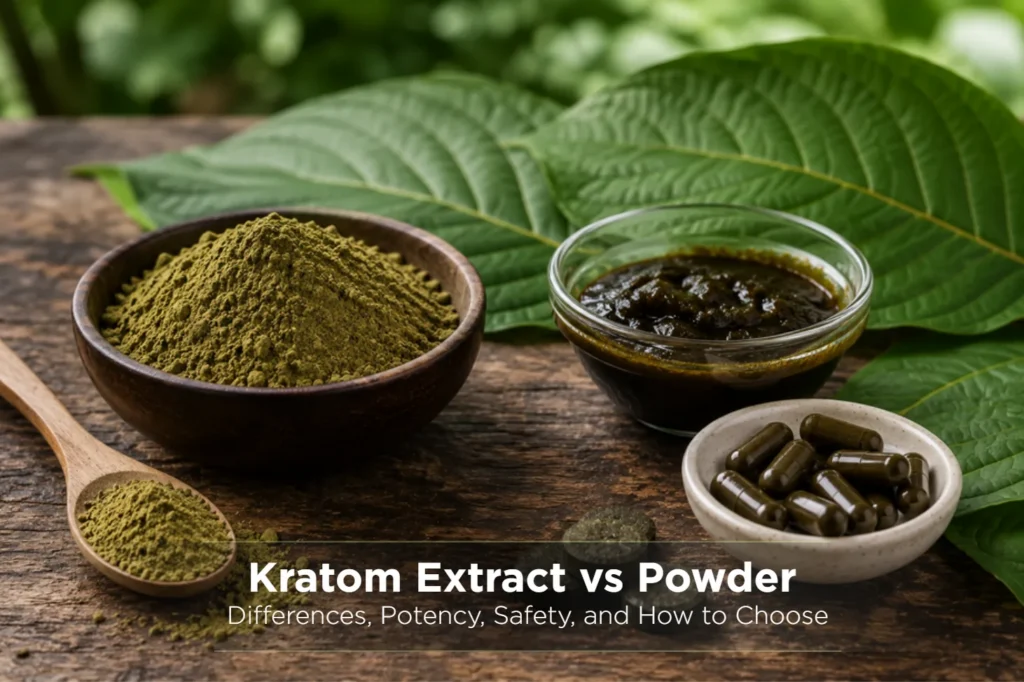
Kratom products are commonly sold as powder or extract, but these two forms differ in concentration, manufacturing, labeling, and available formats. Kratom powder consists of dried, finely ground Mitragyna speciosa leaves, while extract is produced by concentrating naturally occurring alkaloids into a smaller volume or serving. Because extracts are more potent than traditional powder, product labels, serving information, and third-party laboratory testing carry greater weight when evaluating quality.
Choosing between extract and powder involves more than comparing potency. Buyers should also consider manufacturing methods, alkaloid concentration, consistency, cost per serving, storage requirements, and manufacturer transparency. This guide covers how each product is made, how to interpret extract labels, why lab testing matters, and what current research and regulatory guidance say about kratom products.
Important: This article is intended for educational purposes only. Kratom products are not approved by the FDA to diagnose, treat, cure, or prevent any disease. Product quality, alkaloid composition, and regulatory requirements vary by manufacturer and jurisdiction. Consult a qualified healthcare professional before use, especially if you have an underlying health condition, are pregnant or breastfeeding, or take prescription medications.
Kratom Extract vs Powder: Quick Comparison
Kratom powder is the traditional form made from dried, ground Mitragyna speciosa leaves, while kratom extract is a concentrated product processed to increase alkaloid content. That difference in concentration drives distinctions in serving size, potency, labeling, product formats, and cost. The right choice depends on product transparency, manufacturing quality, budget, and your ability to interpret potency labels and lab testing rather than relying on extract ratios or marketing claims alone.
| Comparison Factor | Kratom Powder | Kratom Extract |
| Source Material | Finely ground dried leaves of the Mitragyna speciosa tree | Concentrated product derived from kratom leaves or powder |
| Manufacturing Process | Harvested, dried, and ground into powder | Processed to concentrate naturally occurring alkaloids |
| Potency | Lower alkaloid concentration per gram than most extracts | Higher alkaloid concentration than traditional powder |
| Primary Alkaloids | Naturally contains mitragynine, 7-hydroxymitragynine, and other alkaloids in whole-leaf proportions | Contains the same naturally occurring alkaloids but often at higher concentrations, depending on manufacturing and standardization |
| Common Product Forms | Loose powder, capsules, tea | Liquid shots, tinctures, enhanced powders, gummies, resin, tablets |
| Serving Size | Generally larger because it is less concentrated | Usually smaller because of higher concentration |
| Preparation | May require measuring, brewing, mixing, or encapsulating | Often sold in ready-to-use or pre-measured formats |
| Taste | Naturally bitter and earthy | Some products are flavored or taste-masked, although flavor varies by formulation |
| Cost Per Gram | $0.30 to $0.55 per gram | $15 to $70+ per unit |
| Label Complexity | Simpler product labeling | May include extract ratios, alkaloid percentages, or standardized potency claims that require careful interpretation |
| Quality Evaluation | Third-party laboratory testing remains important | Batch-specific laboratory testing is particularly important because extract strength can vary considerably between manufacturers |
| Storage | Stores well when kept sealed in a cool, dry place | Storage recommendations vary by product form, especially for liquid extracts after opening |
| Best Suited For | Buyers seeking a traditional whole-leaf product with flexible preparation options | Buyers looking for concentrated products in compact, convenient formats while carefully following product labeling |
What Is Kratom Powder?
Kratom powder is a fine botanical powder produced by drying and grinding the leaves of Mitragyna speciosa, a tropical tree native to Southeast Asia. Unlike kratom extract, it retains the whole-leaf alkaloid profile without additional concentration, making it the basis for most loose powder and capsule products on the market.
Because kratom powder undergoes minimal processing, its alkaloid composition reflects the source material directly. Cultivation conditions, harvest practices, and drying methods can all affect the final alkaloid composition, which is why reputable manufacturers conduct third-party laboratory testing and provide batch-specific Certificates of Analysis (COAs) verifying identity, purity, and consistency. Concentration alone is not a reliable measure of quality, and freshness, transparent labeling, and verified COAs offer a more accurate basis for evaluation.
How Is Kratom Powder Made?
Kratom powder is made by harvesting mature Mitragyna speciosa leaves, cleaning them, drying them under controlled conditions, and grinding them into a fine, consistent powder. No additional concentration step is involved, meaning the finished product retains the whole-leaf botanical composition rather than isolating or amplifying individual alkaloids.
Drying method and grind consistency are the two manufacturing variables that most directly affect the finished powder. Leaves are typically dried in shaded or climate-controlled environments to limit degradation of naturally occurring alkaloids, then milled to a uniform particle size before packaging. Because no extraction or solvent process is used, the powder’s alkaloid profile reflects the source leaf material directly.
Natural Alkaloid Profile
Kratom powder naturally contains over 40 plant alkaloids, with mitragynine as the predominant compound, measured at 3.16–13.66 mg/g in commercial leaf powder products. 7-hydroxymitragynine occurs in trace amounts, alongside speciogynine, speciociliatine, and paynantheine (Fowble & Musah, 2019). The proportion of these compounds varies depending on growing region, soil composition, climate, leaf maturity, drying method, and post-harvest handling.
Research confirms that withering duration alone can increase mitragynine concentrations by 14–65% depending on the cultivar, and that drying temperatures above 40°C reduce key alkaloid levels, including speciogynine and paynantheine (Zhang et al., 2025). Two products labeled as the same strain may not share identical alkaloid profiles, making laboratory analysis a more reliable basis for evaluation than product names or color designations.
Common Forms of Kratom Powder
Kratom powder is available in several product formats, allowing buyers to choose the option that best fits their preferences and preparation methods. In the United States, kratom powders are the predominant powdered leaf format, typically consumed as loose powder, capsules, or brewed tea rather than fresh leaves, which are not commercially available outside Southeast Asia.
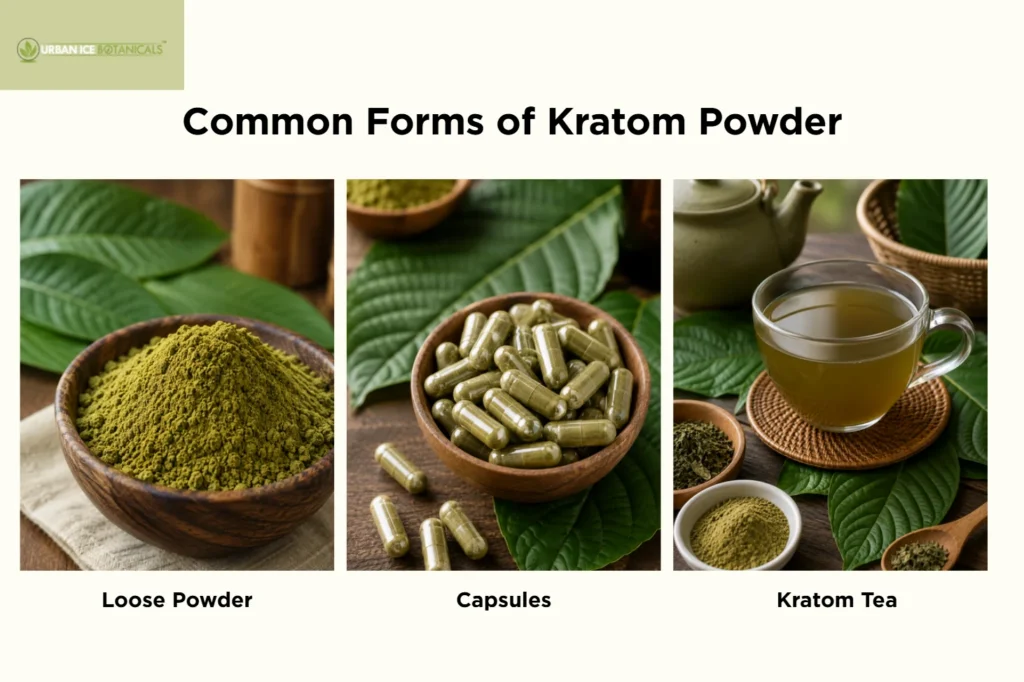
- Loose Powder
Loose powder is the most widely available and commonly purchased form of kratom in the U.S. It can be mixed directly into beverages such as water, juice, or smoothies, or stirred into food. Buyers should always follow the preparation and serving guidelines provided by the specific manufacturer. - Capsules
Capsules contain pre-measured quantities of kratom powder enclosed in a gelatin or vegetable-based shell. They offer a convenient alternative for individuals who prefer to avoid measuring loose powder or who want to avoid the plant material’s naturally bitter taste. Capsule products use the same whole-leaf powder as loose formats, with no change to the underlying alkaloid composition. - Kratom Tea
Some buyers prepare kratom powder as a tea by combining it with hot water. This mirrors the traditional preparation method used in Southeast Asia, where kratom leaves have been brewed for centuries. Preparation methods and steep times vary among individuals and manufacturers, so users should always follow the recommendations provided with the specific product.
Available Vein Types
Kratom powder is commonly marketed under three primary vein-color classifications, which reflect a combination of leaf maturity at harvest and post-harvest processing methods, including drying techniques, drying duration, and fermentation.
- Red Vein Powder
Among the three classifications, red vein kratom is the most widely available and most purchased category in the U.S. market. Products in this category are typically dried for longer or exposed to greater sunlight and may undergo fermentation, all of which can influence the final alkaloid ratio. Mitragynine content and overall alkaloid ratios can still differ meaningfully between red vein powder products from different manufacturers and harvest batches. - Green Vein Powder
Positioned between red and white varieties, green vein kratom is broadly available across commercial vendors and frequently marketed as a mid-range option. It is generally associated with partial drying methods that preserve more of the original leaf alkaloid profile. The degree of drying and the duration of withering vary by manufacturer, so no two green vein products are guaranteed to have the same chemical composition. - White Vein Powder
Typically processed using shorter drying times and less direct sunlight exposure than red or green varieties, white vein kratom is the third primary classification offered across most commercial product lines. This approach can influence the mitragynine-dominant alkaloid profile associated with this category. Processing standards and sourcing practices vary considerably across vendors, making manufacturer transparency an important factor when comparing white vein products.
Note: Vein color classifications are widely used commercial designations within the kratom industry. No universally accepted scientific standard currently confirms that vein color alone consistently predicts a product’s alkaloid composition, and batch-specific laboratory analysis remains the most reliable basis for product evaluation.
Common Uses of Kratom Powder
Kratom powder is the most widely consumed form of kratom in the United States and serves as the starting material for many other kratom products, including capsules and some extract formulations. U.S. consumers most commonly use kratom powder by mixing it into water, juice, or other beverages, packing it into their own capsules for pre-measured servings, or brewing it as a hot water tea. Some buyers also mix it into food. Loose powder is the preferred format for regular daily routines due to its flexibility in preparation, wider availability across vendors, and lower cost relative to concentrated extracts and liquid products.
What is Kratom Extract?
Kratom extract is a concentrated form of kratom produced by processing kratom leaves or powder to increase the concentration of naturally occurring alkaloids. Unlike whole-leaf powder, extracts undergo additional manufacturing steps that reduce plant material while concentrating specific botanical compounds. The primary distinction between extract and powder is concentration rather than composition, as both originate from the same Mitragyna speciosa source material and contain many of the same naturally occurring alkaloids.
Extraction techniques, source material, standardization methods, and quality-control practices vary considerably among manufacturers, meaning products with similar names or extract ratios may differ in their actual alkaloid profile and consistency. This variability makes accurate labeling and batch-specific laboratory testing significantly more important with extracts than with whole-leaf powder, and Certificates of Analysis remain the most reliable basis for evaluating any extract product rather than potency claims alone.
How Is Kratom Extract Made?
Kratom extract is produced by processing Mitragyna speciosa leaves or powder using techniques such as water-based decoction, ethanol extraction, or supercritical CO2 extraction, each of which draws out naturally occurring alkaloids at different efficiencies and influences the final mitragynine concentration and overall alkaloid profile. The process typically involves preparing and selecting source material, applying the extraction method under controlled conditions, removing excess plant material, concentrating the botanical extract, and conducting identity, purity, and alkaloid testing before packaging.
Because extraction methods and quality-control practices vary considerably between manufacturers, two products labeled with the same extract ratio may not contain identical alkaloid concentrations. Batch-specific Certificates of Analysis provide a more reliable basis for comparison than extract ratio claims or potency labels alone.
Why Are Kratom Extracts More Concentrated?
Kratom extracts are more concentrated because the manufacturing process removes non-alkaloid plant material while preserving or increasing the alkaloid proportion in the finished product. Research has documented that alkaloid-rich extracts can contain mitragynine at 28.32% by weight compared to 1.43% in source leaf powder, representing roughly a 20-fold increase (Kaewchompoo et al., 2025).
Concentration varies between kratom extract products because manufacturers use different source material, extraction processes, and standardization methods, meaning two extracts with similar names or ratios may not have identical potency or alkaloid profiles. Kratom resin products, for example, have been documented to contain 35.6–62.6 mg/g of mitragynine compared to 12–21 mg/g in dried leaf powder (EUDA, 2024), making batch-specific Certificates of Analysis a more reliable basis for comparison than extract names or ratios alone.
Common Forms of Kratom Extract
Manufacturers produce kratom extract in several formats to support different product preferences and applications. Although the active botanical source remains the same, each format differs in concentration, onset, convenience, and storage requirements.
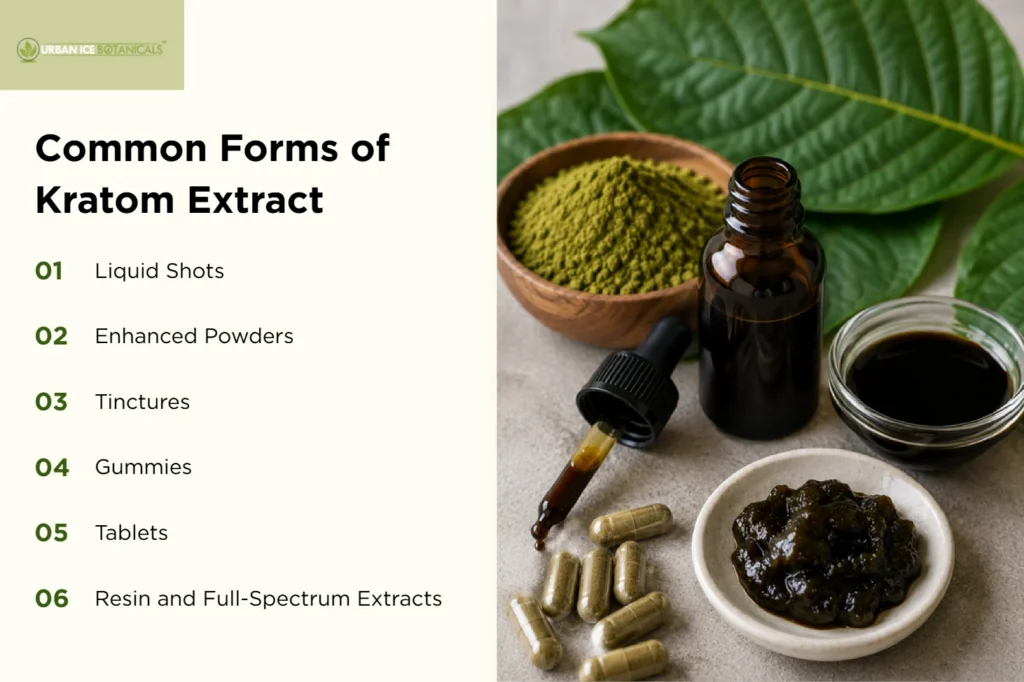
- Liquid Shots
Liquid kratom shots deliver concentrated extract in a ready-to-use format, typically sold in 10ml or 2oz bottles, requiring no preparation. They are among the fastest-acting extract formats, with onset generally reported within 10 to 20 minutes compared to 30 to 45 minutes for whole-leaf powder. Concentration varies substantially between brands, making serving size, mitragynine content, and batch-specific laboratory testing important factors to review before purchasing. - Enhanced Powders
Enhanced powders combine traditional kratom powder with added extract to increase overall alkaloid concentration, typically labeled by a strength multiplier such as 2x, 5x, or 10x, or by mitragynine percentage. Because these products contain both whole-leaf material and concentrated extract, they should not be evaluated using the same assumptions as regular kratom powder. - Tinctures
Kratom tinctures are liquid extracts produced using alcohol-based or water-based extraction methods, packaged with a dropper for measured dispensing and typically taken sublingually or added to beverages. They generally represent a lower-concentration point within the extract category, making them a common entry point for buyers transitioning from whole-leaf powder. - Gummies
Kratom extract gummies are flavored, chewable edibles with pre-measured mitragynine content per piece, offering a portable alternative that avoids the naturally bitter taste of kratom. Buyers should review the mitragynine content per serving rather than relying on the number of gummies per package. - Tablets
Kratom extract tablets compress concentrated botanical material into a fixed, measured serving in a portable and discreet format. Like other pre-dosed formats, tablet formulations differ among manufacturers and should be evaluated using serving information and laboratory documentation rather than tablet count alone. - Resin and Full-Spectrum Extracts
Resin and full-spectrum extracts are among the most concentrated kratom preparations available, produced by reducing liquid extract under heat until a thick, dense concentrate remains. Full-spectrum formulations preserve the broader range of naturally occurring alkaloids rather than isolating mitragynine alone and are typically portioned in very small amounts due to their high concentration. Batch-specific laboratory testing remains the most reliable basis for evaluating their composition.
Available Vein Types
Kratom extracts are commonly marketed using red, green, and white vein classifications. These labels refer to the maturity and vein color of the source leaves at harvest rather than guaranteeing a specific alkaloid profile or potency level.
- Red Vein Extract
Red vein extracts are produced from mature Mitragyna speciosa leaves and are widely available in liquid shots, tinctures, powders, and capsules. Vein color alone does not confirm the alkaloid concentration of the extract. Buyers should compare batch-specific COAs, mitragynine content per serving, and manufacturing transparency rather than selecting products based on color classification. - Green Vein Extract
Sourced from mid-maturity leaves, green vein extracts are commonly produced in powder, capsule, and concentrated liquid formats. Extract quality depends on the source material, concentration method, batch consistency, and third-party laboratory testing, rather than on vein-color marketing alone. - White Vein Extract
Among the three main extract categories, white vein extracts are derived from younger Mitragyna speciosa leaves and are available in powder, capsule, and liquid concentrate formats. As with all kratom extract products, buyers should evaluate Certificates of Analysis, mitragynine concentration per serving, and the extract ratio or alkaloid percentage stated on the label before comparing products.
Important: Vein color in kratom extract products reflects the source leaf material used during manufacturing, not a standardized measure of extract strength or alkaloid composition. Third-party laboratory analysis remains the most reliable way to assess and compare the characteristics of extract products.
How Kratom Extract Differs from Whole-Leaf Powder
Kratom extract contains significantly higher mitragynine concentrations than whole-leaf powder, with the extraction process capable of increasing mitragynine content to 40% or higher in commercial products compared to whole-leaf powder (Grundmann, 2024). While powder preserves the full ground leaf in its natural proportions, extract undergoes additional processing such as water-based, ethanol, or solvent extraction to concentrate mitragynine and 7-hydroxymitragynine into a smaller serving size.
That concentration difference affects serving size, labeling, cost, and quality-control requirements. Extract labels typically include ratios such as 2:1 or descriptors like full spectrum, which should be verified through batch-specific lab data rather than accepted at face value.
Understanding Kratom Extract Potency
Kratom extract potency labels such as 10x, 25x, or 50x do not follow a universal industry standard, meaning two products with the same ratio claim can differ significantly in mitragynine concentration, alkaloid profile, and overall chemical composition. These designations are marketing terms rather than verified measurements, and relying on them as the primary basis for comparing extract products can lead to inaccurate potency assumptions.
Actual potency depends on the quality of the source leaf, the extraction method used, the concentration of mitragynine and 7-hydroxymitragynine in the finished product, and whether the manufacturer standardizes output across batches. Buyers should look for products that provide batch-specific COAs from accredited third-party laboratories, with the mitragynine percentage clearly stated by weight, rather than relying on ratio claims or extract-strength descriptors alone.
What Do 10x, 25x, and 50x Mean?
Extract ratios such as 10x, 25x, and 50x generally indicate how much raw kratom leaf was used to produce a given amount of finished extract. A product labeled 10x, for example, suggests that 10 parts of leaf material were processed down to 1 part of concentrated extract, though this ratio reflects the starting material volume rather than a verified alkaloid concentration in the finished product.
No regulatory standard governs how these ratios must be calculated or displayed, which means manufacturers may apply different extraction methods or labeling conventions to the same numeric claim. Buyers should treat extract ratios as general manufacturing references rather than as standardized potency measurements, and prioritize products in which mitragynine concentration is independently verified through batch-specific laboratory verification.
| Label Element | What It Means | What It Doesn’t Mean |
| 10x Extract | Manufacturing ratio | Guaranteed potency |
| 25x Extract | Botanical concentration reference | Clinical strength |
| Mitragynine % | Measured alkaloid content | Overall product quality |
| Batch Number | Production identifier | Safety certification |
| COA | Independent testing | FDA approval |
Why Extract Ratios Are Not Standardized
Unlike pharmaceuticals, kratom extract ratios are not governed by a standardized reporting system, so the same numeric designation can reflect different manufacturing inputs and finished product compositions across manufacturers. Variables such as source material quality, extraction method, recovery yield, and post-production standardization all influence the final alkaloid concentration independently of the ratio stated on the label.
As a result, two products labeled 25x may differ meaningfully in mitragynine content even when packaging appears similar. Batch-specific laboratory data confirming alkaloid concentration by weight provides a more reliable basis for product comparison than extract ratio terminology alone.
Mitragynine Percentage vs. Extract Ratio
One of the most useful data points on a kratom extract label is the mitragynine percentage or the amount of mitragynine listed per serving. Unlike extract ratios, this measurement provides a more direct indication of alkaloid concentration, and research has confirmed that mitragynine is the dominant alkaloid in Mitragyna speciosa, accounting for up to 66% of the total alkaloid fraction in the leaf (Eastlack et al., 2020).
For example, a manufacturer may report:
- Mitragynine percentage (%)
- Milligrams of mitragynine per serving
- Total alkaloid content
- Standardized extract concentration
When supported by a batch-specific COA, these measurements allow buyers to compare products using verified analytical data rather than marketing terminology. Because mitragynine is one component of a broader alkaloid profile, full-panel testing provides a more complete basis for product evaluation than reports limited to mitragynine alone.
Why Two “10x Extracts” Can Be Different
Two kratom extracts carrying the same 10x label can differ significantly in mitragynine concentration and overall alkaloid profile because the extraction ratio reflects starting material volume rather than the composition of the finished product. Variables such as source leaf quality, geographic origin of the botanical material, harvesting and drying practices, extraction technique, manufacturing controls, and post-production standardization all influence the final alkaloid content, independently of the ratio stated on the label.
As a result, two manufacturers may legitimately produce extracts labeled 10x while laboratory testing reveals meaningfully different mitragynine percentages or alkaloid profiles. Without batch-specific COA data confirming alkaloid concentration by weight, extract ratio claims alone provide an incomplete picture of what a product actually contains.
What Information Matters More Than the Extract Ratio?
When evaluating a kratom extract, mitragynine percentage by weight, batch-specific verified data, and independent laboratory testing provide a more reliable basis for comparison than extract ratio claims alone. The following indicators offer the most objective information when comparing products:
- Batch-specific Certificate of Analysis (COA) from an accredited independent laboratory
- Mitragynine content reported as a percentage or milligrams per serving
- 7-hydroxymitragynine content, when available
- Heavy metal and microbial screening results
- Residual solvent testing for solvent-based extracts
- Lot number linking the product to its laboratory report
Extract ratios such as 10x, 25x, or 50x reflect only one aspect of the manufacturing process and should not serve as the primary measure of quality or potency when comparing products across manufacturers
Kratom Extract vs. Powder: Detailed Comparison
Although kratom extract and kratom powder originate from the same botanical source, they differ in concentration, manufacturing, labeling, convenience, and quality-control requirements. The following comparisons examine the characteristics that most influence product selection, including alkaloid concentration, serving size, preparation, storage, cost, and laboratory testing.
| Factor | Powder | Extract |
| Processing | ★ | ★★★★ |
| Convenience | ★★ | ★★★★★ |
| Cost | ★★★★★ | ★★ |
| Preparation | ★★ | ★★★★★ |
| Label Complexity | ★★★★★ | ★★ |
| Lab Testing Importance | ★★★ | ★★★★★ |
Potency
Kratom extract is more potent per serving than whole-leaf powder because additional processing concentrates naturally occurring alkaloids. Standard powder contains roughly 1% to 2% total alkaloids by weight, while concentrated extracts can reach 40% to 70% or higher depending on extraction method and standardization. That concentration gap changes how each product is measured, labeled, and consumed.
A higher concentration does not automatically indicate better quality. Full-spectrum extracts that preserve supporting alkaloids like paynantheine and speciogynine tend to produce a more rounded profile than single-alkaloid isolates targeting mitragynine alone. The manufacturing process, source material, and standardization practices all influence the finished product. Buyers should evaluate verified laboratory data and transparent labeling rather than comparing products by extract ratio or marketing terminology alone.
Alkaloid Concentration
Whole-leaf powder preserves mitragynine and 7-hydroxymitragynine in the natural proportions of the ground leaf. In quality commercial powder, mitragynine typically ranges from 1.2% to 2.0% by weight, with 7-hydroxymitragynine generally under 0.04%. Mitragynine accounts for roughly 66% of the total alkaloid fraction, while 7-hydroxymitragynine represents about 2%, according to published analyses.
Extract processing concentrates those alkaloids through methods such as water-based extraction, ethanol extraction, acid-base extraction, supercritical CO2 extraction, or solid-phase microextraction (SPME). Both forms contain dozens of additional compounds, including speciogynine, speciociliatine, paynantheine, and corynantheidine, but concentrations vary substantially based on extraction method, source material, harvest season, geographic origin, and postharvest handling. Drying temperature and withering duration alone can shift mitragynine concentration by 14% to 65% in certain cultivars.
Serving Size
Whole-leaf powder typically requires a serving of several grams, while concentrated extract delivers higher alkaloid content in a fraction of that weight, sometimes a single milliliter or one gummy. Liquid shots commonly contain 35mg to 135mg of mitragynine per bottle, while extract gummies typically provide 10mg to 30mg per piece. Serving assumptions used for powder should never be applied to extract products.
A 20% miscalculation in powder serving size is uncomfortable. The same miscalculation with a concentrated extract can yield significantly more adverse effects due to the compressed alkaloid load. Buyers should always follow the manufacturer’s serving guidance for the specific product and verify that mitragynine content is stated in milligrams per serving, not per bottle or per package, to avoid confusion between formats.
Onset and Duration
Whole-leaf powder retains the full botanical matrix of the ground leaf, including plant fiber that slows digestion and absorption. Liquid extract formats, such as shots and tinctures, remove that fiber, allowing alkaloids to be absorbed more rapidly. Many users report feeling the effects of liquid shots within 15 to 30 minutes, while powder and capsules take longer because they need more time to break down plant material.
Liquid formats tend to peak faster and taper sooner, often lasting 3 to 5 hours depending on serving size. Capsules and gummies may extend that window slightly through slower absorption. No universally accepted timeframe applies to either product form, as variables including serving size, individual physiology, food intake, and preparation method all influence the experience. Anecdotal claims should not substitute for standardized data.
Consistency
Kratom extract can offer greater batch-to-batch consistency than whole-leaf powder when manufacturers standardize to a defined mitragynine percentage using analytical methods like high-performance liquid chromatography (HPLC). Powder is more susceptible to natural variation from environmental conditions, harvesting practices, and seasonal shifts. Research on Thai cultivars has found mitragynine content ranging from 0.35% to nearly 5.0%, depending on the region and season.
Some extract manufacturers standardize their output across all batches, while others do not. Consistency varies by brand regardless of product form. Buyers should look for products in which the COA shows alkaloid testing performed on the specific batch being sold, rather than a generic test applied across an entire product line. Batch-level standardization is the most reliable indicator of predictable alkaloid content from purchase to purchase.
Preparation
Loose kratom powder requires measuring with a scale, mixing into beverages, brewing as tea, or filling capsules before each use. Extract products eliminate that handling through ready-to-use formats: liquid shots (single-serve bottles consumed directly), tinctures (dropper-dispensed liquids), gummies (chewable edibles with pre-set mitragynine per piece), tablets and capsules (swallow-and-go formats), enhanced powders (whole-leaf blended with extract), and resin (semi-solid concentrate dissolved in warm liquid).
Powder offers more flexibility in preparation methods and wider access to all available strains, including red, green, white, and yellow-vein varieties. Extract products may be available only in select strains, depending on the manufacturer. For users who value preparation control and strain variety, powder is the more versatile option. For users who prioritize speed and portability, extract formats require no equipment or cleanup.
Taste
Whole-leaf kratom powder carries a naturally earthy, bitter flavor from its alkaloid content that many users find unpleasant, particularly at larger serving sizes. This bitterness is characteristic of the Mitragyna speciosa leaf and intensifies with higher-quality, alkaloid-rich material. Concentrated extracts, such as resin or enhanced powder, that retain significant botanical material tend to preserve the same flavor profile.
Extract products vary considerably based on formulation. Liquid shots, gummies, and flavored extract powders often include citrus, fruit, or mint flavoring to mask bitterness, making them the most palatable options for taste-sensitive users. Gummies skip the bitter aftertaste entirely. Tinctures made with alcohol-based extraction introduce an additional sharp taste from the solvent base. For users who dislike the natural kratom flavor, a flavored extract format is the clearest solution.
Convenience
Loose powder requires a precision scale, preparation space, and cleanup before each use. Extract products eliminate that process entirely. Liquid shots fit in a pocket and can be consumed in seconds. Gummies travel discreetly with no aftertaste. Tablets and capsules offer pre-measured servings in a swallow-and-go format. Tinctures allow precise adjustment via a dropper for users who want control without measuring powder.
Powder offers greater flexibility in serving size and preparation methods, which matters for users who frequently adjust their serving size or prefer brewing tea. The trade-off is time: consistent powder preparation takes more effort and equipment than grabbing a pre-dosed shot or gummy. For daily at-home use, powder works well. For travel, work, or situations where speed and discretion matter, extract formats hold a clear advantage.
Storage
Dry kratom powder is the easiest form to store long-term. It remains stable in a cool, dry, airtight container below 75°F and under 60% relative humidity, protected from heat, moisture, and direct sunlight. Sealed mylar bags or original packaging with a food-safe desiccant packet helps prevent oxidation and moisture absorption. Kratom is hygroscopic, meaning it naturally pulls moisture from surrounding air, so bathroom and kitchen storage should be avoided.
Liquid extracts and ready-to-use formulations degrade faster from air and environmental exposure. Opened liquid shots and tinctures should be used within days to weeks, and some require refrigeration after opening. Capsules add a barrier against air exposure compared to loose powder. Resin extracts should be kept sealed in cool, dark conditions to maintain alkaloid integrity over time.
Shelf Life
Kratom powder maintains peak potency for 6 to 12 months and can remain usable up to 24 months with proper storage. Sealed in mylar below 75°F, the powder can remain stable for two years, though a noticeable decline often begins after 12 to 18 months with periodic opening. Capsules last slightly longer, often up to two years sealed. Dry concentrated extracts (powdered or resinous) can last for 2 to 3 years due to their lower moisture content and higher alkaloid concentration.
Liquid shots have shorter shelf lives, typically 6 to 12 months when unopened. Alcohol-based tinctures in glass bottles can last several years due to alcohol’s preservative properties. Gummies and edibles have the shortest shelf life, often 3 to 6 months, because additional ingredients introduce more variables that cause degradation. Always check the manufacturer’s printed expiration date.
Cost Per Serving
Kratom extract costs more per unit ($15 to $70+ depending on format and concentration) than whole-leaf powder ($0.30 to $0.55 per gram). A single liquid shot with 100 mg+ of mitragynine runs $15 to $30, while a comparable amount of mitragynine from quality powder at 1.5% concentration requires roughly 6 to 7 grams and costs approximately $2 to $4. Additional processing, solvent use, purification, and testing drive up extract production costs.
Whole-leaf powder offers a lower cost per milligram of alkaloid overall. Daily users will find powder significantly more economical over time. Extract products deliver convenience and portability at a premium that occasional or on-the-go users may find worthwhile. Meaningful cost comparisons depend on alkaloid concentration per serving, not package price alone, so checking the mitragynine-per-dollar ratio is the most accurate way to compare.
Product Availability
Both forms are widely available from commercial vendors, but extracts come in a broader range of formats: liquid shots, enhanced powders, tinctures, gummies, tablets, softgel capsules, resin extracts, and flavored extract powders. Powder is sold primarily as loose powder or pre-filled capsules and is typically available across all strain varieties (red, green, white, yellow vein).
Extract products may be limited to select strains or sold as strain-neutral concentrates depending on the manufacturer. The growing variety of extract formulations expands buyer options but increases the importance of reviewing labels and COA documentation before purchase. Mitragynine content, extraction method, and added ingredients can differ dramatically between products that appear similar on the shelf or share similar packaging and marketing language.
Quality Control
Extract demands more rigorous quality-control evaluation than powder because processing steps, solvent use, and concentration variability raise the stakes of independent verification. At a minimum, testing should cover alkaloid profiling via HPLC, heavy-metal screening (arsenic, cadmium, lead, mercury) via ICP-MS, microbial contamination testing (E. coli, Salmonella, mold, coliforms), and pesticide residue screening. Products that fail any category should be rejected outright.
The American Kratom Association (AKA) GMP Standards Program sets manufacturing, labeling, and testing requirements based on FDA 21 C.F.R. 111 for dietary supplements. Vendors holding AKA GMP Qualified status have been independently audited. Regardless of product form, reputable manufacturers should provide batch-specific quality documentation from accredited third-party labs, with lot numbers that match the product packaging. If a vendor cannot produce a batch-specific COA on request, look elsewhere.
Benefits and Limitations of Kratom Extract
Kratom extract delivers higher alkaloid concentration in a smaller serving than whole-leaf powder, but that concentration raises the bar for product quality, labeling accuracy, and laboratory verification.
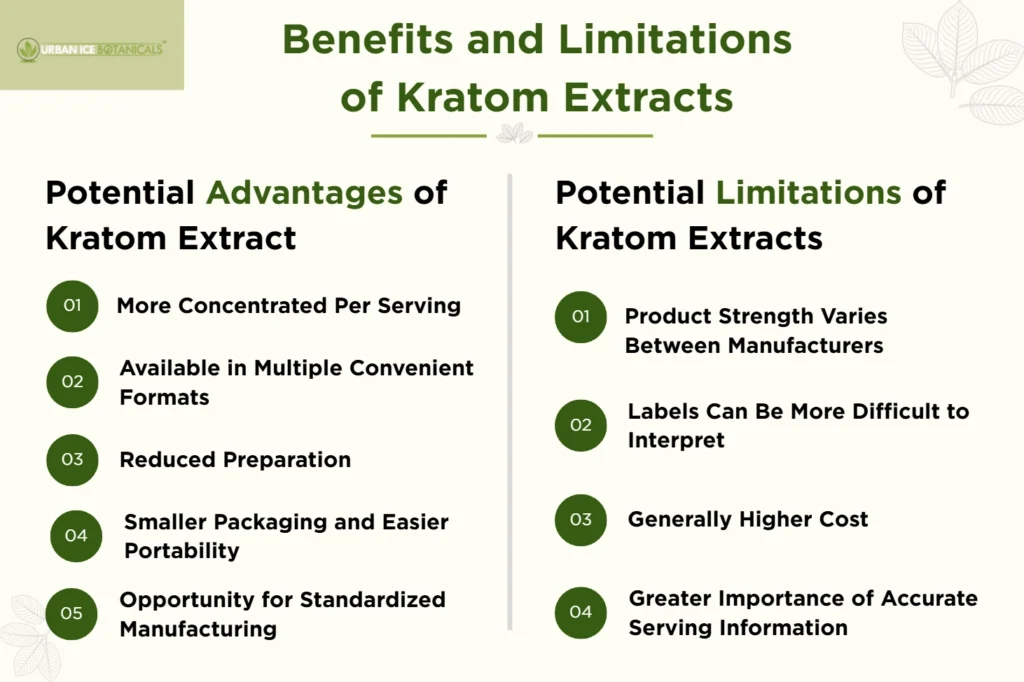
Potential Advantages of Kratom Extract
Kratom extract offers practical advantages over powder in concentration, convenience, portability, variety of formats, and manufacturing consistency, though each benefit depends on the manufacturer’s transparency and testing practices.
- More Concentrated Per Serving
Kratom extract contains a higher concentration of naturally occurring alkaloids per gram than whole-leaf powder because additional processing removes plant material while retaining and concentrating the alkaloid content. This means extract products are packaged in smaller serving sizes, but the concentration also makes it critical to understand serving information and product labeling before comparing formulations. - Available in Multiple Convenient Formats
Kratom extract is manufactured in several product forms, including liquid shots, tinctures, enhanced powders, gummies, tablets, and resin extracts. This variety allows buyers to select a format that aligns with their preparation preferences, storage requirements, and lifestyle needs. - Reduced Preparation
Many extract products are sold in ready-to-use formats that require little or no preparation. Liquid shots, tablets, and gummies come pre-portioned and eliminate the measuring, mixing, and cleanup that loose powder requires. - Smaller Packaging and Easier Portability
Because extracts concentrate alkaloids into a smaller volume, manufacturers can package them in compact containers compared with the larger bags or jars needed for loose powder. This compact sizing improves portability for travel, work, or any situation where carrying bulk powder is impractical. - Opportunity for Standardized Manufacturing
Some manufacturers standardize kratom extracts by targeting consistent alkaloid concentrations across production batches using analytical methods like HPLC. When supported by independent laboratory testing, standardization can deliver greater batch-to-batch consistency than products that rely solely on natural variation, though practices differ widely among manufacturers and COAs remain the only reliable way to verify claims.
Potential Limitations of Kratom Extracts
Kratom extract has practical limitations in labeling consistency, cost, serving size sensitivity, and quality verification that buyers should weigh against its convenience and concentration advantages.
- Product Strength Varies Between Manufacturers
No industry-wide standard exists for extract ratios or potency labeling, which means two products with the same labeled ratio may differ significantly in mitragynine concentration, overall alkaloid profile, extraction method, standardization process, and laboratory verification. Extract ratios alone should never be used to compare product quality between brands. - Labels Can Be More Difficult to Interpret
Extract products frequently include terms such as 10x, 25x, 50x, full-spectrum, standardized extract, or mitragynine percentage, but without supporting laboratory documentation, these terms do not provide enough information for meaningful comparison. Buyers should review batch-specific test documentation alongside product labels to verify what the numbers actually represent. - Generally Higher Cost
Extract manufacturing involves additional processing, concentration steps, solvent use, purification, and laboratory testing that raise production costs above traditional powder. Although extracts cost more per package or per gram, direct price comparisons should also factor in alkaloid concentration per serving and verified mitragynine content rather than package price alone - Greater Importance of Accurate Serving Information
Because extracts compress a higher alkaloid load into a smaller serving, even small measurement errors have a greater impact than the same miscalculation in whole-leaf powder. Responsible manufacturers provide clear serving information with mitragynine stated in milligrams per serving, standardized manufacturing where applicable, and transparent alkaloid reporting through product labels and batch-specific lab reports.
Benefits and Limitations of Kratom Powder
Kratom powder provides the traditional whole-leaf form of Mitragyna speciosa with minimal processing, offering preparation flexibility, straightforward labeling, and lower cost, but its quality depends on natural batch variation, sourcing practices, and manufacturer transparency.
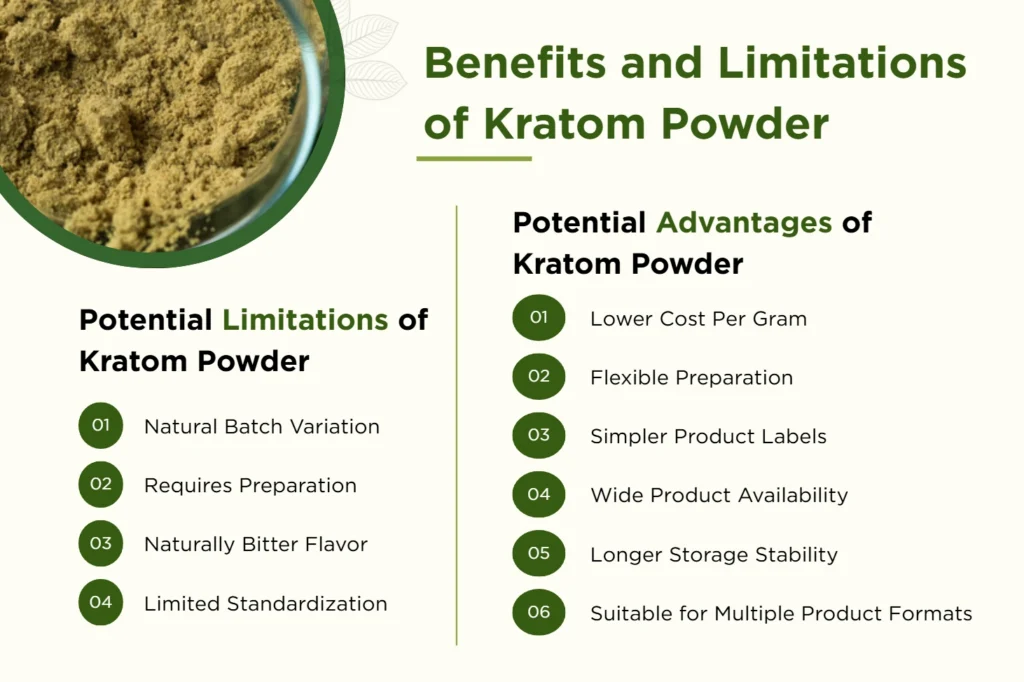
Potential Advantages of Kratom Powder
Kratom powder offers practical advantages in cost, preparation flexibility, labeling simplicity, availability, storage stability, and versatility as a base ingredient across multiple product formats.
- Lower Cost Per Gram
Kratom powder generally costs $0.30 to $0.55 per gram, significantly less than concentrated extracts, because it requires fewer manufacturing steps, no solvent processing, and less intensive quality-control procedures. Buyers comparing value should still factor in laboratory testing, freshness, and verified alkaloid content alongside price. - Flexible Preparation
Kratom powder supports multiple preparation methods, including brewing it as tea, mixing it into beverages, blending it into smoothies, or filling capsules at home. This flexibility gives buyers direct control over serving size and preparation style in a way that pre-portioned extract formats do not offer. - Simpler Product Labels
Traditional kratom powder labels are more straightforward than extract products because they identify the product type, vein color, batch or lot number, serving guidance, and laboratory testing without using extract ratios, mitragynine milligram counts, or concentration terminology that can vary in meaning between manufacturers. - Wide Product Availability
Kratom powder is the most widely available kratom product form, offered by nearly every commercial vendor in loose and capsule formats across all major vein types, including red, green, white, and yellow. This broad selection gives buyers more strain variety than extract products, which are often limited to select strains or sold as strain-neutral concentrates. - Longer Storage Stability
Dry kratom powder maintains peak potency for 6 to 12 months and can remain usable up to 24 months when stored in a sealed, airtight container below 75°F, away from moisture, heat, and direct sunlight. Its low moisture content and simple composition make it less susceptible to degradation than liquid extracts, gummies, or other ready-to-use formats. - Suitable for Multiple Product Formats
Whole-leaf powder serves as the base ingredient for capsules, tea bags, and enhanced powder formulations where the extract is blended back into the ground leaf. This versatility makes powder the foundation of the broader kratom product category and gives buyers a starting point they can adapt to their preferred consumption method.
Potential Limitations of Kratom Powder
Kratom powder carries practical limitations in batch consistency, preparation demands, taste, quality variation, and natural alkaloid variability that buyers should weigh against its cost and flexibility advantages.
- Natural Batch Variation
Kratom powder is an agricultural product, so its alkaloid profile shifts between harvests based on growing region, season, leaf maturity, and drying practices. Research on Thai cultivars found mitragynine content ranging from 0.35% to nearly 5.0% depending on these variables, making batch-specific laboratory testing the only reliable way to verify what a given bag of powder actually contains. - Requires Preparation
Loose powder requires measuring with a scale, mixing into a liquid, or manually filling capsules before each use, which adds time and cleanup compared to grab-and-go extract formats. Buyers who prioritize convenience and speed may find liquid shots, gummies, or tablets more practical for daily use, travel, or workplace settings. - Naturally Bitter Flavor
Whole-leaf kratom powder has a strong earthy, bitter taste driven by its alkaloid content that intensifies at larger serving sizes. This flavor is characteristic of the Mitragyna speciosa leaf and is not an indicator of quality, but buyers who find it unpleasant may prefer flavored extract formats such as gummies, citrus-flavored shots, or flavored powders that mask the bitterness. - Limited Standardization
Unlike extracts that can be manufactured to a target mitragynine percentage, whole-leaf powder reflects the natural variability of harvested botanical material with no concentration or standardization step applied. Product consistency depends entirely on responsible sourcing, controlled drying and processing conditions, and the manufacturer’s quality assurance procedures rather than any post-harvest alkaloid adjustment.
How to Read Kratom Labels
Reading a kratom label starts with checking the product type and serving size, the alkaloid content in milligrams per serving, the lot or batch number, the linked Certificate of Analysis from a third-party lab, and the full ingredient list. Not every manufacturer labels the same way, so understanding what each element represents helps you evaluate quality, spot missing information, and identify brands that prioritize transparency.

- Serving Size
Serving size defines how the manufacturer intends the product to be measured and compared across formulations. Because extracts are significantly more concentrated than whole-leaf powder, serving sizes vary widely across product types, and buyers should compare products using the label’s stated serving information rather than assuming that similar packaging indicates equivalent concentration. - Mitragynine Content
Of all the data points on a kratom label, mitragynine content is the most useful for comparing alkaloid strength between products. Some manufacturers report it as a percentage of total weight, while others list milligrams per serving or per container, and the number only becomes a reliable comparison tool when backed by a batch-specific Certificate of Analysis rather than a generic or outdated test. - 7-Hydroxymitragynine Information
Present at much lower concentrations than mitragynine (typically under 0.04% in whole-leaf powder), 7-hydroxymitragynine is the second most commonly measured kratom alkaloid and appears on most laboratory reports. It is considered more potent by weight, so its reported level should be interpreted within the context of the full laboratory report rather than viewed as a standalone quality indicator. - Extract Ratio
Labels like 10x, 25x, or 50x describe the relationship between raw botanical input and finished extract output, but there is no universal industry standard for calculating these ratios. Two products labeled 25x from different manufacturers may contain very different mitragynine concentrations, alkaloid profiles, and extraction methods, so ratios should be treated as general product descriptions while laboratory testing provides the meaningful comparison. - Batch or Lot Number
Every reputable kratom product should carry a batch or lot number linking it to specific manufacturing and laboratory records. This unique identifier lets buyers match the product to its COA, verify testing results, and confirm that the lab report applies to the exact batch being sold rather than a different or older production run. - Manufacturing and Expiration Dates
Product freshness directly affects alkaloid stability, making manufacturing and expiration dates practical quality indicators. Powder typically maintains peak potency for 6 to 12 months after production, while liquid formats may have shorter windows, so products with clearly printed dates demonstrate greater transparency than those without a traceable manufacturing timeline. - Third-Party Laboratory Testing
Independent laboratory testing is the strongest quality signal on any kratom label because it means the product was analyzed by a lab with no financial ties to the manufacturer. A reputable label should provide a QR code, website link, or lot-number lookup that lets buyers access the batch-specific COA for the exact product they purchased, covering alkaloid content, heavy metals, microbial contamination, and pesticide screening. - Ingredient List
What goes into the product beyond kratom itself matters more with extracts than with powder. Whole-leaf powder typically contains only ground Mitragyna speciosa leaves, while extract products may include flavoring agents, sweeteners, stabilizers, glycerin, citric acid, or capsule shell materials, depending on the format. Therefore, reviewing the full ingredient list helps identify any additives before purchasing. - Storage Instructions
How you store a kratom product determines how long it retains its alkaloid integrity. Dry powder and capsules generally need only cool, dry, airtight storage below 75°F away from sunlight, while liquid extracts and gummies may require refrigeration after opening or carry shorter post-opening use windows that the label should specify.
How to Evaluate Kratom Products’ Quality
To evaluate kratom quality, look beyond product names and potency claims and focus on independent laboratory testing, transparent manufacturing practices, traceable batch numbers, and accurate labeling. Because kratom is derived from botanical raw materials, quality varies with cultivation, harvesting, processing, and quality-control standards, and reputable manufacturers reduce that variability through standardized processes and third-party verification.
| COA Element | Why It Matters |
| Batch Number | Matches the report to the product |
| Mitragynine Analysis | Confirms alkaloid content |
| 7-Hydroxymitragynine | Shows measured concentration |
| Heavy Metals | Screens for contaminants |
| Microbial Testing | Verifies cleanliness |
| Residual Solvents | Important for extracts |
| Test Date | Indicates recency |
| Independent Laboratory | Improves transparency |
- Certificate of Analysis (COA)
A COA is the single most important document for verifying kratom quality because it independently confirms identity, alkaloid content, and contaminant levels for a specific production batch. Reputable manufacturers make batch-specific COAs accessible through their website, packaging QR code, or customer support. - Alkaloid Analysis
Laboratory-measured alkaloid data provides a factual comparison that marketing language cannot. Most COAs report mitragynine concentration and may include 7-hydroxymitragynine, and these verified numbers are far more reliable than extract ratios or label terminology for evaluating product strength. - Heavy Metal Testing
Independent heavy metal testing screens for lead, arsenic, cadmium, and mercury to verify levels fall within acceptable limits. Soil composition, water quality, and growing conditions all influence heavy metal uptake in kratom, making this panel a non-negotiable part of any credible quality-control program. - Microbial Testing
Microbial screening tests for Salmonella, E. coli, yeast, and mold to confirm the product was produced, dried, and stored under sanitary conditions. Improper drying or high-humidity storage can introduce contamination risks that are invisible without laboratory verification. - Residual Solvent Testing
For extracts produced using ethanol, acetone, or other solvents, residual solvent testing checks whether processing chemicals remain within acceptable limits in the finished product. This panel is less relevant to whole-leaf powder but becomes critical for any extract in which solvents were part of the manufacturing process. - Batch-Specific Testing
Generic lab reports covering an entire product line do not verify what is inside the specific package you are buying. Each batch should carry its own COA linked through the lot number printed on the label, and the number on the packaging should match the number on the report. - Manufacturing Standards
Documented quality-control procedures across harvesting, processing, packaging, and storage separate reputable manufacturers from vendors reselling untested material. The AKA GMP Standards Program requires independent audits of facility conditions, testing protocols, and labeling accuracy, and vendors holding AKA GMP Qualified status have passed these verifications. - Product Traceability
Traceable products connect each package to a documented production history through batch numbers, manufacturing dates, expiration dates, and linked laboratory reports. This documentation lets buyers verify sourcing, confirm testing, and evaluate freshness instead of trusting undated or unlabeled products. - Vendor Transparency
Manufacturers who share batch-specific COAs, ingredient lists, serving information, storage guidance, and accessible lab reports give buyers evidence to make informed comparisons. Vendors who withhold this documentation or provide only generic reports should be treated with caution regardless of pricing or marketing claims.
Is Kratom Safe? Key Safety Considerations for Buyers
No kratom product is risk-free, and safety depends on product quality, accurate labeling, verified lab testing, and responsible use. The FDA has not approved kratom for any medical use and continues to warn consumers about potential adverse effects, including nausea, liver toxicity, and seizures. Both powder and extracts require careful evaluation of manufacturer transparency, batch-specific COAs, serving guidance, and legal status before purchase, with extracts demanding additional caution due to their compressed alkaloid concentration and faster tolerance buildup.
Why Kratom Extracts Require Additional Attention
Kratom extracts require more caution than powder because their concentrated alkaloid load leaves less room for error in serving size, labeling, and quality verification. Concentrated extracts also accelerate tolerance buildup compared with whole-leaf powder, and products with elevated levels of 7-hydroxymitragynine (7-OH) have drawn increased regulatory scrutiny, with some states banning concentrated 7-OH products while keeping natural leaf products legal.
The following practices help reduce risk regardless of which kratom product form you choose.
- Follow Product Label Instructions
Manufacturer-provided serving information, storage recommendations, and ingredient details exist because different formulations behave differently. Reading label instructions is particularly important with concentrated extracts, which may differ significantly from whole-leaf powder in how they are measured and consumed. - Avoid Mixing with Alcohol or Other Substances
Kratom alkaloids are metabolized by cytochrome P450 enzymes (primarily CYP3A and CYP2D6), the same liver enzymes that process many prescription medications, which creates a real risk of drug interactions that can alter how other substances are absorbed. Anyone taking prescription medications, managing underlying health conditions, or consuming alcohol should consult a qualified healthcare professional before using any kratom product. - Store Products Properly
Cool, dry, airtight storage below 75°F and under 60% relative humidity protects alkaloid integrity and prevents microbial contamination across all kratom formats. Liquid extracts and gummies may require refrigeration after opening, and all products should be kept in original sealed packaging between uses to minimize oxidation and moisture exposure. - Keep Products Out of Reach of Children and Pets
Gummies, flavored shots, and other palatable extract formats pose a particular risk of accidental consumption because they resemble candy or energy drinks. All kratom products should be stored securely out of reach, in original child-resistant packaging where available, with containers closed between uses. - Verify Product Quality Before Purchasing
Product quality should be confirmed through documentation before purchasing, not assumed from packaging or marketing claims. Buyers should verify that the product carries a batch-specific COA linked through a matching lot number, independent third-party lab testing covering alkaloids, heavy metals, microbials, and residual solvents where applicable, and clear labeling with serving information stated in milligrams. - Check Your State and Local Kratom Laws
Kratom is legal at the federal level but banned in several states as of mid-2026, including Alabama, Arkansas, Connecticut, Indiana, Kansas, Louisiana, Tennessee, Vermont, and Wisconsin. Over 18 states regulate kratom under the Kratom Consumer Protection Act (KCPA), which requires age verification (typically 21+), product labeling, and lab testing. City and county-level bans also exist in otherwise legal states, so buyers should verify local regulations before purchasing or traveling with kratom. - Consult a Qualified Healthcare Professional When Appropriate
People who are pregnant or breastfeeding, have underlying medical conditions, take prescription medications, or have a history of substance use should seek professional medical advice before using kratom. Reported side effects include nausea, constipation, dizziness, and drowsiness, and rare but serious adverse effects such as liver injury and seizures have appeared in clinical case reports, particularly in cases involving polysubstance use.
Which Should You Choose – Kratom Extract or Powder?
The right choice depends on how you plan to use the product, how much preparation you prefer, and how closely the manufacturer supports its claims with verified lab testing and transparent labeling. This is where choosing a trusted kratom vendor matters, because reliable sourcing, batch-specific testing, clear ingredient details, and accurate labeling help you compare extract and powder products with more confidence. Neither form is inherently superior, as powder offers lower cost per serving, flexible preparation, and wider strain access, while extracts deliver higher concentration, faster onset, and portable convenience at a premium price.
The following considerations help you compare both forms using objective quality indicators rather than potency claims or marketing language.
| If You Value… | Consider… |
| Traditional whole-leaf product | Kratom Powder |
| Concentrated formulation | Kratom Extract |
| Lower cost | Kratom Powder |
| Ready-to-use formats | Kratom Extract |
| Flexible preparation | Kratom Powder |
| Portable packaging | Kratom Extract |
| Objective quality verification | Products with batch-specific COAs and independent laboratory testing |
Choose Kratom Powder If You Prefer a Traditional Whole-Leaf Product
Kratom powder is the better fit if you want a minimally processed product with lower cost per milligram of alkaloid, flexible preparation options, and access to all available strain varieties. Whole-leaf powder retains the natural alkaloid composition of the dried leaf without additional concentration, is available in loose and capsule formats with simpler labeling, and works well for daily use where cost efficiency and serving control matter more than portability or speed.
Choose Kratom Extract If You Prefer a More Concentrated Product
Kratom extract is the better fit if you want higher alkaloid concentration in a compact, ready-to-use format with minimal preparation. Extracts are available as liquid shots, tinctures, gummies, tablets, and enhanced powders, each with varying concentrations and onset profiles. Because formulations vary widely, buyers should verify serving information in milligrams per serving, alkaloid reporting on the COA, and batch-specific lab testing before comparing extract products against each other or against powder.
Compare Product Quality Before Comparing Potency
A product with verified lab testing, transparent manufacturing, and accurate labeling is a stronger purchase than one that simply advertises a high extract ratio or mitragynine percentage without documentation. Quality indicators like batch-specific COAs, AKA GMP certification, and clearly stated ingredient lists provide a verifiable basis for comparison, while unsubstantiated potency claims tell you nothing about what is actually inside the package.
Consider the Product Format
Format determines how much time, equipment, and preparation each serving requires. Loose powder offers the most control over serving size and preparation method, but it needs a scale and mixing. Capsules simplify handling without changing the base product. Liquid shots, gummies, and tablets provide grab-and-go convenience with pre-measured servings. The right format depends on whether you prioritize flexibility and cost (powder) or speed and portability (extract formats).
Review Laboratory Testing
Batch-specific laboratory testing is the only reliable way to verify what a kratom product actually contains. Before purchasing, confirm that the manufacturer provides a COA from an accredited third-party lab tied to the exact lot number on the product, covering at minimum alkaloid content (mitragynine and 7-hydroxymitragynine), heavy metals, and microbial contamination. A product without accessible batch-level testing should not be compared alongside products that provide it.
Evaluate Manufacturer Transparency
Transparent manufacturers provide documentation to verify their claims independently, while opaque vendors ask you to trust the packaging alone. Look for openly accessible COAs, published mitragynine content per batch, clear ingredient lists, stated serving sizes in milligrams, storage guidance, and responsive customer support. Vendors who withhold this information or provide only generic lab reports that are not linked to specific batches make objective product comparison impossible.
Questions to Ask Before Buying
Asking the right questions can help you evaluate kratom products more effectively.
- Is a Batch-Specific Certificate of Analysis Available?
A reputable manufacturer should provide a Certificate of Analysis that matches the product’s batch or lot number. This report allows buyers to verify that the specific product has undergone independent laboratory testing. - Has the Product Been Tested by an Independent Laboratory?
Independent laboratory testing provides greater confidence than manufacturer claims alone. Buyers should confirm that testing includes alkaloid analysis and, where applicable, screening for common contaminants. - Does the Label Clearly Explain the Product?
A transparent label should identify the product type, serving information, ingredients, batch number, storage instructions, and manufacturer details. Complete labeling makes product comparisons more reliable. - Does the Manufacturer Explain Its Quality Standards?
Manufacturers that describe their sourcing, quality-control procedures, and testing practices demonstrate greater transparency than those providing only basic product descriptions. - Can You Verify the Information Independently?
The best product claims are those supported by evidence. Buyers should look for QR codes, downloadable laboratory reports, or other documentation that enables independent verification of product information.
Frequently Asked Questions
Is kratom extract stronger than kratom powder?
Yes, kratom extract is significantly more concentrated per serving than whole-leaf powder. Standard powder contains 1% to 2% total alkaloids by weight, while extracts can reach 40% to 70% or higher. Strength varies between products, so buyers should compare batch-specific COAs rather than extract ratios.
Does kratom powder contain the same alkaloids as kratom extract?
Both kratom powder and extract contain the same naturally occurring alkaloids, including mitragynine, 7-hydroxymitragynine, paynantheine, and speciogynine, as they are derived from the same Mitragyna speciosa leaf. The difference is concentration, not composition. Powder retains the full botanical profile of the dried leaf, while extracts concentrate specific alkaloids during processing, with full-spectrum extracts preserving more supporting compounds than single-alkaloid isolates.
What does 10x kratom extract mean?
A 10x label generally means 10 grams of raw leaf were used to produce 1 gram of finished extract. No universal standard governs how these ratios are calculated, so two 10x products from different manufacturers may contain very different mitragynine levels. Batch-specific lab testing is the only reliable way to compare actual potency.
Why is kratom extract usually more expensive?
Extract costs more because manufacturing involves solvent extraction, alkaloid concentration, purification, and more extensive lab testing than drying and grinding leaves. A liquid shot with 100mg+ mitragynine runs $15 to $30, while comparable alkaloid content from powder at 1.5% mitragynine costs roughly $2 to $4.
Does kratom extract last longer than powder?
Dry concentrated extracts last longer than powder, holding stability for 2 to 3 years compared to powder’s 6 to 12 months at peak potency. Liquid formats are shorter-lived: shots last 6 to 12 months unopened, alcohol-based tinctures can last several years, and gummies have the shortest window at 3 to 6 months due to added ingredients.
Can two extracts with the same ratio have different potency?
Yes, two extracts labeled with the same ratio can have very different alkaloid concentrations. No universal standard governs how ratios like 10x, 25x, or 50x are calculated, so one brand’s 25x may contain 50mg of mitragynine per serving, while another’s may contain 120mg. Batch-specific COAs showing verified mitragynine in milligrams are the only accurate way to compare actual potency between products.
What should a Certificate of Analysis (COA) include?
A complete COA should include the batch or lot number matching the product, mitragynine and 7-hydroxymitragynine analysis, heavy metal screening (lead, arsenic, cadmium, mercury), microbial testing (Salmonella, E. coli, mold), residual solvent testing for extracts, the third-party lab name, and test date. The lot number on the COA must match the lot number on the product packaging.
Why is third-party laboratory testing important?
Third-party testing matters because it is the only objective way to verify what a kratom product actually contains. The kratom industry is largely unregulated at the federal level, and testing is voluntary, so an independent lab with no financial ties to the manufacturer provides far more credibility than internal claims. Results should be batch-specific and accessible to buyers before purchase.
How should kratom products be stored?
Store all kratom in airtight containers in a cool, dry, dark location at temperatures below 75°F and relative humidity below 60%. Powder and capsules do well in sealed mylar bags or glass jars with desiccant packets. Liquid extracts and gummies may need refrigeration after opening and typically have shorter post-opening shelf lives on the label.
Are kratom products regulated the same way in every U.S. state?
No, kratom regulation varies by state, county, and city. Kratom is federally legal, but as of mid-2026, it is banned in Alabama, Arkansas, Connecticut, Indiana, Kansas, Louisiana, Tennessee, Vermont, and Wisconsin. Over 18 states regulate it under the Kratom Consumer Protection Act (KCPA), which includes age verification (typically 21+), mandatory lab testing, and labeling standards. Local bans also apply in cities like San Diego, Denver, and Sarasota County, so buyers should verify both state and local laws before purchasing.