Skip to main content


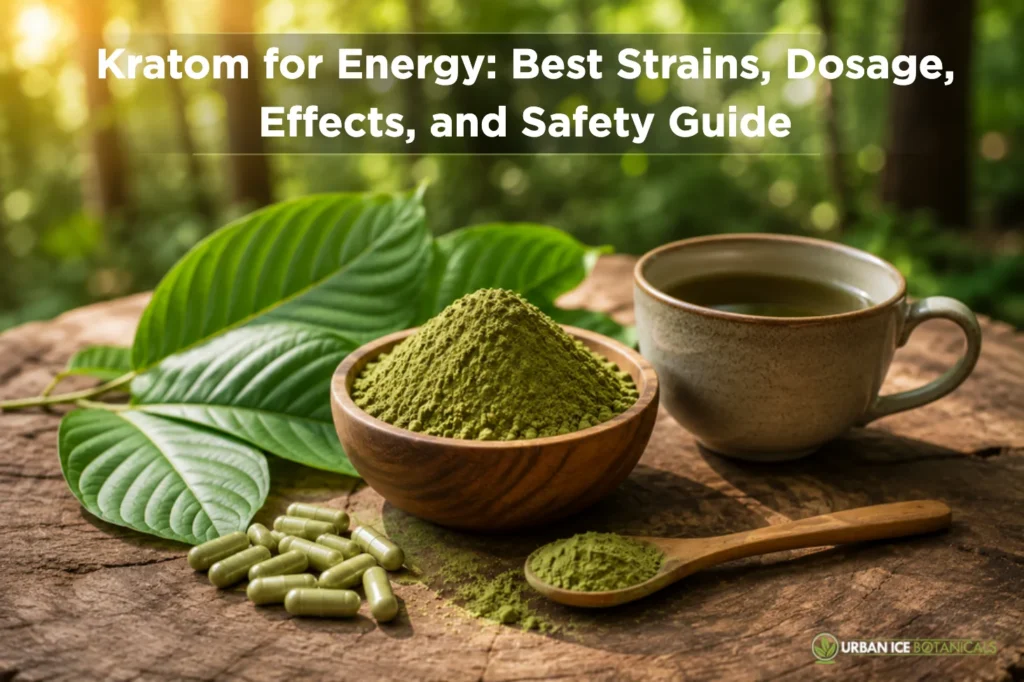
Kratom is widely used by people seeking increased energy, focus, motivation, and mental clarity during work, study, and other daytime activities, though effects vary and are not guaranteed. These effects are most often associated with specific white vein and green vein strains, with alkaloid content, dosage, product quality, and individual tolerance all shaping the experience. Popular options such as White Maeng Da, White Thai, Green Maeng Da, and Green Malay are frequently discussed for their potential to support productivity and concentration.
Choosing the right strain involves more than a name. Vein color, mitragynine content, serving size, product form, and safety all influence how a product affects alertness and focus. This guide compares white and green vein varieties, explains dosage considerations, covers potential side effects and safety risks, and outlines the factors that help users make informed decisions when evaluating kratom for energy.
What Is Kratom for Energy?
Kratom for energy refers to kratom strains that users commonly associate with alertness, focus, motivation, and mental clarity. Rather than being a separate type of kratom, these effects are typically linked to factors such as vein color, alkaloid content, strain selection, and dosage, with white-vein kratom and certain green-vein strains most frequently discussed for daytime energy and productivity.
This user-reported pattern is backed by research. According to a 2024 study published in JAMA Network Open that tracked 357 regular kratom users over 15 days of real-time smartphone reporting, increasing energy and focus were among the most common reasons participants used kratom, and most reported feeling energized, focused, or alert shortly after (Smith et al., 2024).
Among the strains associated with this effect, White Maeng Da, White Thai, Green Maeng Da, and Green Malay are the most popular choices. However, product quality, serving size, and individual tolerance mean that results vary from person to person. Ultimately, strain type, alkaloid profile, and dosage together form the foundation for choosing the best kratom for energy and focus.
Does Kratom Give You Energy?
Yes, kratom can provide energy, focus, and motivation for some users, particularly at lower doses (1-5 grams), with white vein and certain green vein strains most commonly chosen for daytime use. Animal research supports kratom’s dose-dependent profile: a 2021 rat study in Frontiers in Pharmacology found low-dose kratom produced antidepressant-like effects while both low and high doses produced analgesia (Buckhalter et al., 2021)
Results vary based on alkaloid content, product quality, and individual tolerance, so energy effects are not guaranteed for every user. According to a case report published in Annals of Internal Medicine: Clinical Cases (Alomar et. al., 2025), over half of 42,000 social media comments analyzed cited kratom for its energy-boosting effects, highlighting why dosage and strain selection matter when evaluating kratom for energy support.
Is Kratom an Upper or a Downer?
Kratom acts as both an upper and a downer, with its effects determined by strain, alkaloid profile, and dose. At lower doses, it produces stimulating, focus-oriented effects, while higher doses bring on relaxation and sedation. As per the New York State Department of Health, this happens because mitragynine, kratom’s primary alkaloid, interacts with adrenergic and serotonergic receptors to drive stimulant-like effects at lower doses, while mu-opioid receptor activity takes over at higher doses, producing opioid-like sedation. White vein and some green vein strains are commonly used for energy and mental clarity in smaller amounts, while larger doses of the same product shift the experience toward relaxation. Kratom, therefore, carries both stimulant and depressant properties, with the dose deciding which one dominates.
Why Some Kratom Feels More Energizing Than Others
Kratom strains feel different because mitragynine, the alkaloid most tied to energy and focus, varies with vein color, leaf maturity, and processing, typically running 1% to 2% by weight in raw leaf (extracts can reach 45% or more, which is why they behave so differently). Three factors drive the energy profile: alkaloid composition, vein color, and dosage. White vein, harvested from younger leaves, carries a higher mitragynine share and is most associated with energy and alertness. Green vein sits in between for a steadier lift. Red vein from mature leaves has a higher overall alkaloid density and more sedating compounds, making it the least suited for energy. Lower doses favor stimulation; higher doses of the same strain shift toward sedation.
Alkaloids That Influence Energy, Focus, and Sedation
Kratom contains more than 40 identified psychoactive alkaloids, but only a handful meaningfully shape the energy-related experience. Mitragynine accounts for 60% to 66% of the total alkaloid content in dried kratom leaves and is the compound most associated with energy, alertness, and mental clarity. Paynantheine, the second most abundant alkaloid at roughly 9%, and speciogynine, at around 7%, are believed to contribute to a smoother, less jittery form of stimulation. 7-hydroxymitragynine and speciociliatine, by contrast, account for only about 1% to 2% of the total alkaloid content but exhibit far greater potency at opioid receptors, thereby pulling the overall effect toward sedation. Rather than any single compound determining how a strain feels, this combined ratio is what shapes the final profile.
Mitragynine vs 7-Hydroxymitragynine for Energy
Mitragynine and 7-hydroxymitragynine are the two most studied kratom alkaloids, but they pull the experience in different directions. Mitragynine is the dominant alkaloid by far, present at roughly 60-66% of the total alkaloid content, and is the primary driver of energy, focus, and daytime productivity. Strains marketed for energy, such as White Maeng Da or White Thai, tend to carry a higher mitragynine-to-alkaloid ratio.
7-hydroxymitragynine, by comparison, occurs naturally at trace levels, under 2% of total alkaloid content, but binds opioid receptors with far greater potency than mitragynine. This outsized potency relative to its small share is why it is linked more to sedation and pain relief than to clean, sustained energy. For someone choosing kratom specifically for energy, total mitragynine content and the overall alkaloid balance matter more than the 7-hydroxymitragynine level alone.
How Dose Changes Kratom’s Energy Profile
Dosage is one of the most important factors in how kratom feels, regardless of strain. Lower doses (1-5 grams) are more consistently linked to energy, focus, and motivation, while higher doses (5-15+ grams) of the same product shift toward relaxation and reduced stimulation as opioid receptor activity takes over from adrenergic stimulation.
A strain like White Maeng Da illustrates this well, since it may feel energizing and productivity-oriented at a lower serving size but noticeably more sedating as the serving size increases. Individual tolerance, product potency, and batch-to-batch alkaloid variation, which published lab analyses show can differ substantially even within the same strain name, further shape how each dose feels. Because of this variability, no fixed dosage guarantees energy-related effects for every user.
Which Kratom Veins Are Best for Energy?
White and green vein kratom are generally the best choices for energy, with mitragynine content typically running around 1.3% to 1.8%, compared to roughly 1.0% to 1.4% in red vein kratom, a gap that, along with leaf maturity and processing, explains why red strains are typically associated with less stimulating effects. That said, vein color is only a starting point, since alkaloid content, dosage, product quality, and individual tolerance all influence the overall experience, and lab testing shows mitragynine levels can vary by several percentage points even within the same strain name depending on the batch.
White Vein Kratom for Strong Energy
White vein kratom is widely regarded as the most energy-focused kratom category, largely because it is harvested earlier in the leaf’s growth cycle, which preserves a higher mitragynine-to-alkaloid ratio while keeping 7-hydroxymitragynine, the more sedating alkaloid, at minimal levels. Many users choose white vein strains for alertness, concentration, motivation, and daytime productivity, with effects often reported within 15 to 30 minutes of use.
Popular options such as White Maeng Da, White Thai, and White Borneo are frequently recommended for users looking for stronger energy support. Because white vein kratom can feel more stimulating, it is often best suited for daytime use and may require careful dose management, particularly for new or sensitive users.
Green Vein Kratom for Balanced Energy and Focus
Green vein kratom is commonly viewed as a balanced option that combines energy, focus, and mood support, with mitragynine levels in a similar 1.2% to 1.4% range to white vein, but a higher proportion of secondary alkaloids like paynantheine and speciogynine, rounding out the experience. Many users choose green strains when they want sustained productivity without the stronger stimulation sometimes associated with white vein kratom.
Strains such as Green Maeng Da, Green Malay, and Green Thai are popular among users seeking steady energy and mental clarity. Green Malay, in particular, has been shown to have among the highest total alkaloid content among common strains, which may contribute to its reputation for a fuller, more sustained effect. Compared with white vein kratom, green vein kratom are often described as smoother and more balanced, making them a common choice for work, study, and other daily activities.
Red Vein Kratom and Why It Is Less Energy-Focused
Red vein kratom is the least energy-focused of the three main vein types, since its mitragynine content typically runs lower, around 1.0% to 1.4%, while its share of 7-hydroxymitragynine and paynantheine, the alkaloids most tied to relaxation and muscle relief, runs higher than in white or green vein leaves. This shift happens because red vein leaves are harvested at full maturity, which produces greater overall alkaloid density but a lower mitragynine-to-alkaloid ratio, the ratio that drives stimulation.
For this reason, red vein kratom is not typically the first choice for users specifically searching for the best kratom for energy. Those prioritizing focus, motivation, and daytime performance often gravitate toward white or green vein strains instead. While red vein kratom remains popular within the broader kratom market, they are usually discussed for purposes other than energy support.
White Vein vs Green Vein Kratom for Energy
| Factor | White Vein | Green Vein |
| Alertness | Higher | Moderate |
| Focus | High | High |
| Productivity | High | High |
| Intensity | Higher | Moderate |
| Beginner Friendly | Lower | Higher |
| Long-Term Use | Moderate | Higher |
Which Kratom Strains Are Best for Energy?
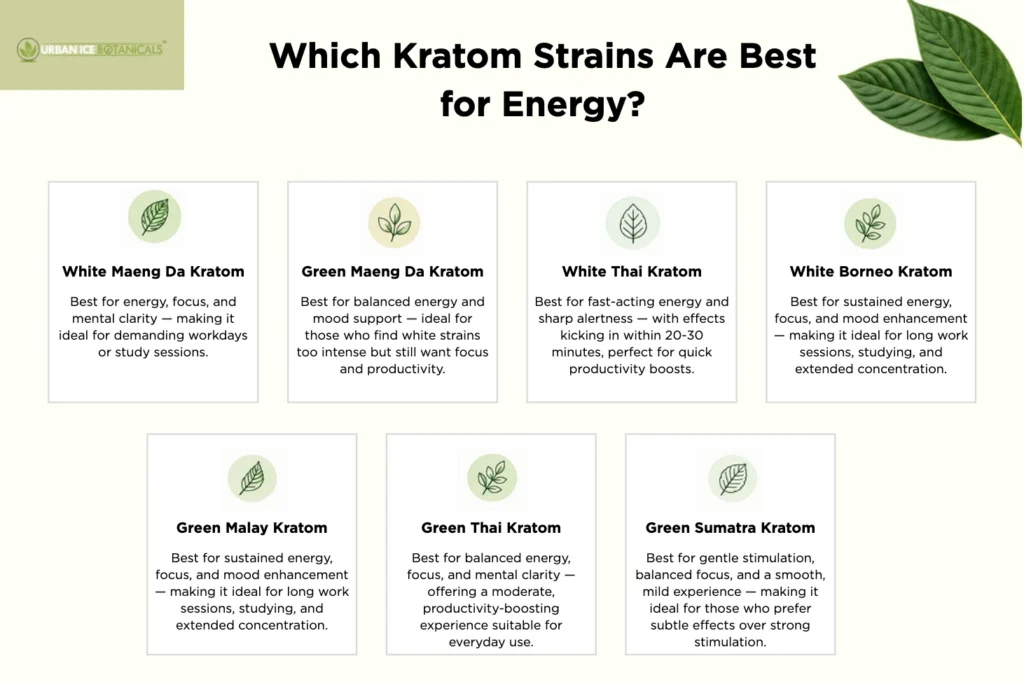
White Maeng Da, White Thai, White Borneo, Green Maeng Da, and Green Malay are generally considered the best kratom strains for energy. However, individual strains can still offer different levels of energy, focus, and motivation depending on cultivar, harvest region, and processing. These strains have developed strong reputations among users for their association with productivity, mental clarity, and daytime performance, though effects can vary with dosage, alkaloid content, and individual response.
White Maeng Da Kratom
White Maeng Da is one of the most popular energy-focused kratom strains available, known for carrying a notably higher mitragynine concentration than other white vein strains. Users often choose it for its strong alertness, concentration, and motivation, with many reporting effects that outlast those of other white strains by a few hours. It is frequently recommended for demanding workdays, study sessions, and situations that require sustained mental focus.
Because of its reputation for stimulation, White Maeng Da is often considered one of the strongest white-vein options. New users may benefit from starting with a lower serving size, often in the 1-2.5 gram range, to assess their response before increasing it.
Green Maeng Da Kratom
Green Maeng Da is commonly chosen by users seeking a balance between energy and mood support. It typically provides a smoother experience than White Maeng Da while still offering noticeable focus and productivity benefits, owing to a mitragynine content closer to the 1.2%-1.4% range typical of green-vein strains.
Many users view Green Maeng Da as a versatile daytime strain because it combines mental clarity with a more balanced profile. This makes it a popular option for individuals who find white strains too intense.
White Thai Kratom
White Thai is frequently associated with fast-acting energy and heightened alertness, with users often reporting effects within 20 to 30 minutes due to its higher mitragynine-to-alkaloid ratio. Many choose this strain for a stimulating experience that supports concentration and productivity throughout the day.
Its energetic profile, often described as sharper than White Borneo but shorter-lived than White Maeng Da, has made White Thai a common recommendation among experienced users seeking stronger daytime stimulation.
White Borneo Kratom
White Borneo is often described as providing clean energy and mental clarity without the intensity some users associate with White Maeng Da, in part because it has a somewhat lower mitragynine concentration while maintaining low 7-hydroxymitragynine levels. Many people choose it when they want focus-oriented effects that feel more manageable and balanced.
Because of its reputation for smoother stimulation, White Borneo is frequently discussed as an option for users seeking productivity without excessive intensity.
Green Malay Kratom
Green Malay is one of the most widely recognized green vein strains for sustained energy and focus, and lab analyses have found it can carry some of the highest total alkaloid content of any commonly tested strain. Users often describe it as providing balanced stimulation combined with a positive mood profile.
Its popularity stems from its reputation for delivering steady daytime performance, making green malay kratom a common choice for work, studying, and extended periods of concentration.
Green Thai Kratom
Green Thai is commonly selected for balanced energy, focus, and mental clarity, with mitragynine levels in the 1.2% to 1.4% range typical of green vein strains. Compared with White Thai, it is generally considered less stimulating yet still supportive of productivity and motivation.
Many users choose Green Thai for a moderate-energy profile that often lasts several hours and remains suitable for everyday use, without the intensity of white vein strains.
Green Sumatra Kratom
Green Sumatra is often viewed as a milder energy-focused strain, typically carrying a lower mitragynine concentration than Green Malay or Green Maeng Da. Users commonly associate it with gentle stimulation, balanced focus, and a smoother overall experience.
For individuals who prefer subtle effects over strong stimulation, Green Sumatra may be an approachable option in the green vein category, particularly for those newer to green vein strains.
Kratom Energy Selection Matrix
Choosing the best kratom for energy depends on your specific goal. Some users prioritize strong stimulation and productivity, while others prefer balanced focus that feels smoother throughout the day. Rather than searching for a single “best” strain, it is often more useful to match a strain’s profile to the outcome you want to achieve.
The strains below are commonly discussed in relation to different energy-related goals. Individual experiences can vary based on dosage, alkaloid content, tolerance, and product quality.
| Strain | Energy Level | Focus Level | Duration | Beginner Friendly |
| White Maeng Da | High | High | Medium | Moderate |
| White Thai | High | Medium | Medium | Low |
| White Borneo | Medium-High | High | Medium | Moderate |
| Green Maeng Da | Medium | High | Medium-Long | High |
| Green Malay | Medium | High | Long | High |
| Green Thai | Medium | Medium-High | Medium | High |
| Green Sumatra | Low-Medium | Medium | Medium | High |
The best strain often depends less on strength and more on the specific outcome a user wants to achieve.
Best Kratom for Energy by Goal
Different energy goals often require different strain characteristics. Matching a strain to a specific use case can make the selection process easier than simply choosing the strongest available option.
| Goal | Recommended Strain Type |
| Morning Energy | White Maeng Da |
| Office Productivity | Green Maeng Da |
| Studying | Green Malay |
| Long Workdays | Green Malay |
| Strong Stimulation | White Thai |
| Smooth Focus | White Borneo |
| Beginners | Green Sumatra |
Best Kratom for Beginners
Many new users start with green-vein strains because they are often considered more balanced than white-vein options. Green Malay and Green Sumatra are commonly discussed as beginner-friendly choices due to their reputation for providing focus and energy without excessive stimulation.
Most beginner guides recommend starting at 1 to 2 grams and waiting 45 to 60 minutes to assess the effect before considering more. Starting at this lower end can help users understand how a particular strain affects them before considering stronger energy-focused options.
Best Kratom for Work and Productivity
Users seeking productivity often look for strains that support concentration, motivation, and sustained mental clarity. Green Maeng Da and Green Malay are among the most frequently discussed options because they are commonly associated with balanced energy and focus that can last several hours without a sharp comedown.
These strains are often chosen for office work, studying, project-based tasks, and situations that require consistent attention without feeling overly stimulating, typically at doses in the 2-4 gram range.
Best Kratom for Long Focus Sessions
Green Malay has developed a strong reputation among users seeking extended periods of focus and productivity, helped by its comparatively high total alkaloid content among commonly tested strains. Many users describe it as providing a steady energy profile that remains suitable for workdays, study sessions, and other mentally demanding activities.
Its balanced nature makes it a popular alternative for individuals who find stronger white vein strains too intense for prolonged use during a multi-hour session.
Best Kratom for Strong Stimulation
White Maeng Da and White Thai are commonly discussed among users looking for stronger energy-oriented effects, both carrying a higher mitragynine-to-alkaloid ratio than other white vein strains. These strains are frequently associated with alertness, motivation, and mental engagement, making them popular choices for demanding tasks and active schedules.
Because stronger stimulation may not suit everyone, dose management becomes especially important with these strains, and beginners should stay closer to 1 to 2 grams, even with stronger strains.
Best Kratom for Smooth Daytime Energy
Some users prefer energy support that feels balanced rather than intense. White Borneo, Green Thai, and Green Sumatra are often selected for this reason, generally carrying a lower mitragynine concentration than strains like White Maeng Da or Green Malay. These strains are commonly associated with mental clarity and productivity while maintaining a more moderate stimulation profile.
For users who want focus and motivation without pursuing the strongest available energy effects, these strains are often among the most discussed options, typically at moderate doses of around 2 to 3 grams.
Kratom Dosage for Energy
Dosage is one of the most important factors affecting how kratom feels. As per a clinical study published in PMC examining kratom’s drug interaction potential, kratom leaf preparations produce dose-dependent effects, with doses of roughly 1 to 5 grams producing a mild stimulating effect comparable to caffeine, while doses of about 5 to 15 grams shift toward opioid-like effects (Tanna et al., 2023). The ideal amount can still vary based on body weight, tolerance, strain potency, and product form, so dosage should be viewed as a general guideline rather than a universal rule.
- Beginner Energy Dose: 1-2 Grams
A serving of 1 to 2 grams sits at the low end of the stimulant range identified in clinical research and is often discussed as a starting point for users who are new to kratom. At this level, users can evaluate how their bodies respond to a particular strain while minimizing the risk of adverse effects associated with higher doses.
This range is commonly chosen when the goal is to assess effects on focus, alertness, and energy. - Moderate Energy Dose: 2-4 Grams
Many users consider 2 to 4 grams a common range for balancing energy and focus, still within the roughly 1 to 5 gram window associated with stimulant-like effects in clinical research. Depending on the strain and individual tolerance, this amount may provide noticeable stimulation while remaining suitable for daytime activities.
White vein kratom and green vein strains are frequently used within this range by individuals seeking productivity and concentration. - Higher Dose Range: 4-5 Grams
At 4 to 5 grams, users are approaching the upper edge of the stimulant-dose range, and effects may become stronger and more variable between users. While some individuals continue to report energy-related effects, others may notice an earlier shift away from stimulation with increasing dose.
Tolerance, strain selection, and alkaloid content often become more significant factors as dosage increases. - Doses to Avoid for Energy: 5 Grams and Above
Doses above roughly 5 grams move into the range that clinical research associates with opioid-like effects rather than stimulation. Many users report that larger amounts are more likely to reduce alertness and increase the likelihood of side effects such as nausea, dizziness, or discomfort.
For users specifically seeking energy, focus, and productivity, increasing dosage beyond this point may not necessarily improve results and can lead to a noticeably different, more sedating experience.
Which Kratom Product Form Is Best for Energy?
Powder is generally the best kratom form for energy because it allows the most precise serving control, with adjustments possible in increments as small as 0.5 grams, and a faster onset than capsules since there is no shell to dissolve first. That said, the right format still depends on personal preference, lifestyle, and experience level. Kratom capsules offer convenience and consistent 0.5-gram servings for users who dislike the taste of powder, extracts concentrate mitragynine to roughly 5% to 45% or more for experienced users comfortable verifying potency through lab results, and shots offer portability but often deliver doses, sometimes 30mg of mitragynine or more, well above a typical 1-gram powder serving.
- Kratom Powder
Kratom powder is one of the most popular formats because it allows flexible serving sizes and relatively fast use, with raw leaf typically carrying about 1% to 2% mitragynine by weight. Users can mix the powder with water, juice, or other beverages, making it easy to adjust the amount to suit individual preferences.
Many experienced users prefer kratom powder for energy-focused routines because it provides greater control over dosage, often in 0.5-gram increments. Since serving sizes can be measured precisely, users can fine-tune their intake to support alertness, focus, and productivity. - Kratom Capsules
Kratom capsules contain around 0.5 grams of kratom powder each, offering convenience and simplicity since servings are pre-measured and easy to track without weighing or mixing. Reaching a typical 2-4 gram serving usually requires 4-8 capsules.
Although capsules may take longer to take effect than powder, often by 15 to 30 minutes, because the capsule shell must dissolve first, many users choose them for portability and consistent dosing. Kratom capsules are particularly popular among individuals who dislike the taste of kratom powder, since the shell masks its bitterness. - Kratom Extracts
Kratom extracts concentrate alkaloids from kratom leaves, with mitragynine levels running roughly 5% to 45% or more, well above the 1% to 2% typical of raw leaf. Because of this, even a serving of less than 0.5 grams can deliver the alkaloid equivalent of several grams of standard powder, so extracts require careful dosing.
Vendors often label extracts with an “x” ratio, like 10x or 50x, but this reflects how much raw leaf was used, not the final alkaloid percentage, and can vary in strength between brands. Kratom extracts are best suited for experienced users who verify potency through lab-tested percentages rather than the ratio alone. - Kratom Shots
Kratom shots are liquid products designed for convenience and rapid consumption. They are commonly used by individuals who want a portable option that requires no preparation.
Because many kratom shots contain concentrated kratom extracts, with some products delivering 30mg or more of mitragynine per serving compared to the roughly 10 to 20mg found in a typical 1-gram serving of raw powder, users should pay close attention to serving information and alkaloid content. While the convenience is appealing, the concentrated nature of some products may increase the risk of consuming more alkaloids than intended.
Kratom vs Coffee for Energy
Kratom and coffee are both commonly discussed in conversations about energy and productivity, but they work through different mechanisms. Coffee derives its stimulating effects from caffeine, typically around 95mg per cup, which blocks adenosine receptors in the brain to override the signal of tiredness. Kratom instead relies on alkaloids like mitragynine, which act on adrenergic and serotonergic receptors rather than adenosine, producing a different kind of stimulation entirely.
Although some users compare kratom energy to coffee, the two products should not be viewed as direct equivalents. Differences in onset, duration, stimulation profile, and individual response can lead to very different experiences.
Does Kratom Have Caffeine?
No, kratom does not naturally contain caffeine. The stimulating effects some users report come from kratom’s alkaloids, primarily mitragynine, rather than caffeine.
This distinction matters because many people assume that any energy-related product must contain caffeine. While kratom and coffee may both be used for alertness and focus, they rely on entirely different active compounds and brain pathways to get there.
Kratom vs Caffeine: Onset, Duration, Jitters, and Crash
Coffee is widely known for its rapid onset, with effects typically felt within 15 to 30 minutes as caffeine blocks adenosine receptors. However, that same mechanism is behind its drawbacks. Because adenosine keeps building up behind the blockade the entire time, many users experience a noticeable crash once caffeine wears off, along with jitters or anxiety if intake runs high.
Kratom’s onset of noticeable effects often begins within 10 to 30 minutes, with peak plasma concentration typically reached around an hour, but users often describe the comedown as smoother than coffee’s. Because mitragynine works through adrenergic and serotonergic pathways rather than blocking adenosine, there is no adenosine backlog waiting to hit once the effects fade, which is why kratom is more often described as tapering off gradually rather than crashing. That said, individual response still varies significantly based on strain, dosage, and alkaloid content, so neither option can be universally considered better for energy.
How Fast Does Kratom Work for Energy?
Kratom’s effects begin within 10 to 30 minutes, with peak plasma concentration reached around an hour after a single dose. However, onset can shift based on product form, serving size, metabolism, food intake, and individual physiology. Some users report noticing effects sooner when using powder or liquid products, while capsules may take longer because they must first dissolve.
Taking kratom on an empty stomach may also speed up the onset, although this approach can increase the likelihood of stomach discomfort for some individuals. Product quality and alkaloid concentration can further affect how quickly effects are perceived.
Because multiple factors influence onset, there is no exact timeframe that applies to every user. The same strain may produce noticeably different experiences depending on how it is consumed and the circumstances surrounding its use.
How Long Does Kratom Energy Last?
Kratom’s energy-related effects last around 2 to 6 hours, though duration can vary based on strain type, dosage, alkaloid content, product form, metabolism, and tolerance. Some users report longer-lasting effects from certain green vein strains, while others find that product strength has a greater impact than strain name alone.
Dosage also plays a role. Larger amounts (over 5 grams) may shift the overall experience toward sedation rather than energy. In comparison, lower amounts within the 1 to 5 gram stimulant range are more commonly associated with energy-focused use and a comparatively shorter, more alert-feeling window. Tolerance developed through frequent use can further influence both intensity and duration.
Since individual responses differ considerably, no fixed duration applies to every strain or every user. Product quality, serving size, and personal physiology all contribute to how long energy-related effects may be perceived.
How to Use Kratom for Energy Safely
Using kratom for energy safely means starting at a low serving of 1 to 2 grams, monitoring individual response, avoiding frequent dosage increases, and checking for interactions if you take prescription medications. Factors such as timing, serving size, frequency of use, and individual tolerance can all influence the overall experience, and even energy-focused strains may produce different effects when used inconsistently or in larger amounts than intended.
Because mitragynine is processed by the liver enzymes CYP3A4 and CYP2D6, the same pathways that metabolize many prescription medications, anyone taking prescription drugs, particularly opioids, benzodiazepines, or antidepressants, should talk to a doctor before using kratom, as interactions can alter how those medications are processed.
Best Time of Day to Take Kratom for Energy
Morning and early afternoon are generally the best times to take kratom for energy, since effects last around 2 to 6 hours and align with daytime alertness, focus, and productivity needs. White vein kratom and green vein kratom are commonly selected for morning routines, work schedules, and study sessions because they are generally associated with daytime use.
Taking stimulating strains later in the evening may not align with everyone’s routine, particularly for individuals who are sensitive to energizing effects or whose sleep schedule falls within that multi-hour window. Personal response and daily schedule should be considered when determining timing.
Empty Stomach vs With Food
Food intake can influence how quickly kratom effects are perceived. Some users report a faster onset, within the typical 10 to 30 minute window, when taking kratom on an empty stomach, while others prefer taking it with food to reduce the likelihood of stomach discomfort.
Neither approach is universally better. Individual digestion, product type, and personal tolerance often determine which method feels more comfortable and effective.
How Often to Use Kratom Without Building Reliance
Most experienced users take kratom no more than 2 to 3 times per week, or every other day, to avoid building tolerance, keeping it to an intermittent schedule rather than daily use and avoiding serving-size increases as effects fade. Staying at or below 3-4 days per week helps prevent significant tolerance development, and avoiding daily use is the pattern most experienced users follow.
Frequent use may reduce the perceived effects over time. As tolerance develops, the same serving may produce less noticeable energy and focus than it did initially, which is why increasing the amount is generally discouraged. When tolerance does build, many users take a 1-2 week break to restore sensitivity rather than use more. Most users report that taking a 7 to 14-day break restores most of their original sensitivity.
Why Tolerance Can Reduce Energy Effects
Tolerance develops because mitragynine acts on mu-opioid and adrenergic receptors, and repeated activation leads those receptors to desensitize and downregulate. As the receptors adapt to ongoing exposure, the energy, focus, or motivation previously felt at a given serving becomes less pronounced.
This often prompts users to increase the serving size to chase the original effect. Because larger amounts saturate more receptors and accelerate this adaptation, increasing the serving tends to accelerate tolerance rather than restore the effect. Higher doses saturate more receptors, triggering faster adaptation. Monitoring frequency of use and keeping serving sizes consistent are more reliable ways to maintain energy-related effects over time.
What Factors Affect Kratom’s Energy Effects?
Kratom’s energy effects are shaped mainly by strain type, alkaloid content, vein color, product form, serving size, user tolerance, and product quality, which is why the same strain can feel more stimulating for one person than another. Physiology adds further variation, so identical products can still produce different outcomes. Understanding these variables helps explain the range of energy-related experiences across users.
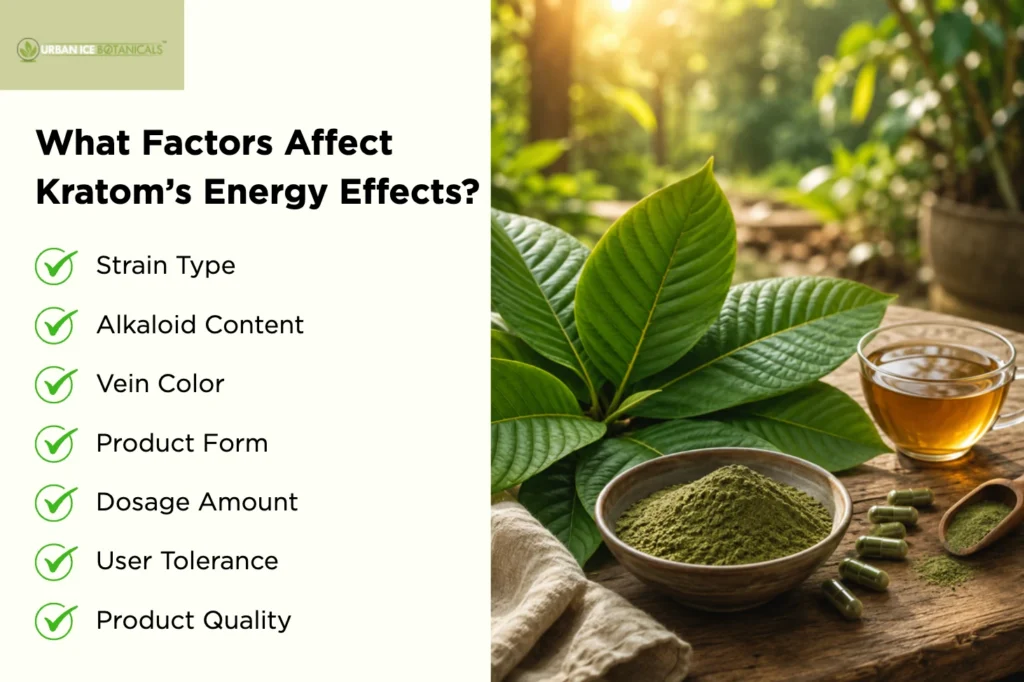
- Strain Type
Different kratom strains have distinct alkaloid profiles, and varieties like White Maeng Da, Green Malay, and White Thai are commonly discussed for energy and focus, while others are selected for other purposes. That said, strain names are only a starting point, since product quality and actual alkaloid content often play a larger role than the name alone. - Alkaloid Content
Alkaloids are the active compounds in kratom leaves, and products with different alkaloid concentrations may produce noticeably different experiences even when they share the same strain name. Mitragynine content is often the focus when evaluating energy-oriented products because it is the most abundant alkaloid present in kratom. - Vein Color
White, green, and red vein kratom are associated with different user-reported experiences, with white vein frequently linked to stronger stimulation, green vein described as more balanced, and red vein generally less associated with energy-focused use. Vein color offers a useful reference point but should be weighed alongside strain, alkaloid content, and product quality rather than relied on alone. - Product Form
Powders, capsules, extracts, and liquid shots differ in potency, convenience, and onset, with extract-based products often containing higher alkaloid concentrations than standard powders. The chosen format can influence both dosing precision and the overall experience. - Dosage Amount
Serving size is one of the most important variables affecting kratom’s energy profile, with lower amounts more commonly associated with alertness and focus, and larger amounts producing a different experience. Because potency varies among manufacturers, serving-size guidance should always be approached with caution. - User Tolerance
Tolerance can influence both the intensity and duration of perceived effects, so users with established tolerance may respond differently to the same serving size than someone new to kratom. This variation is a key reason identical products can produce different outcomes across users. - Product Quality
Product quality strongly affects consistency and reliability, shaped by alkaloid content, manufacturing standards, storage conditions, and laboratory testing. Products that undergo third-party testing and share transparent quality information tend to offer greater consistency than those with limited quality controls.
What Are the Side Effects of Using Kratom for Energy?
Kratom’s potential side effects include nausea and dizziness, increased heart rate and blood pressure, dependence and withdrawal, liver toxicity, seizures, heavy metal contamination, and drug interactions, with likelihood and severity varying by dosage, product quality, frequency of use, individual sensitivity, and combination with other substances. Users pursuing energy effects often assume lower doses eliminate risk, but unwanted effects can occur at any serving size. Understanding these risks helps users recognize when a product or serving size may not be suitable for them.
- Nausea and Dizziness
Nausea is one of the most commonly reported side effects of kratom use, and some users also experience dizziness, particularly at larger serving sizes or when trying a new strain for the first time. These effects may be more noticeable in people sensitive to kratom or using products with higher alkaloid concentrations, so starting with a lower serving size can help users assess their tolerance. - Increased Heart Rate and High Blood Pressure
Some users report elevated heart rate or temporary increases in blood pressure after using stimulating strains, with energy-focused varieties like white vein more likely to produce these effects in sensitive individuals. Anyone with a cardiovascular condition should consult a qualified healthcare professional before using kratom or any substance intended to influence energy levels. - Dependence and Addiction
Regular use may lead to physical dependence in some individuals, occurring because kratom’s alkaloids act on mu-opioid receptors and the body adapts to repeated activation, making it harder to stop without unwanted symptoms. The risk generally increases with frequent use, higher serving sizes, and long-term consumption, and while dependence is not inevitable, it remains an important consideration for regular users. - Withdrawal Symptoms
Individuals who develop dependence may experience withdrawal symptoms after reducing or stopping kratom, including irritability, restlessness, fatigue, sleep disturbances, and mood changes. Severity varies considerably between individuals and may depend on duration of use, serving size, and frequency of consumption. - Liver Toxicity
Although uncommon, there have been reports linking kratom use to liver-related adverse events, with possible symptoms including fatigue, dark urine, abdominal discomfort, or yellowing of the skin and eyes. Anyone experiencing symptoms that suggest liver dysfunction should seek medical attention promptly. - Seizures and Overdose Risk
Seizures have been reported in association with kratom use, particularly when large amounts are consumed or when kratom is combined with other substances, though the exact cause is not always clear, given the multiple factors that may be involved. Exceeding the recommended serving size or combining kratom with alcohol, medications, or other substances may increase safety risks. - Heavy Metals and Contamination
Product quality is a real concern, and some kratom products have tested positive for contaminants like lead, nickel, and Salmonella due to poor manufacturing and sourcing. A 2018 FDA and CDC investigation linked Salmonella-contaminated kratom to 199 illnesses across 41 states. Choosing products that undergo independent laboratory testing helps reduce the risk of contamination and offers greater transparency about product quality. - Drug Interactions
Kratom may interact with prescription medications, over-the-counter products, and dietary supplements, since its alkaloids affect the CYP3A4 and CYP2D6 metabolic pathways that process many drugs. Individuals who take medications regularly should consult a healthcare professional before using kratom to evaluate potential interactions.
What Else Should You Know Before Using Kratom for Energy?
Before using kratom for energy, the main things to know are that effects are dose-dependent (more is not stronger energy), large servings raise side-effect risk, a post-use energy crash is possible, and legal status varies by location. Understanding these considerations helps users evaluate products more realistically and avoid common misconceptions about energy-related use.
- Sedative Thresholds
Kratom’s effects are dose-dependent, with smaller servings of roughly 1 to 5 grams more commonly associated with alertness and focus, and larger servings above that range tending to feel more sedating than stimulating. This is the main reason that increasing the serving size does not produce stronger energy effects and can have the opposite effect past a certain point. - Dangerous Dosage Boundaries
Separate from the sedation shift, very large amounts raise the likelihood of side effects and adverse reactions regardless of how they feel. Because potency varies considerably between products, there is no universal safe threshold, so following product-specific serving guidance and avoiding unnecessary increases is the more reliable way to limit risk. - Kratom Energy Crash
Some users report a drop in energy once the effects wear off, with intensity varying by strain, serving size, tolerance, and individual physiology. Not everyone experiences this, but knowing that post-use fatigue is possible is useful when evaluating energy-focused products. - Legal Status in the United States
Kratom is legal at the federal level but regulated inconsistently across the country, with some states, counties, and municipalities enacting restrictions or outright bans while most others allow it. Because these laws change frequently, users should verify the current legal status of kratom in their specific location before purchasing or using any product.
How to Choose the Best Kratom for Energy
To choose kratom for energy, start with a clear goal and match it across vein color, strain, product form, serving size, and manufacturing quality, since no single strain guarantees an outcome, and the strongest option is rarely the best fit. Some users want strong stimulation for demanding tasks, while others want balanced energy for sustained focus, and matching the strain to that intended use is more useful than defaulting to the most potent product available. Buying from a trusted kratom vendor helps users compare lab-tested options, product forms, and strain details before choosing.
- Choose White or Green Vein First
Start by narrowing options by vein color, the quickest filter. Pick white vein for stronger stimulation, alertness, and motivation, or green vein for more balanced energy and focus. If you want maximum daytime energy, begin with white vein; if you want steadier productivity, try green vein options like Green Malay or Green Maeng Da. - Match the Strain to Your Energy Goal
Within your chosen vein color, select a specific strain by reputation. Go with White Maeng Da or White Thai for stronger stimulation, or Green Malay or Green Maeng Da for balanced focus during long work sessions. Choosing by intended outcome narrows the field and sets realistic expectations for how it will feel. - Pick the Right Product Format
Match the format to how you plan to use it. Choose powder for precise serving adjustments, capsules for consistency and portability, or extracts for concentrated alkaloid content. A format that fits your routine makes it easier to maintain consistent serving sizes and avoid unnecessary increases. - Stick to Low Doses for Energy
Start low and adjust gradually rather than reaching for larger amounts. Increasing the dose does not reliably increase stimulation and can shift the experience toward sedation, so a conservative serving lets you gauge how a strain affects you before raising intake. - Check AKA GMP Certification
Confirm the vendor participates in the American Kratom Association’s Good Manufacturing Practices program, which requires stricter manufacturing, testing, and quality-control standards. Treat it as added confidence in manufacturing and consistency, but not a guarantee of effectiveness. - Verify Third-Party Lab Testing
Check for independent, batch-specific lab testing before buying, and avoid vendors that cannot provide it. A valid report verifies alkaloid content and screens for contaminants like heavy metals and bacteria, giving you a far more reliable quality signal than marketing claims.
What to Look for in a Kratom Vendor
Before buying, check for AKA GMP participation, third-party lab reports (COAs), transparent strain labeling, clear batch numbers, and real customer reviews across multiple platforms, since the same strain can vary in consistency, potency, and purity depending on the supplier. Use these five signals to separate reputable vendors from companies that share little about their products.
- AKA GMP Certification
Confirm the vendor participates in the AKA GMP program, which requires manufacturing and quality-control standards aimed at consistency and safety. Treat participation as a sign of quality assurance, but remember it speaks to how a product is made, not how effective it is, so pair it with the checks below. - Third-Party Lab Reports
Ask for a Certificate of Analysis (COA) and do not buy from vendors that cannot produce one. Verify that it confirms the advertised alkaloid content and screens for contaminants such as heavy metals and bacteria, and prioritize a current, batch-specific report over any marketing claim about quality. - Transparent Strain Labeling
Check that the label clearly states strain name, product format, and serving information before purchasing. Treat vague or incomplete labeling as a warning sign, since it makes products hard to compare and suggests the vendor is withholding details. - Clear Batch Numbers
Look for a batch number on the product and confirm it matches the COA to ensure the testing documentation applies to the exact batch you are buying. A vendor that cannot connect a product to its specific lab results offers no real traceability, regardless of other claims. - Real Customer Reviews
Read reviews across independent platforms, not just the vendor’s own site, where testimonials are curated. Look for a large volume of detailed feedback and watch for recurring mentions of consistency, potency, and shipping reliability, which reveal more than a handful of five-star ratings.
FAQs About Kratom for Energy
What kratom is best for energy?
White Maeng Da, White Thai, Green Maeng Da, and Green Malay are among the most commonly discussed strains for energy and focus. The best option depends on individual goals, tolerance, and preferred level of stimulation.
Which kratom gives you the most focus?
Many users associate Green Maeng Da and Green Malay with focus-oriented effects because they are often described as providing balanced energy and mental clarity.
Is white or green kratom better for energy?
White vein kratom is generally associated with stronger stimulation, while green vein kratom is often viewed as more balanced. The better choice depends on whether the user prefers maximum alertness or steady productivity.
How much kratom should I take for energy?
Many users start with a lower serving of around 1 to 2 grams and adjust gradually, since lower amounts are generally more compatible with energy-focused goals than larger ones. Individual response varies with product strength, tolerance, and physiology, and no standardized clinical dose exists.
Can kratom make you tired instead of energized?
Yes, larger serving sizes of kratom may produce noticeably more sedating effects than smaller amounts. Individual response, strain selection, and tolerance also influence the experience.
Does kratom cause an energy crash?
Some users report feeling less energetic after the effects wear off, while others notice no real crash. The likelihood and intensity vary based on dosage, strain type, and individual physiology.
Is kratom safer than coffee?
No, kratom is not established as safer than coffee, and the two are not directly comparable. Both act as stimulants at lower doses, but kratom acts on opioid receptors and carries documented dependence, withdrawal, and contamination risks that coffee does not. Caffeine has its own risks, but a much longer safety record. Which is safer depends on dosage, health status, and frequency of use.