Skip to main content


Bali Kratom is a commercial category of products derived from Mitragyna speciosa, a tropical tree native to Southeast Asia. It is commonly sold as Red Bali, Wild Red Bali, Green Bali, and White Bali in powder, capsule, and extract forms. These names represent commercial classifications rather than standardized botanical varieties. Bali products contain alkaloids including mitragynine and 7-hydroxymitragynine (7-OH), but concentrations vary among products, batches, and preparations, meaning strain names alone cannot reliably predict chemical composition, potency, or effects.
Research associates kratom with dose-dependent stimulant-like and sedative or opioid-like effects, alongside potential adverse effects including nausea, dizziness, rapid heart rate, dependence, withdrawal, seizures, and liver injury. Responsible use therefore involves reviewing labels, checking laboratory testing, understanding product concentration, avoiding risky drug combinations, monitoring tolerance, and seeking medical guidance when appropriate. FDA warns consumers about kratom-related adverse events and particularly advises avoiding products containing added or enhanced 7-OH, distinguishing these concentrated products from naturally occurring trace 7-OH in kratom leaf.
What Is Bali Kratom?
Bali Kratom is an herbal product made from crushed or powdered leaves of the tropical Mitragyna speciosa tree, a species native to Southeast Asia, including Indonesia. The term “Bali” commonly functions as a commercial category rather than a formally recognized botanical classification. Products carrying this label can vary in leaf material, processing methods, alkaloid content, and preparation.
Research indicates that Bali-labeled kratom products can vary in their alkaloid profiles, meaning the label alone may not accurately reflect the chemical characteristics of a particular product. One laboratory study measured 0.011% 7-hydroxymitragynine in a methanolic Bali extract, compared with 0.052% in a Red Maeng Da extract. Similarly, Huisman et al. (2023) found no significant differences in mitragynine (p = 0.362) or total alkaloid content (p = 0.500) among six commercial products, including Green Bali and Red Bali. These findings suggest that commercial strain labels may not reliably indicate a product’s specific alkaloid composition.
Where Does Bali Kratom Come From?
Despite its name, Bali Kratom does not actually grow on the island of Bali. Instead, it primarily originates from the Borneo region of Indonesia and is a specific commercial blend of Mitragyna speciosa leaves. The Bali name is tied more to historical trade and commercial distribution than to the plant’s exact growing location. Producers source leaves from kratom-growing areas across Indonesian Borneo, then process and market the resulting products under the Bali designation based on established naming practices within the kratom industry.
What Are the Different Types of Bali Kratom?
The different types of Bali Kratom include Red Bali, Wild Red Bali, Green Bali, and White Bali Kratom. These commercial categories are distinguished primarily through product naming, sourcing, and processing rather than established botanical classifications. Research also shows that color or strain labels do not necessarily correspond to distinct chemical profiles. Huisman et al. (2023) analyzed six commercial products, including Red Bali and Green Bali, and found no significant differences in mitragynine (p = 0.362) or total alkaloid content (p = 0.500) across the products tested.
Red Bali Kratom
Red Bali Kratom is an herbal supplement made from the leaves of the tropical Mitragyna speciosa tree that some users consume for relaxation and pain relief, though health authorities warn that kratom carries serious health risks. It is commercially classified as a red-vein Bali kratom rather than a standardized botanical type. Boffa et al. (2018) detected 24 alkaloids in the Red Bali sample, compared with 11 in each of four other varieties, and measured total alkaloids at 9.84 mg/g of leaf material. These findings describe the tested sample rather than a universal Red Bali composition.
Wild Red Bali Kratom
Wild Red Bali Kratom is a red-vein variety of Mitragyna speciosa harvested from mature, uncultivated trees growing naturally in the JongKong region of Indonesia rather than on commercial farms. The “wild” designation describes its reported sourcing method, not a recognized botanical classification or standardized chemical profile. A 2026 Boise State University study included commercial Wild Red Bali alongside Green Bali and White Bali to examine the stability of mitragynine, 7-hydroxymitragynine, speciogynine, speciociliatine, and paynantheine. Its inclusion as a commercial sample does not establish “wild” as a chemically distinct kratom type (Johnson et al., 2026).
Green Bali Kratom
Green Bali Kratom is a popular, balanced herbal strain of Mitragyna speciosa harvested from mid-maturity leaves and differentiated from Red and White Bali primarily through its green-vein naming and processing practices. Huisman et al. (2023) analyzed three batches labeled Green Bali and reported mean concentrations of 1.44% mitragynine and 2.28% total measured alkaloids. Yet, the study found no statistically significant differences in mitragynine or total alkaloid concentrations across the six commercial products examined, indicating that Green Bali labeling does not consistently correspond to a distinct alkaloid composition.
White Bali Kratom
White Bali Kratom is an herbal powder made from early-harvested leaves of the Mitragyna speciosa tree, native to Southeast Asia. It is commonly marketed for energizing, focused, and uplifting effects and distinguished from Red and Green Bali by its white-vein designation and processing practices. Research specifically characterizing White Bali remains limited, although laboratory testing confirms measurable alkaloid content. A 2025 certificate of analysis for one commercial White Bali powder reported 1.50% mitragynine (source: Columbia Laboratories). This result represents the tested product and does not establish a standardized chemical profile for White Bali.
What Alkaloids Are Found in Bali Kratom?
Bali Kratom contains naturally occurring alkaloids found in Mitragyna speciosa, including mitragynine, 7-hydroxymitragynine (7-OH), speciociliatine, speciogynine, and paynantheine. Boffa et al. (2018) detected 24 alkaloids in the Red Bali sample, compared with 11 in each of four other kratom varieties analyzed. Mitragynine was more abundant than paynantheine in that Red Bali extract, although alkaloid proportions can vary with geographic origin, maturity, and ecotype. More broadly, over 45 kratom alkaloids have been isolated, with mitragynine receiving particular attention as the major alkaloid and 7-OH as a more potent μ-opioid receptor-active compound.
Mitragynine
Mitragynine is the major alkaloid in Mitragyna speciosa and a principal compound studied in kratom research. A validated UPLC-MS/MS study reported concentrations ranging from 0.7% to 38.7% by weight across analyzed kratom materials (source: Sharma et al., 2019). It acts at the μ-opioid receptor (MOR) while interacting with other central nervous system targets. It can also be metabolized into 7-hydroxymitragynine, which shows greater MOR potency in experimental research. One study reported EC₅₀ values of 339 nM for mitragynine and 34.5 nM for 7-hydroxymitragynine, an approximately tenfold difference in potency in that assay (Kruegel et al., 2019).
7-Hydroxymitragynine
7-Hydroxymitragynine, commonly called 7-OH, is a minor alkaloid naturally associated with Mitragyna speciosa and occurs at much lower concentrations than mitragynine in analyzed kratom material. Sharma et al. (2019) reported 0.01%–0.04% by weight in the kratom products and extracts they analyzed. Research has also shown that mitragynine can be metabolized into 7-hydroxymitragynine through CYP3A-mediated metabolism. Experimental pharmacology indicates that 7-OH has substantially greater μ-opioid receptor potency than mitragynine. Its concentration can vary between products, so the amount of 7-OH should not be inferred from the Bali Kratom label alone.
Why the Alkaloid Ratio Matters in Kratom?
The alkaloid ratio matters because the relative amounts of mitragynine, 7-hydroxymitragynine (7-OH), and other alkaloids can influence a kratom product’s pharmacological activity and make products with similar labels chemically different. Todd et al. (2020) analyzed 53 commercial kratom products and identified two distinct chemical profiles, demonstrating measurable product variation. Mitragynine can account for up to 66% of total alkaloids (EUDA, n.d.), while 7-OH showed approximately 10-fold greater μ-opioid receptor potency than mitragynine in vitro (Kruegel et al., 2016). Therefore, individual alkaloid concentrations provide more chemical information than strain or color labels alone.
Looking for a Bali Kratom Products?
Our Bali Kratom collection includes a variety of Bali kratom products, making it easy to find the format that best fits your preferences.
What Forms Does Bali Kratom Come In?
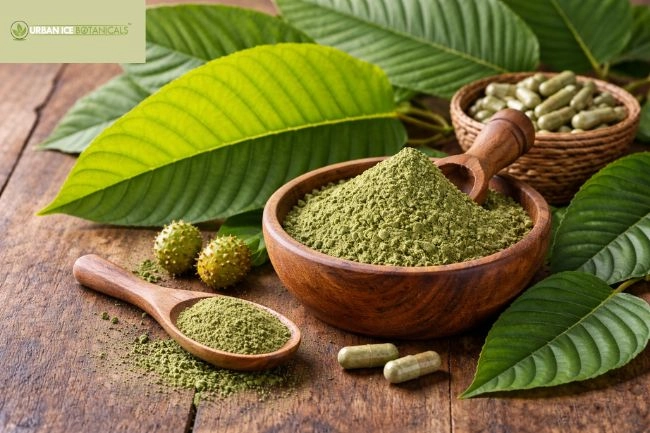
Bali Kratom comes in powder, capsules, and extracts, with each form differing in preparation, concentration, convenience, and measurement. Powder consists of ground kratom leaf, capsules contain measured quantities of kratom material, and extracts contain concentrated plant constituents. Research confirms substantial differences among commercial formulations. Sharma et al. (2019) measured mitragynine concentrations ranging from 0.7% to 38.7% across leaf-derived preparations, extracts, and commercial products, demonstrating why product form and alkaloid concentration should be considered separately.
Bali Kratom Powder
Bali Kratom powder consists of dried, ground Mitragyna speciosa leaf material and is sold as a loose plant preparation. Because it is not divided into individual units, the amount of material in a serving depends on how the powder is measured. Fowble and Musah (2019) analyzed commercially available kratom products and reported 3.16–13.66 mg/g of mitragynine in powdered products. Their broader analysis of 16 commercial samples found mitragynine concentrations ranging from 2.76 to 20.05 mg/g across different plant materials and formulations. These findings show why the alkaloid concentration of an individual product should not be inferred from the Bali label alone.
Bali Kratom Capsules
Bali Kratom capsules contain measured quantities of kratom material enclosed in capsule shells, providing individual units without separately measuring loose powder. Capsules may contain ground leaf or more concentrated preparations. Prozialeck et al. (2020) examined commercial kratom products that included capsules containing approximately 400–600 mg of finely ground leaf material per capsule. Sharma et al. (2019) found 4.7%–8.7% mitragynine in most capsule formulations analyzed, while one concentrated OPMS capsule product contained 38.7%. These findings show why capsule count alone cannot establish alkaloid concentration or product strength.
Bali Kratom Extracts
Bali Kratom extracts are concentrated preparations produced by extracting alkaloids and other constituents from Mitragyna speciosa. Their composition can differ substantially from plain-leaf products. Sharma et al. (2019) measured 6.24% mitragynine in an ethanolic kratom extract and 33.59% in an alkaloid-rich fraction, demonstrating how concentration can differ by preparation. Manwill et al. (2022) also found that one encapsulated alkaloidal preparation contained approximately 10-fold higher alkaloid concentrations than the other commercial products tested. These findings show why stated alkaloid concentrations and laboratory results provide more useful information than an extract label or ratio alone.
What Are the Potential Side Effects of Bali Kratom?

Potential side effects of Bali Kratom include nausea, vomiting, dizziness, drowsiness, constipation, agitation, rapid heart rate, seizures, respiratory depression, liver injury, dependence, and withdrawal. WHO-reviewed poison-center data document gastrointestinal, neurological, and cardiovascular effects following kratom exposure, while clinical literature identifies less common serious outcomes. Most available research evaluates kratom generally rather than Bali-labeled products specifically, so current evidence does not establish that Bali Kratom has a distinct side-effect or safety profile compared with other kratom products.
Below are the most common reported side effects of Bali Kratom:
- Nausea and Vomiting
Gastrointestinal symptoms are among the more commonly documented effects of kratom exposure. WHO-reviewed poison-center data found nausea in 14.6% and vomiting in 13.2% of 1,174 single-substance cases (WHO, 2022). These percentages represent reported poison-center exposures, not incidence among all users, and current evidence does not show that Bali Kratom causes these symptoms more frequently than other kratom products.
- Dizziness and Drowsiness
Neurological effects reported after kratom exposure include dizziness, sedation, and drowsiness. Poison Control identifies dizziness and drowsiness among mild reported effects, while WHO-reviewed data recorded drowsiness or lethargy in 14.3% of single-substance cases (WHO, 2022). Severity may vary by product composition, amount consumed, individual response, and other substances used. No Bali-specific incidence rate has been established.
- Constipation
Digestive changes associated with kratom use can include constipation, alongside nausea and vomiting. Poison Control recognizes constipation as a reported mild effect of kratom exposure, although reliable population-level estimates of its frequency are unavailable. Current scientific evidence also does not establish that products labeled Bali Kratom cause constipation at a different rate from other kratom varieties or formulations.
- Agitation and Rapid Heart Rate
Behavioral and cardiovascular effects appear relatively frequently in poison-center reports involving kratom. Among 1,174 single-substance cases, 22.9% involved agitation or irritability, 21.4% tachycardia, and 10.1% hypertension (WHO, 2022). These figures describe reported exposures rather than risks among typical users, and available evidence does not demonstrate a distinct cardiovascular profile for Bali-labeled kratom.
- Seizures
More serious neurological events have been reported, although causation remains uncertain. A 2025 systematic review identified 20 patients with seizures across 11 peer-reviewed publications, but only one had quantitative confirmation of mitragynine exposure (Turla et al., 2025). The authors concluded that current evidence is insufficient to establish a causal relationship between kratom and seizures, and no Bali-specific risk has been demonstrated.
- Respiratory Depression
Severe exposures have occasionally involved impaired breathing. WHO-reviewed data identified respiratory effects in 12.1% of kratom toxic-effect cases, while respiratory arrest occurred in 0.5% of 1,174 single-substance cases (WHO, 2022). Interpretation becomes more complicated when opioids, benzodiazepines, or other substances are involved. There is currently no evidence establishing a distinct respiratory-depression risk for Bali Kratom.
- Liver Injury
Liver injury is a rare but clinically documented serious adverse effect associated with regular kratom use. NIH LiverTox reports that acute liver injury generally develops within 1–8 weeks after starting regular kratom use, with symptoms potentially including fatigue, nausea, itching, dark urine, and jaundice. The injury is typically cholestatic or mixed and can occasionally become severe (LiverTox, 2020). Current clinical evidence does not identify Bali Kratom as having a greater or lesser liver-injury risk than other kratom preparations.
- Dependence and Withdrawal
Regular kratom use can lead to dependence and withdrawal in some individuals. Li et al. (2023) analyzed 489 kratom-related FDA adverse-event reports and found that 53 reports (10.8%) mentioned drug dependence and 26 (5.3%) mentioned withdrawal syndrome. These percentages describe spontaneous reports and cannot be interpreted as prevalence among all kratom users. The study also identified disproportionate reporting signals for dependence and withdrawal, but available evidence does not establish that Bali Kratom carries a different dependence risk from other kratom products.
How Does Bali Kratom Compare With Other Kratom Varieties?
Bali Kratom differs from Maeng Da, Yellow Kratom, and other kratom varieties mainly through commercial naming, color designation, sourcing, and processing practices rather than proven botanical distinctions. Laboratory research shows that products carrying different strain names can have overlapping alkaloid profiles. In one study, Red Bali, Green Bali, Red Maeng Da, Green Maeng Da, White Maeng Da, and White Thai showed no statistically significant differences in mitragynine or total measured alkaloid concentrations.
The table below summarizes the key differences between these kratom varieties:
| Comparison Factor | Bali Kratom | Maeng Da Kratom | Yellow Kratom |
| Classification | Commercial regional/strain designation | Commercial strain designation | Commercial color designation |
| Common Variants | Red, Green, White, Wild Red | Red, Green, White | Yellow or Gold-labeled products |
| Origin | Commonly associated with Indonesian kratom and commercial Bali naming | Commercial name associated with Southeast Asian kratom | Not tied to one specific geographic origin |
| Potency | Cannot be predicted reliably from the Bali name | Maeng Da labeling does not guarantee greater potency | Cannot be determined from color alone |
| Effects | Relaxation and winding down | Energy, alertness, and focus | Balanced, mood-oriented use |
| Best Time to Take | Evening or later in the day | Morning or daytime | Daytime or early evening |
Bali Kratom vs. Maeng Da
Bali Kratom is generally marketed as smoother and more relaxation-oriented, whereas Maeng Da is commonly marketed as stronger and more stimulating. These descriptions reflect commercial positioning and user reports rather than scientifically standardized effects. Laboratory research has found overlapping alkaloid profiles among Bali and Maeng Da products, with no statistically significant differences in mitragynine or total measured alkaloid concentrations across several tested commercial samples. Product composition and batch-specific alkaloid content therefore provide stronger chemical comparisons than strain names alone.
Bali Kratom vs. Yellow Kratom
Bali Kratom is generally categorized through regional and vein-color names, while Yellow Kratom is primarily distinguished by its yellow designation and associated processing practices. Bali products commonly include Red, Green, and White varieties, while Yellow Kratom may involve differently processed or blended leaf material. Neither name represents a formally recognized botanical strain with a fixed chemical composition. Alkaloid concentrations can vary between individual products, making laboratory analysis more reliable than color or strain labeling for chemical comparison.
Red Bali vs. Green Bali vs. White Bali
Red Bali is generally marketed for more relaxing effects, with Green Bali positioned as more balanced and White Bali as more stimulating or energizing. The reported characteristics represent commercial classifications and user experiences rather than guaranteed pharmacological outcomes. Research comparing commercial color varieties has found differences in self-reported effects, but laboratory studies have not consistently identified corresponding differences in alkaloid concentrations. Red, Green, and White Bali should therefore be distinguished primarily by labeling and processing rather than assumed potency or predictable effects.
What Should You Know About Bali Kratom Dosage?
When discussing Bali Kratom dosage, the most important consideration you should know is that kratom’s effects can be dose-dependent, with lower amounts associated with stimulant-like effects and larger amounts associated with sedative or opioid-like effects. Reviews describe 1–5 g as associated with stimulant effects and 5–15 g with sedative effects, although these are reported ranges rather than established dosing recommendations (Eastlack et al., 2020).
There is no scientifically established dosage specifically for Bali Kratom, and product composition can vary. Grundmann (2017), in a survey of 8,049 kratom users, found that negative effects, particularly nausea and constipation, were mainly associated with 5 g or more per dose and 22 or more doses per week. These findings highlight the importance of considering amount, frequency, and product composition rather than relying on the Bali strain name alone.
How Can Bali Kratom Be Used Responsibly?
Responsible Bali Kratom use centers on reviewing product information, checking laboratory results, understanding concentration, avoiding risky combinations, monitoring tolerance or dependence, storing products properly, and seeking medical guidance when needed. These measures can reduce uncertainty but do not make kratom risk-free. FDA continues to warn about serious adverse events and contamination in some kratom products.
7 Key practices for responsible Bali Kratom use include:
- Review the Product Label
Check the label for ingredients, product form, serving information, batch identification, and disclosed mitragynine or 7-OH concentrations. This is especially important for extracts because concentrated preparations may differ substantially from plain leaf. FDA specifically advises consumers to avoid products containing added or enhanced 7-OH, including certain tablets, gummies, drink mixes, and shots.
- Check for Laboratory Testing
Independent laboratory testing can provide information about alkaloid concentrations and contaminants that cannot be determined from the Bali name alone. FDA tested 30 commercial kratom products and identified concerns about lead and nickel levels in multiple samples. One Red Bali product contained 10,700 ng/g nickel and 352 ng/g lead, illustrating the value of product-specific testing.
- Avoid Risky Combinations
Avoid combining kratom with other substances that may increase or complicate its effects, particularly opioids and sedating drugs. FDA notes that deaths associated with kratom have generally involved other drugs, although kratom’s contribution is often unclear. Discuss kratom use with a healthcare professional when taking prescription medicines because potential interactions and combined effects may be difficult to predict.
- Understand Product Concentration
Distinguish plain-leaf Bali Kratom from extracts and products containing concentrated or enhanced 7-OH. Do not assume equal quantities of different formulations provide equivalent alkaloid exposure. FDA specifically distinguishes natural kratom leaf from products containing added or enhanced 7-OH, which it describes as potent opioid products that consumers should avoid.
- Monitor Tolerance and Dependence
Pay attention to increasing frequency, needing larger amounts to obtain the same effects, difficulty reducing use, or withdrawal symptoms after stopping. FDA reports cases of kratom-related substance use disorder involving tolerance, cravings, withdrawal, using more than intended, and continued use despite adverse consequences. These signs warrant reducing risk and discussing use with a qualified healthcare professional.
- Store Kratom Properly
Keep Bali Kratom in its original, clearly labeled container and out of reach of children and others who could accidentally consume it. Follow manufacturer storage instructions concerning heat, moisture, and light where provided. Extra care is appropriate for concentrated products, particularly gummies, tablets, liquids, and other formulations that could be mistaken for conventional foods or beverages.
- Seek Medical Advice When Needed
Speak with a healthcare professional when taking medications, managing medical conditions, experiencing adverse effects, or having difficulty reducing kratom use. FDA has associated kratom with serious reported adverse events including liver toxicity, seizures, substance use disorder, dependence, and withdrawal. Severe symptoms such as seizures, breathing problems, or loss of consciousness require urgent medical attention.
Is Bali Kratom Legal in the United States?
Yes, botanical Bali Kratom is not currently controlled under the federal Controlled Substances Act, but its legal status varies at the state and local levels. DEA states that kratom itself is not federally controlled, although some jurisdictions have adopted restrictions or prohibitions. FDA has not approved kratom for medical use and states that it cannot lawfully be marketed as a dietary supplement or added to conventional foods. Before purchasing or possessing Bali Kratom, check applicable rules because kratom legality can change by jurisdiction. Federal authorities also distinguish traditional botanical kratom from concentrated 7-OH products.
State and Local Kratom Laws
As of September 2026, kratom laws vary by state and locality, falling broadly into jurisdictions that permit botanical kratom, jurisdictions that regulate its sale through age or product requirements, and jurisdictions that prohibit or restrict certain kratom substances. DEA confirms that kratom itself is not federally controlled but notes that state regulations or prohibitions may apply. Federal action concerning elevated 7-OH also does not automatically determine each state’s treatment of botanical kratom, making current state and local law the controlling reference.
Where Can You Buy Kratom Legally Online?
Kratom can be purchased online only where the buyer’s jurisdiction permits the particular product and the seller complies with applicable requirements. Before ordering, verify state and local restrictions, any applicable minimum-age rules, product labeling, alkaloid disclosures, batch identification, and available laboratory documentation. Buyers looking for a trusted kratom vendor should also review whether the seller provides clear information about sourcing, testing, ingredients, and product composition. FDA states that kratom is not lawfully marketed as a dietary supplement or conventional food and specifically warns against products containing added or enhanced 7-OH.
For a more positive mindset, Bali kratom, especially gold and green varieties, is often selected for its balanced alkaloid composition, which may contribute to gentle mood support while preserving mental clarity. Its effects are commonly described as steady and uplifting rather than intensely euphoric, helping promote emotional balance without overstimulation. This even profile allows many individuals to maintain a brighter outlook while remaining focused and functional throughout daily activities.