Skip to main content


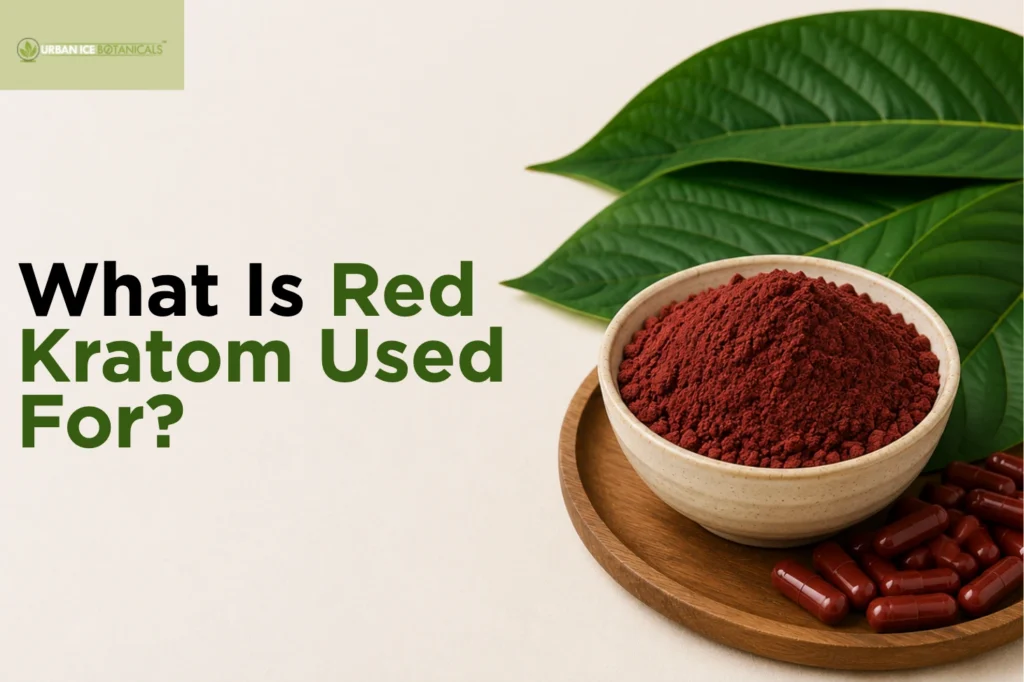
Red kratom is commonly used for managing pain and physical discomfort, promoting relaxation, supporting sleep, improving mood, and self-managing opioid withdrawal symptoms. It is derived from the leaves of Mitragyna speciosa, a tropical tree native to Southeast Asia, and contains naturally occurring alkaloids, including mitragynine and 7-hydroxymitragynine. Although these uses are widely reported by users and traditional communities, red kratom is not approved by the U.S. Food and Drug Administration (FDA) for treating any medical condition.
The effects of red kratom vary depending on the strain, serving size, alkaloid content, product quality, and individual tolerance. Lower servings are generally associated with milder effects, while moderate to higher servings are more often linked to deeper relaxation and body comfort. Some people choose red vein strains to help ease muscle soreness, joint discomfort, post-workout recovery, evening stress, or difficulty winding down before bed, while others report using it during opioid withdrawal. Scientific evidence remains limited, making informed and cautious use important.
Red kratom is most commonly used for:
- Pain Management
- Relaxation and Stress Relief
- Sleep Support
- Opioid Withdrawal Symptom Management
- Mood Balance and Emotional Support
Pain Management
Pain management is one of the most commonly reported reasons people use red kratom, particularly for muscle soreness, joint discomfort, back pain, and general body aches. Grundmann’s 2017 patterns-of-use survey found 68% of respondents use kratom primarily for self-treating pain. In a 2026 briefing to the Washington State Liquor and Cannabis Board, pharmacology professor Oliver Grundmann cited kratom user surveys showing 65 to 85% of respondents use kratom for chronic pain conditions such as arthritis and back pain. This ties to how kratom’s alkaloids interact with opioid receptors. Mitragynine binds to mu, delta, and kappa opioid receptors, giving it analgesic potential with fewer adverse effects than morphine in early studies. Still, one pharmacology study found opioid agonists and 7-hydroxymitragynine relieved pain in rats, while mitragynine alone did not.
Current evidence is limited, and red kratom is not an FDA-approved pain treatment. Servings vary by strain and tolerance, and research hasn’t established a clear dose-response relationship. Higher servings carry a greater risk of drowsiness, nausea, and dependence. Red kratom should not replace medical care for persistent or severe pain.
Red kratom is commonly used for managing:
- Chronic pain
- Muscle soreness
- Joint discomfort
- Back pain
- Neck and shoulder tension
- Arthritis-related discomfort
- Post-workout muscle recovery
- General body aches
- Physical discomfort from strenuous activity
- Temporary pain-related discomfort
Relaxation and Stress Relief
Red kratom is commonly used to promote relaxation and relieve everyday stress, making it a popular choice for unwinding after work or physical activity. A 2018 systematic review by Swogger and Walsh notes that kratom has been reported to produce a calming effect at higher doses and an energizing effect at lower doses. The same review found that relaxation and reduced anxiety appeared in the accounts of 24% of participants in a US-based qualitative study, while 66% of respondents to a large Western survey reported using kratom to relieve negative moods, including anxiety.
Research on kratom’s relaxing effects remains limited, and most evidence comes from user surveys rather than large clinical trials. Reported servings vary by individual and product. There’s no clinical consensus that higher servings reliably produce stronger relaxation. They’re more consistently linked to drowsiness and dizziness. Red kratom should not be considered a treatment for stress, anxiety, or other mental health conditions.
Red kratom is commonly used for:
- Promoting relaxation
- Relieving everyday stress
- Reducing physical tension
- Supporting evening relaxation
- Helping unwind after work
- Encouraging a sense of calm
- Supporting recovery after physical activity
- Relaxing before bedtime
Sleep Support
Red kratom is commonly used to support better sleep and evening relaxation, particularly by people who have difficulty winding down after a busy day. Many users associate red vein strains with calming effects that may help prepare the body for rest. Scientific evidence supporting red kratom specifically for sleep is still limited, and no major health authority recognizes kratom as a treatment for insomnia or other sleep disorders.
Sleep is not actually a leading reason people report using kratom. A Pain News Network survey of 6,150 kratom consumers found only 1.40% used it specifically to treat insomnia, far behind pain and mood-related reasons. Notably, insomnia and disturbed sleep also show up as withdrawal symptoms when people stop using kratom after regular, higher-dose use. Some users report calming or sedating effects at higher servings, but higher servings also raise the risk of next-day drowsiness and dependence, so cautious use matters.
Red kratom is commonly used for:
- Supporting restful sleep
- Promoting evening relaxation
- Helping the body unwind before bedtime
- Encouraging a sense of calm before sleep
- Reducing nighttime physical discomfort
- Supporting better sleep quality (user-reported)
- Relaxing after a physically demanding day
- Winding down before bed
Opioid Withdrawal Symptom Management
Some people report using red kratom to self-manage opioid withdrawal symptoms, including cravings, muscle aches, restlessness, and difficulty sleeping. A Health Affairs Forefront clinical commentary notes that in the US, kratom is used primarily for chronic pain and self-managed opioid withdrawal, though it carries no FDA-approved indication for either use. In a 2026 briefing to the Washington State Liquor and Cannabis Board, pharmacology professor Oliver Grundmann cited kratom user surveys showing 30 to 45% of respondents use kratom to mitigate prescription medicine withdrawal symptoms.
Researchers link this self-reported effect to the activity of mitragynine and 7-hydroxymitragynine at opioid receptors. But the FDA has gone further than “evidence is limited.” In a published warning letter, the FDA stated that kratom products marketed for opioid withdrawal have not been determined safe or effective for that use, and that unproven claims could cause people to delay FDA-approved treatment. Anyone experiencing opioid withdrawal should seek guidance from a healthcare professional rather than relying on kratom alone.
Red kratom is commonly used for:
- Managing opioid withdrawal symptoms
- Reducing opioid cravings
- Easing muscle aches during withdrawal
- Supporting relaxation during withdrawal
- Helping with restlessness
- Supporting sleep during withdrawal
- Managing physical discomfort associated with withdrawal
- Promoting a sense of calm during withdrawal
Mood Balance and Emotional Support
Red kratom is commonly used to support mood balance and emotional well-being, particularly during everyday stress or physical discomfort. Garcia-Romeu et al.’s 2020 survey of 2,798 kratom users found depression and anxiety were motivations for use for 67% and 65% of respondents, respectively. A separate Western survey by Schimmel et al. (2020) found 66% of respondents use kratom to relieve negative moods or mental states, including anxiety, depression, and post-traumatic stress disorder (PTSD).
Research on red kratom’s effects on mood specifically is limited, with most evidence coming from observational studies and user surveys rather than controlled trials. Reported effects vary by strain and tolerance. Higher servings carry a greater risk of drowsiness and dependence rather than a reliably stronger benefit. Red kratom should not substitute for professional treatment of depression, anxiety, or other mental health conditions.
Red kratom is commonly used for:
- Supporting mood balance
- Promoting emotional well-being
- Encouraging a sense of calm
- Relieving everyday stress
- Improving relaxation
- Supporting emotional comfort
- Helping unwind after a stressful day
- Promoting an overall sense of well-being
Red Kratom Strains and Their Specific Uses
The uses of red kratom can vary by strain, with some varieties more commonly associated with pain relief, while others are preferred for relaxation, sleep support, or mood balance. Although all red vein strains come from Mitragyna speciosa, differences in alkaloid content, growing conditions, processing methods, and serving size may influence their reported effects. Most strain-specific information comes from user reports and vendor classifications rather than clinical research, so the sections below explain the most popular red kratom strains and the uses they are commonly associated with.
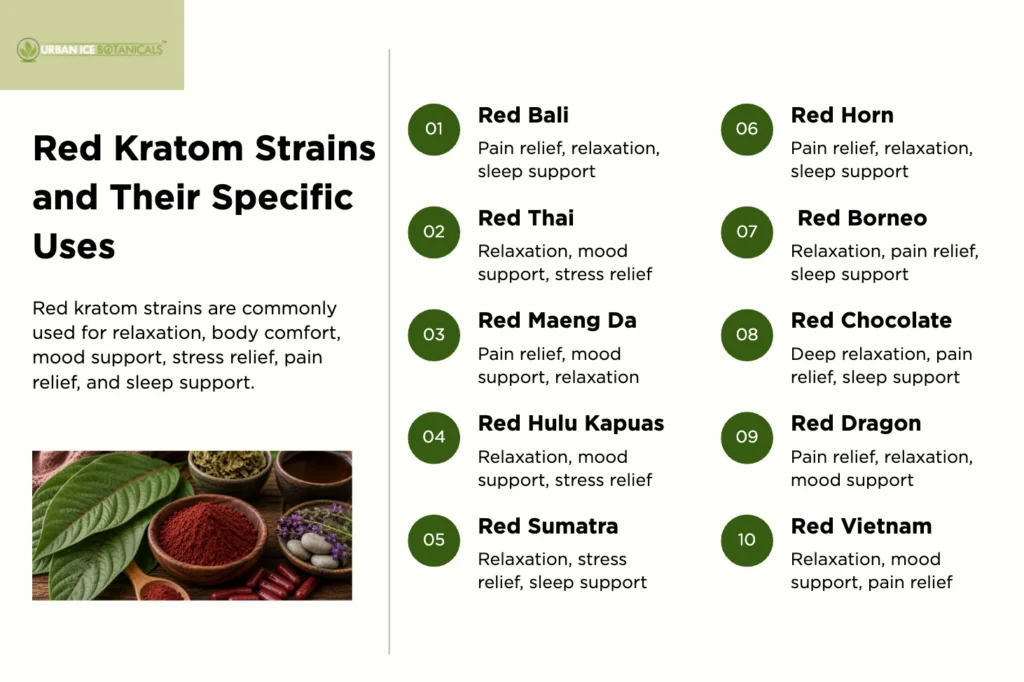
The most commonly used red kratom strains include:
- Red Bali
- Red Thai
- Red Maeng Da
- Red Hulu Kapuas
- Red Sumatra
- Red Horn
- Red Borneo
- Red Chocolate
- Red Dragon
- Red Vietnam
Common Reported Uses of Popular Red Kratom Strains:
| Red Kratom Strain | Common Reported Uses | Common Time of Use | Commonly Reported Serving Preference* |
| Red Bali | Pain relief, relaxation, sleep support | Evening | Moderate to higher servings |
| Red Thai | Relaxation, mood support, stress relief | Daytime to early evening | Low to moderate servings |
| Red Maeng Da | Pain relief, body comfort, long-lasting relaxation | Evening | Moderate to higher servings |
| Red Hulu Kapuas | Relaxation, mood support, body comfort | Afternoon to evening | Moderate servings |
| Red Sumatra | Relaxation, sleep support, stress relief | Evening | Moderate to higher servings |
| Red Horn | Pain relief, relaxation, sleep support | Evening | Moderate to higher servings |
| Red Borneo | Pain relief, relaxation, body comfort | Evening | Moderate to higher servings |
| Red Chocolate | Deep relaxation, sleep support, body comfort | Evening to bedtime | Moderate to higher servings |
| Red Dragon | Pain relief, relaxation, mood support | Evening | Moderate to higher servings |
| Red Vietnam | Relaxation, mood support, body comfort | Daytime to evening | Low to moderate servings |
What Are the Uses of Red Bali Kratom?
Red Bali kratom is one of the most widely recognized red vein strains and is commonly used for pain relief, relaxation, sleep support, and body comfort. Many users also choose it to help ease muscle soreness, joint discomfort, back pain, and everyday stress, making it a popular option for evening or post-activity use.
While Red Bali has not been evaluated as a distinct strain in clinical studies, user reports consistently associate it with balanced, long-lasting effects. Moderate to higher servings are more commonly linked to deeper relaxation and physical comfort, although individual experiences can vary depending on the alkaloid content, product quality, and personal tolerance.
What Are the Uses of Red Thai Kratom?
Red Thai kratom is commonly used for relaxation, mood support, stress relief, and mild body comfort. Many users describe it as providing a balanced experience that promotes calmness without feeling as heavy as some other red vein strains, making it a preferred choice for daytime or early evening use.
Although there is limited scientific research on Red Thai as a specific strain, its reported effects are based primarily on user experiences and vendor classifications. Low to moderate servings are more commonly associated with gentle relaxation and mood support, while higher servings may produce stronger calming effects depending on the alkaloid content, product quality, and individual tolerance.
What Are the Uses of Red Maeng Da Kratom?
Red Maeng Da kratom is commonly used for pain relief, mood support, body comfort, and long-lasting relaxation. Many users choose this strain to help manage muscle soreness, joint discomfort, back pain, and physical fatigue, and it is often regarded as one of the more potent red vein varieties.
Although research has not evaluated Red Maeng Da as a distinct strain, user reports frequently associate it with stronger body-focused effects than many other red kratom varieties. Moderate to higher servings are more commonly selected for deeper relaxation and pain-related discomfort, though the experience can vary based on the alkaloid content, product quality, and individual tolerance.
What Are the Uses of Red Hulu Kapuas Kratom?
Red Hulu Kapuas kratom is commonly used for relaxation, mood support, stress relief, and body comfort. Many users choose this strain for its reported calming effects, making it a popular option for easing everyday stress, physical tension, and discomfort while promoting a balanced sense of well-being.
There is limited scientific research on Red Hulu Kapuas as a distinct strain, and most information comes from user experiences and vendor classifications. Moderate servings are commonly associated with steady relaxation and mood support, while the overall effects may vary depending on the alkaloid content, product quality, serving size, and individual tolerance.
What Are the Uses of Red Sumatra Kratom?
Red Sumatra kratom is commonly used for relaxation, stress relief, sleep support, and body comfort. Many users choose this strain to help unwind after a long day, ease muscle soreness and physical tension, or promote a calmer state before bedtime.
Scientific research has not evaluated Red Sumatra as a distinct strain, so its reported uses are based largely on user experiences and vendor classifications. Moderate to higher servings are more commonly associated with stronger relaxation and sleep support, although the effects can vary depending on the alkaloid content, product quality, serving size, and individual tolerance.
What Are the Uses of Red Horn Kratom?
Red Horn kratom is commonly used for pain relief, relaxation, sleep support, and body comfort. Many users choose this strain to help manage muscle soreness, joint discomfort, physical tension, and evening stress, and it is often regarded as one of the more relaxing red vein varieties.
There is limited scientific research on Red Horn as a distinct strain, and its reported uses are based primarily on user experiences and vendor classifications. Moderate to higher servings are more commonly associated with deeper relaxation and body-focused effects, although the experience can vary depending on the alkaloid content, product quality, serving size, and individual tolerance.
What Are the Uses of Red Borneo Kratom?
Red Borneo kratom is commonly used for relaxation, pain relief, stress relief, and sleep support. Many users choose this strain to help ease muscle soreness, joint discomfort, body aches, and physical tension, making it a popular option for evening use and post-activity recovery.
Research has not evaluated Red Borneo as a distinct strain, so its reported uses are based primarily on user experiences and vendor classifications. Moderate to higher servings are more commonly associated with deeper relaxation and body comfort, although the overall effects can vary depending on the alkaloid content, product quality, serving size, and individual tolerance.
What Are the Uses of Red Chocolate Kratom?
Red Chocolate kratom is commonly used for deep relaxation, pain relief, sleep support, and body comfort. This variety is often made using a fermentation or extended drying process, and many users choose it to help ease muscle soreness, physical tension, and evening stress while promoting a calmer, more relaxed state.
There is limited scientific research on Red Chocolate as a distinct product, and its reported uses are based mainly on user experiences and vendor classifications. Moderate to higher servings are more commonly associated with stronger relaxation, though the effects can vary depending on the processing method, alkaloid content, product quality, serving size, and individual tolerance.
What Are the Uses of Red Dragon Kratom?
Red Dragon kratom is commonly used for pain relief, relaxation, mood support, and body comfort. Many users choose this variety to help manage muscle soreness, physical discomfort, stress, and evening relaxation. Since Red Dragon is often sold as a blend or specially selected red vein product, its reported effects may differ between manufacturers.
Scientific research has not evaluated Red Dragon as a distinct strain, and most information comes from user experiences and vendor classifications. Moderate to higher servings are more commonly associated with stronger body-focused effects, although the experience can vary depending on the blend composition, alkaloid content, product quality, serving size, and individual tolerance.
What Are the Uses of Red Vietnam Kratom?
Red Vietnam kratom is commonly used for relaxation, mood support, pain relief, and body comfort. Many users choose this strain to help ease everyday stress, muscle soreness, physical discomfort, and evening tension, while promoting a calm and balanced experience.
There is limited scientific research on Red Vietnam as a distinct strain, and its reported uses are based primarily on user experiences and vendor classifications. Low to moderate servings are more commonly associated with gentle relaxation and mood support, while higher servings may produce stronger calming effects depending on the alkaloid content, product quality, serving size, and individual tolerance.
Red Kratom Dosage Guide: How Dose Affects Use
The effects of red kratom are commonly described as serving-dependent, but the research behind this is thinner than most guides suggest. A 2022 study in Frontiers in Pharmacology by Smith and colleagues notes that typical kratom doses and the threshold for low versus high-dose effects are not well documented, and within that review, Grundmann’s 2017 survey found beneficial effects clustered at lower doses of 1 to 5 grams when taken 2-3 times a day, while adverse effects became more likely at higher doses (8 g and higher) taken 4-5 times daily.
A 2024 placebo-controlled clinical trial in Psychopharmacology tested isolated mitragynine doses in humans and found the lowest dose, 5 mg, increased subjective ratings of arousal and attention, along with measurable gains in sustained attention, while the highest dose, 40 mg, increased ratings of amnesia and produced mild psychological symptoms (Prevete et al., 2024). No dosage has been approved by the FDA for any use, and product potency varies by batch, so starting with the lowest practical serving is a reasonable way to gauge individual response.
What Are the Uses of Red Kratom at Low Doses?
Low servings of red kratom are commonly associated with mild stimulation rather than heavier body effects. A pharmacokinetics study published in Clinical and Translational Science notes that kratom leaf preparations produce dose-dependent effects, with lower doses of 1 to 5 grams producing a mild stimulating effect comparable to caffeine. This lines up with how some users describe light servings as energizing or mood-lifting rather than sedating, though individual responses vary by strain, alkaloid content, and tolerance.
Current research has not established standardized effects for any specific low serving, and outcomes depend on factors like body weight, metabolism, product quality, and prior kratom use. Starting with a small serving is a reasonable harm-reduction approach for assessing individual tolerance before considering larger amounts.
What Are the Uses of Red Kratom at Moderate Doses?
Moderate servings of red kratom are commonly associated with stronger body-focused effects than lower servings, though the evidence is mostly anecdotal. A University of Illinois Chicago Drug Information Group review, citing the National Institute on Drug Abuse, notes that higher doses of 5 to 15 grams are theorized to produce opioid- or sedative-like effects, although studies have not established dose-dependent effects. Sanderson and Rowe’s 2019 clinical review in CMAJ notes that moderate to heavy daily users, taking three or more doses per day, commonly have cravings and withdrawal symptoms similar to opioid withdrawal upon cessation.
Research has not established a standardized serving range for pain relief, relaxation, or mood support, and responses vary depending on strain, alkaloid content, product quality, body weight, metabolism, and tolerance. As serving size increases, so does the likelihood of drowsiness, nausea, or dizziness, making responsible use and careful adjustments to servings important.
What Are the Uses of Red Kratom at High Doses?
High servings of red kratom are sometimes associated with deep relaxation and stronger body comfort, but the research here points mainly toward risk rather than benefit. A clinical review published via NCBI’s StatPearls notes that kratom’s effects vary dose-dependently, with opioid-like effects appearing at higher doses, and that toxicity typically occurs once intake exceeds 8 grams. Eastlack, Cornett, and Kaye’s 2020 review in Pain and Therapy notes that the symptomology of kratom overdose can mimic the opioid toxidrome, particularly when patients consume more than 15 grams.
Reported toxicities at these higher doses include hepatotoxicity, seizure, coma, lung injury, kidney injury, and cardiotoxicity. Because of these risks, high servings should be approached with caution and should not be used as a substitute for medically approved treatment. Anyone experiencing severe or persistent physical discomfort should consult a healthcare professional rather than increasing their kratom serving size.
Red Kratom Forms: Which to Choose for Your Goals
Red kratom is available in several forms, including capsules, powder, and extracts, each offering different levels of convenience, potency, and serving flexibility. While the primary alkaloids remain the same, the onset, concentration, and ease of measuring servings can vary by product form.
Choosing the right form depends on your experience level, intended use, lifestyle, and preference. For example, some people prefer capsules for convenience, powder for flexible serving sizes, and extracts for their higher concentration. The following sections compare each form to help you understand which option best aligns with your goals while emphasizing responsible use and product quality.
What Are the Uses of Red Kratom Capsules?
Red kratom capsules are commonly used for pain relief, relaxation, mood support, and sleep support, while offering a convenient and pre-measured way to consume kratom. Many users prefer capsules because they are easy to carry, mask the bitter taste of kratom powder, and simplify serving consistency.
The InfantRisk Center at Texas Tech University Health Sciences Center notes that kratom teas and extracts taken on an empty stomach typically have an onset of 10 to 20 minutes, while red kratom capsules taken on a full stomach can delay onset by 1 to 3 hours. The capsule shell itself must dissolve before its contents can be absorbed, which is the main driver of that delay. The overall effects can still vary depending on strain, alkaloid content, serving size, product quality, and individual tolerance.
What Are the Uses of Red Kratom Powder?
Red kratom powder is commonly used for pain relief, relaxation, mood support, sleep support, and body comfort. It is the most traditional form of kratom and allows users to prepare teas, mix it with beverages, or measure servings according to their individual preferences.
A pharmacokinetic study on encapsulated dried kratom leaf powder, published in PMC, found a mean mitragynine half-life of 43.4 hours after a single dose and 67.9 hours after multiple daily doses, indicating that the alkaloids remain in the body considerably longer than the felt effects typically last (Huestis et al., 2024). Accurate serving measurements remain important when using products such as red kratom powders, as effects may vary depending on alkaloid content, serving size, product quality, and individual tolerance.
What Are the Uses of Red Kratom Extract?
Red kratom extract is commonly used for stronger pain relief, deep relaxation, body comfort, and sleep support because it contains a concentrated amount of kratom alkaloids. Many experienced users choose extracts when they prefer a smaller serving volume or a more potent product.
A 2024 study titled “Growing pains with kratom: experiences discussed in subreddits contrast with satisfaction expressed in surveys,” published via PMC, found that users describing extract use often pointed to its greater potency and greater potential for physical dependence compared to leaf products. The researchers note that severity of physical dependence may be greater with concentrated extracts, though no human laboratory studies have confirmed this. Product strength can vary widely between manufacturers, making clear alkaloid labeling and third-party lab testing important when selecting a red kratom extract.
How Does Red Kratom Differ From Green and White Vein?
Red kratom is commonly chosen for pain relief, relaxation, sleep support, and body comfort, while green kratom is generally associated with balanced effects, and white kratom is more often used for energy and focus. All three come from Mitragyna speciosa and contain the same primary alkaloids, mitragynine and 7-hydroxymitragynine, although differences in alkaloid content, harvesting, processing, and product quality may influence their reported effects.
Current research has not established standardized differences between vein colors, and much of the available information comes from user reports and observational evidence. Individual experiences can vary depending on the strain, serving size, alkaloid profile, product quality, and personal tolerance.
| Feature | Red Kratom | Green Kratom | White Kratom |
| Primary reported use | Pain relief, relaxation, sleep support | Balanced energy and relaxation | Energy, focus, alertness |
| Common time of use | Evening or nighttime | Daytime or afternoon | Morning or daytime |
| Body comfort | High | Moderate | Mild |
| Relaxation | High | Moderate | Low |
| Mood support | Moderate | Moderate | Mild to Moderate |
| Reported stimulation | Low | Moderate | High |
| Typical user goal | Unwind, recover, rest | Balanced daily support | Productivity and focus |
What Are the Side Effects and Safety Precautions of Red Kratom?
Red kratom may cause side effects, particularly when taken in higher servings or used frequently over time. A clinical trial protocol notes that adverse events reported in 10% or more of populations across published kratom studies include constipation, dizziness, drowsiness, nausea, vomiting, and appetite loss (Boffa et al., 2018). A narrative health-effects review found nearly 4 out of 5 (78.1%) surveyed kratom users who reported a negative reaction also reported stomach problems (Striley et al., 2022), and a separate survey noted prior research found adverse effects ranging from 0.8% to 76.8% depending on the symptom (Smith et al., 2022). Because its alkaloids interact with opioid receptors, regular use may increase the risk of tolerance, dependence, and withdrawal symptoms. Research has also raised concerns about liver injury, seizures, and contamination with heavy metals or harmful microbes in poorly manufactured products.
To reduce potential risks, choose third-party lab-tested products that provide a Certificate of Analysis (COA) for alkaloid content, heavy metals, and microbial contamination. Red kratom should not be combined with alcohol, opioids, sedatives, or other medications that affect the central nervous system, as these combinations may increase the risk of serious adverse effects. People who are pregnant, breastfeeding, have liver disease, or are taking prescription medications should consult a qualified healthcare professional before using red kratom.
Reported side effects of red kratom are:
- Nausea
- Dizziness
- Drowsiness
- Constipation
- Dry mouth
- Loss of appetite
- Vomiting
- Increased urination
- Sweating
- Itching
Potential long-term risks may include:
- Tolerance
- Dependence
- Withdrawal symptoms
- Liver injury
- Elevated heart rate
- Product contamination
- Drug interactions
- Impaired coordination and judgment
How to Choose the Right Red Kratom Strain?
Choosing the right red kratom strain depends on your intended use, experience level, preferred serving size, and product quality. While strains are commonly marketed for different purposes, their reported effects can also vary because of differences in alkaloid content, cultivation, harvesting, processing methods, and individual tolerance. Focusing on your goals and selecting products from transparent, reputable vendors can help you make a more informed decision.
Since commercial strain names are not standardized by scientific research, it is important to look beyond the label. Prioritize third-party lab-tested products with a Certificate of Analysis (COA) that verifies alkaloid content, heavy metal screening, and microbial safety. Starting with a lower serving and adjusting gradually, if appropriate, may also help reduce the risk of unwanted effects while allowing you to assess your individual response.
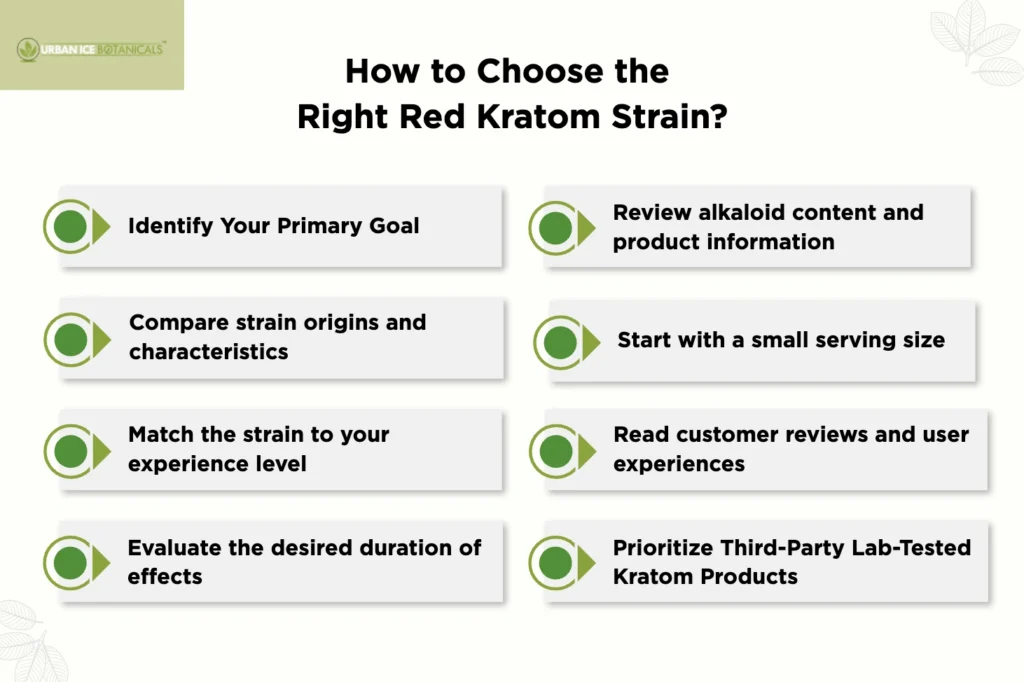
- Identify Your Primary Goal
Start by deciding why you are considering red kratom. Pain and mood support are the two most commonly cited reasons in user surveys, while relaxation, sleep, and general body comfort tend to follow as secondary goals. Naming your goal first makes the rest of these steps easier, since strain marketing, serving size, and even product format (powder, capsule, extract) are usually built around a specific use case. - Compare strain origins and characteristics
Review the reported characteristics of different red kratom strains, but remember that none of these strain names, including Red Bali, Red Maeng Da, or Red Borneo, have been evaluated as distinct strains in clinical research. What you’re comparing is mostly vendor classification and accumulated user reports, not lab-confirmed differences between strains.
- Match the strain to your experience level
If you are new to red kratom, consider starting with a strain users commonly describe as balanced or mild rather than one marketed as especially potent. Pay closer attention to the product form here, too. Capsules have a slower, more predictable onset than powder or extract, which can make them easier to manage as a starting point.
- Evaluate the desired duration of effects
Some strains are reported to provide longer-lasting relaxation, while others may offer a more balanced experience. Duration also depends heavily on form. Extract is generally reported as faster-onset and shorter-duration, while powder and capsules tend to last longer. Higher servings of any form raise the risk of next-day drowsiness, so duration and serving size should be considered together, not separately.
- Review alkaloid content and product information
Choose products that clearly disclose mitragynine content, serving information, batch details, and a Certificate of Analysis (COA). This matters more for red kratom than it might seem: lab analyses of commercial kratom products have found alkaloid concentrations varying substantially between products labeled similarly, so the label alone isn’t a reliable guide to actual strength.
- Start with a small serving size
Beginning with a low serving allows you to assess your individual tolerance before considering larger amounts. This is especially important with extract, where as little as 0.5 grams can produce an effect comparable to 4 to 5 grams of powder, leaving little margin for error if you misjudge the serving.
- Read customer reviews and user experiences
Customer reviews can provide insight into a product’s consistency, taste, packaging, and reported effects, but they reflect individual experience, not controlled testing. Two people using the same product can report different effects for reasons that have nothing to do with the product itself, including body weight, metabolism, and prior tolerance.
- Prioritize Third-Party Lab-Tested Kratom Products
Look for reliable kratom vendors that provide independent laboratory testing for alkaloid content, heavy metals, pesticides, residual solvents, and microbial contamination. A Certificate of Analysis is one of the few objective, verifiable pieces of information available for an unregulated product category, which is why it carries more weight than strain name or marketing copy.
Frequently Asked Questions about Red Kratom
How long does it take for red kratom to work?
Most red kratom users report onset within 10 to 30 minutes for powder or tea taken on an empty stomach, while capsules can take 1 to 3 hours longer because the shell must dissolve first. Extract tends to act faster than powder due to its concentrated alkaloid content, and taking kratom with a full stomach can delay onset regardless of form.
How long do the effects of red kratom last?
Effects of red kratom last 2 to 7 hours, with stimulating effects from lower servings generally fading sooner than the sedating effects associated with higher servings. Duration also depends on strain, metabolism, and alkaloid content, and larger servings tend to extend how long effects are felt while increasing the likelihood of drowsiness.
Can you take red kratom every day?
Daily use of red kratom is generally not recommended because repeated exposure, especially three or more doses per day, has been associated with a higher likelihood of withdrawal symptoms similar to opioid withdrawal upon stopping. Taking breaks between uses may help reduce these risks, although no standardized guidelines exist.
Is red kratom legal in the United States?
The legal status of red kratom depends on state and local laws. Kratom is not federally scheduled as a controlled substance in the United States, but it has been categorized as a “drug of concern” by the DEA, and several states, counties, and municipalities have restrictions or outright bans on its sale and possession.
Can you mix red kratom with alcohol or prescription medications?
Mixing red kratom with alcohol, opioids, sedatives, antidepressants, or other medications that affect the central nervous system may increase the risk of serious adverse effects, including dangerous interactions with drugs processed by the same liver enzymes kratom affects. Consult a healthcare professional before combining kratom with any medication.
How should red kratom be stored?
Store red kratom in an airtight container away from heat, moisture, and direct sunlight to help preserve its alkaloid content and overall quality. Alkaloid content can degrade with prolonged light or moisture exposure, so proper storage also reduces the risk of contamination over time.
What should you look for when buying red kratom?
Choose red kratom products that include third-party laboratory testing, a Certificate of Analysis (COA), clear alkaloid content, batch information, and screening for heavy metals and microbial contamination. Since commercial strain names aren’t standardized or clinically verified, transparent lab testing is a stronger indicator of quality than the strain name or marketing claims alone.
Can beginners use red kratom?
Beginners should start with low servings of red kratom, generally under 5 grams of plain leaf powder, and select products from reputable vendors that provide third-party testing. Individual responses vary, so increasing the serving gradually, if appropriate, can help assess tolerance while reducing the likelihood of unwanted effects.