Skip to main content


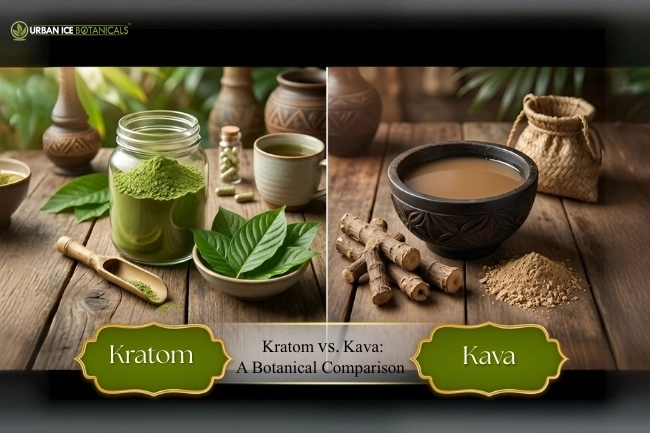
Kava and kratom differ in their botanical families, plant parts, geographic origins, active compounds, and effects. Kava comes from the roots of Piper methysticum, a South Pacific shrub in the Piperaceae family, and contains kavalactones such as kavain and methysticin. These compounds primarily produce calming, muscle-relaxing, and mildly sedating effects. Kratom, on the other hand, comes from the leaves of Mitragyna speciosa, a Southeast Asian tree in the Rubiaceae family, and contains more than 40 alkaloids, mainly mitragynine. Its effects vary by amount, ranging from stimulant-like alertness and energy to more sedating and opioid-like effects.
Both of these botanicals have long histories of traditional cultural use and are now available as powders, capsules, teas, beverages, and extracts. However, their safety and regulatory profiles differ considerably. Kratom has a more documented risk of tolerance, physical dependence, and withdrawal. Neither botanical has an FDA-approved therapeutic drug product for the uses discussed, while kratom also faces varying state and local restrictions across the United States.
What Is Kava?
Kava (Piper methysticum) is a South Pacific shrub whose roots are traditionally prepared as a non-alcoholic, psychoactive drink for ceremonial and social occasions. Its active compounds, kavalactones, are associated with relaxing and sedative effects. Kava consumption remains widespread in Pacific communities, with Fiji’s 2025 STEPS Survey reporting that 56.0% of adults consumed kava within the previous 30 days, including 71.3% of men and 39.5% of women (Ministry of Health and Medical Services [MHMS], 2026).
Modern kava products include beverages, powders, capsules, and extracts. A U.S. survey of 2,000 adults found that 10% reported using kava in the past year, and 88.1% of users considered it effective for relaxation and stress relief (Mamallapalli et al., 2026). However, clinical evidence remains mixed, a 171-participant trial found no significant anxiety reduction compared with placebo.
How Does Kava Work?
Kava works through kavalactones, active compounds in the root of Piper methysticum that travel through the blood to your brain and nervous system. Researchers have identified at least 15 kavalactones, and six major compounds account for about 96% of the lipid-soluble fraction of the resin (IARC, 2016). These compounds influence several brain pathways, including GABA-A receptors and sodium and calcium channels, contributing to calming, muscle-relaxing, and sedative effects. In a human pharmacokinetic study, five major kavalactones reached peak blood concentrations within 1-3 hours, with exposure increasing proportionally across doses of 75-225 mg (Pantano et al., 2022). Effects can therefore vary with dosage, preparation, kavalactone composition, and individual response.
What Is Kratom?
Kratom is a tropical evergreen tree (Mitragyna speciosa) native to Southeast Asian countries such as Thailand, Malaysia, and Indonesia, where its leaves have a long history of traditional use. Dried kratom leaves contain more than 40 identified alkaloids, with mitragynine representing up to 66% of the total alkaloid content (Eastlack et al., 2020). These active compounds interact with receptors in the body and contribute to kratom’s reported effects.
Traditionally, people consumed fresh leaves by chewing them or preparing them as tea. Modern kratom products include dried powders, capsules, teas, and concentrated liquid extracts. Reported effects vary with the amount consumed, with lower amounts associated with stimulant-like effects and higher amounts associated with more sedating and opioid-like effects.
How Does Kratom Work?
Kratom (Mitragyna speciosa) produces dose-dependent effects through active alkaloids that interact with opioid receptors and other signaling systems in the brain. Mitragynine, its primary alkaloid, contributes substantially to these effects. Lower amounts, such as 1 to 2 g, have been associated with stimulant-like effects, including greater alertness, while higher doses, 5 to 15 g, may produce more sedating and opioid-like effects. Human research remains limited, so further studies are needed to determine kratom’s safety, effectiveness, and potential medical applications.
How Are Kava and Kratom Different?
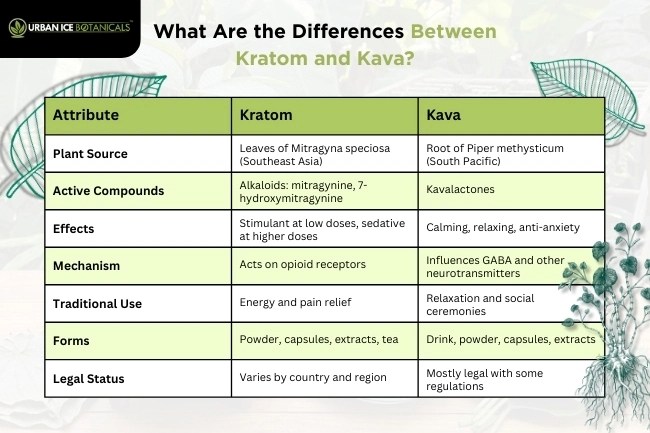
Kava and kratom differ primarily in their botanical origin, active compounds, effects, traditional uses, consumption methods, and regulatory status, with kava being a root-based South Pacific botanical and kratom a leaf-based Southeast Asian botanical. Derived from Piper methysticum, kava contains kavalactones such as kavain, whereas kratom comes from Mitragyna speciosa and contains more than 40 alkaloids, with mitragynine as the dominant compound. Kava is primarily associated with relaxation and anxiety-related effects, whereas kratom produces dose-dependent stimulant-like and sedating effects and is commonly reported for energy, pain, and opioid withdrawal-related purposes.
The key differences between kava and kratom are summarized across the following features:
| Feature | Kava | Kratom |
| Botanical Origin | Piper methysticum, a Piperaceae shrub; roots and rhizomes are used | Mitragyna speciosa, a Rubiaceae tree; leaves are used |
| Geographic Origin | South Pacific, especially Vanuatu, Fiji, Tonga, and Samoa | Southeast Asia, especially Thailand, Malaysia, and Indonesia |
| Active Compounds | Kavalactones such as kavain, methysticin, and yangonin | 40+ alkaloids, mainly mitragynine and 7-hydroxymitragynine |
| Effects | Mainly calming, relaxing, muscle-relaxing, and mildly sedating | Stimulant-like at lower amounts; more analgesic and sedating at higher amounts |
| Legal Status | Not federally scheduled in the U.S.; subject to FDA food regulations | Not federally scheduled, but some states impose bans, age limits, and product rules |
| Uses | Relaxation, socialization, and anxiety-related purposes | Energy, endurance, pain-related effects, mood, and reported opioid withdrawal-related use |
| Forms | Traditional root drink, powder, capsules, and extracts | Fresh or dried leaves, tea, powder, capsules, extracts, and resins |
| Traditional Use | Ceremonial and communal use across South Pacific cultures | Occupational, social, and folk use across Southeast Asia |
| Onset & Duration | Usually noticeable within 30-60 minutes; effects may last several hours | Usually noticeable within 15-60 minutes; effects may last several hours |
| FDA Approval | No FDA-approved therapeutic product for the uses discussed | No FDA-approved therapeutic product for the uses discussed |
| Studied/Reported Benefits | Studied mainly for anxiety-related symptoms and relaxation | Reported for pain, energy, mood, and opioid withdrawal; clinical evidence remains limited |
Botanical Origin
Kava derives from Piper methysticum, a perennial tropical shrub in the pepper family (Piperaceae) whose active pharmacological constituents accumulate exclusively within its underground rootstock and rhizomes. In contrast, kratom comes from Mitragyna speciosa, a tropical evergreen tree in the madder or coffee family (Rubiaceae) whose active constituents concentrate in its broad, veined leaves. These distinct taxonomic backgrounds govern their entire biology, dictating how each plant synthesizes secondary metabolites, how they are agriculturalized and harvested, and which plant tissues, fibrous subterranean roots versus pliable aerial leaves, are processed for human consumption.
Geographic Origin
Native to the South Pacific, kava evolved across island nations such as Vanuatu, Fiji, Tonga, and Samoa, unlike kratom, which is indigenous to the tropical rainforests of Southeast Asia. Indigenous seafaring populations cultivated and distributed specific noble kava cultivars throughout Oceania through ancient maritime trade routes, whereas kratom naturally thrives in the hot, humid river basins of Thailand, Malaysia, Indonesia, Myanmar, and Papua New Guinea. These geographically isolated ecosystems shaped distinct ancestral interactions, influencing how local populations historically cultivated, post-harvest processed, and integrated each botanical into their native regional heritage.
Active Chemical Compounds
Kava’s physiological activity comes from kavalactones, which modulate the central nervous system by enhancing GABA-A activity, inhibiting sodium/calcium channels, and blocking monoamine oxidase B without affecting opioid receptors. By contrast, kratom contains over 40 distinct indole alkaloids, dominated by mitragynine (roughly 66% of the total alkaloid payload) and 7-hydroxymitragynine (Eastlack et al., 2020). These alkaloids function as partial agonists at mu- and delta-opioid receptors, creating a stark biochemical divergence between kava’s non-opioid GABAergic mechanism and kratom’s alkaloid-driven opioid receptor affinity.
Effects Profile
A calming, non-intoxicating experience characterizes kava, with tension relief, muscle relaxation, increased sociability, and preserved cognitive clarity, in contrast to kratom, which produces dose-dependent effects ranging from stimulant-like alertness at lower amounts to analgesia and sedation at higher amounts. A review of 10 human kava trials found no consistently replicated cognitive impairment (LaPorte et al., 2011). Kratom is associated with stimulant effects at 1-5 g and sedative effects at 5-15 g; among 8,049 users, 80% reported decreased pain and 79% increased energy (Grundmann, 2017).
Legality and Regulatory Status
Kratom faces more legal restrictions and regulatory scrutiny than kava, although the status of both botanicals depends on product type and jurisdiction. In the United States, kratom remains outside federal controlled-substance scheduling, but kratom-specific state laws include bans, age restrictions, labeling requirements, and product standards. In July 2026, the DEA began the temporary scheduling process for 7-OH above a proposed threshold and three related synthetic substances, while excluding natural kratom leaf containing trace levels of 7-OH. Kava is also not federally scheduled, but the FDA has determined that its use as an ingredient in conventional foods is not GRAS and considers such use an unapproved food additive. Because regulatory requirements can change, consumers should verify current federal, state, and local rules.
Uses of Kratom and Kava
The primary uses of kava center on relaxation and anxiety, while kratom is more often associated with energy, pain-related effects, and opioid withdrawal symptoms. Pacific communities traditionally consume kava during social and ceremonial gatherings to promote relaxation and socialization. Kratom has traditionally been consumed in Southeast Asia to reduce fatigue and support endurance during physical work. Modern users report using both botanicals for several purposes, but reported use does not establish medical effectiveness. Neither kava nor kratom is an FDA-approved treatment for these reported uses.
Forms and Consumption Methods
Traditionally, kava is consumed as a water-based beverage made from its roots, compared with kratom, which is consumed by chewing fresh leaves or brewing them as tea. Kava beverages are prepared by extracting crushed roots or rhizomes with water, while modern products include powders, capsules, and extracts (Wang et al., 2015). Preparation directly affects potency, kratom tea infusions extracted only 0.062-0.131% mitragynine, compared with 0.485-0.616% using methanol (Grundmann et al., 2023). Commercial forms can be considerably stronger, with kratom resins containing 35.6–62.6 mg/g mitragynine versus 12–21 mg/g in dried-leaf products (EUDA, n.d.).
Traditional and Cultural Use
Kava has a ceremonial and communal role in South Pacific cultures, whereas kratom has traditionally been associated with occupational, social, and folk use in Southeast Asia. A systematic review found 56% of examined records identified cultural reasons for kava use, including ceremonies, weddings, funerals, and preserving cultural identity (Economidis et al., 2025). In Fiji, 56% of adults reported kava consumption in the past month in 2025 (MHMS, 2026). Kratom traditionally supported physical labor in Thailand and Malaysia. A Malaysian study of 29 long-term daily users documented its use for improving stamina, reducing fatigue, and socializing (Singh et al., 2025).
Onset and Duration
Kava typically produces noticeable effects within about 30 to 60 minutes, whereas kratom commonly begins producing effects within approximately 15 to 60 minutes after consumption. Research on standardized kava extracts shows that individual kavalactones differ in absorption, peak concentration, and elimination. Kratom’s effects commonly persist for several hours, but timing varies across products and users. For both botanicals, onset, peak effects, and total duration depend on dose, preparation, active-compound concentration, metabolism, food intake, use frequency, and individual physiology.
FDA Approval
Neither kava nor kratom has an FDA-approved therapeutic drug product for the uses discussed here. Commercial availability should therefore not be interpreted as FDA confirmation of safety or effectiveness for treating anxiety, pain, opioid withdrawal, or other medical conditions. FDA specifically states that no prescription or over-the-counter drug products containing kratom or its known alkaloids are legally marketed in the United States. FDA also concludes that kratom is not lawfully marketed as a dietary supplement and cannot lawfully be added to conventional food under current determinations (FDA, 2025). For kava, FDA has determined that available evidence does not support GRAS status when used as an ingredient in conventional foods and therefore considers such use an unapproved food additive (FDA, 2020).
Primary medicinal or beneficial uses
Kava has been studied mainly for anxiety-related symptoms and relaxation, while kratom users commonly report pain, mood symptoms, and opioid withdrawal as reasons for use. A six-week randomized trial enrolled 75 participants and tested 120-240 mg of kavalactones daily, finding greater anxiety reduction with kava than placebo (Sarris et al., 2013).In a survey of 2,798 kratom users, 91% reported pain-related use and 41% used kratom to reduce or stop opioids. Among them, 411 reported over one year of continuous opioid abstinence attributed to kratom (Garcia-Romeu et al., 2020). These self-reported findings do not establish clinical efficacy.
What Are the Effects of Kava?
Kava primarily produces calming, relaxing, and mild sedative effects through its active compounds, kavalactones. Reported effects include reduced tension, muscle relaxation, increased sociability, and temporary mouth numbness. Clinical evidence for anxiety reduction is mixed, although one randomized trial found that 26% of participants receiving kava achieved remission from generalized anxiety disorder compared with 6% receiving placebo (Sarris et al., 2013). Effects depend on dose, preparation, kavalactone composition, and individual response. Kava can also cause adverse effects, and excessive or inappropriate use may increase safety risks.
How Long Do Kava Effects Last?
Kava effects begin within 15 to 45 minutes, peak around 2 hours, and last about 3 to 6 hours, with calming, muscle-relaxing effects. In a recent survey, 79.4% of respondents reported noticeable effects lasting for hours (Smith et al., 2026). Controlled research involving 10 healthy adults found that five major kavalactones reached peak blood concentrations within 1 to 3 hours (Kanumuri et al., 2022). Although noticeable effects generally last several hours, kavalactones may remain in the body longer. Duration varies with dose, preparation, food intake, kavalactone composition, metabolism, and individual response.
What Are the Effects of Kratom?
Kratom can produce stimulant-like and opioid-like effects, depending on dose, product composition, and individual response. Reported effects include increased alertness and energy as well as relaxation and pain-related effects. Controlled human evidence remains limited. In a recent placebo-controlled study of 15 healthy volunteers, 5 mg of mitragynine increased subjective arousal and attention, while doses up to 40 mg generally produced limited effects on most measured outcomes (Prevete et al., 2025). Kratom’s principal alkaloid, mitragynine, also has opioid-receptor activity, but kratom is not an FDA-approved treatment for pain or other medical conditions.
How Long Do Kratom Effects Last?
Kratom’s noticeable effects generally last about 2–5 hours, depending on dose, preparation, alkaloid concentration, metabolism, and frequency of use. Human pharmacokinetic research shows that mitragynine is absorbed relatively quickly but remains measurable long after its noticeable effects fade. In 10 regular kratom users, mitragynine reached peak plasma concentration after 0.83 ± 0.35 hours and had an estimated terminal half-life of 23.24 ± 16.07 hours (Trakulsrichai et al., 2015). A later 2-g kratom-tea study found peak mitragynine concentrations at about 1 hour, demonstrating rapid absorption (Tanna et al., 2022). Pharmacokinetic half-life should not be interpreted as the duration of noticeable effects.
Which Is More Dangerous? Kava vs Kratom
Neither kava nor kratom is universally more dangerous, but kratom has a more documented risk of dependence and withdrawal, while both have been associated with potentially serious adverse effects. Among 2,798 kratom users, 9.5% reported withdrawal and 17.5% possible withdrawal (Garcia-Romeu et al., 2020). U.S. poison centers recorded 1,807 kratom exposures, with 51.9% involving serious outcomes (Post et al., 2019). Kava reports reached 203 cases in 2025, with 32% involving serious outcomes and liver-enzyme elevations in 1.7% of single-substance cases (Towers et al., 2026). Additional concerns include liver injury, concentrated 7-OH products, polysubstance use, and kratom contamination with lead and nickel.
What Happens When Kava and Kratom Are Combined?
Combining kava and kratom may intensify central nervous system effects and increase the risk of excessive sedation, although direct clinical evidence on this combination remains limited. Co-use may cause pronounced drowsiness, dizziness, impaired coordination, and reduced alertness, particularly at higher doses. Potential risks may also depend on metabolism, product concentration, and individual response. Combining either botanical with alcohol, opioids, sedatives, or other central nervous system depressants may further increase adverse effects and make interactions less predictable.
Do Kava and Kratom Have the Same Active Ingredients?
No, kava and kratom contain different active ingredients that produce distinct pharmacological effects. Kavalactones such as kavain and methysticin are the primary active compounds in kava, while kratom contains more than 40 alkaloids, dominated by mitragynine, resulting in fundamentally different chemical and pharmacological profiles.
Kava’s major compounds also include dihydrokavain and yangonin, which influence several central nervous system pathways associated with relaxation. Kratom contains mitragynine and smaller amounts of 7-hydroxymitragynine, which interact with opioid receptors and other signaling systems. These differences in compound class, concentration, and receptor activity contribute to kava’s predominantly calming effects and kratom’s dose-dependent stimulant-like and opioid-like effects.
When Should Someone Be Concerned About Kava or Kratom Use?
Individuals using kratom or kava should be concerned if they experience severe sedation, confusion, breathing difficulty, seizures, jaundice, persistent vomiting, escalating use, tolerance, inability to stop, or withdrawal symptoms. These signs may indicate serious adverse effects, dependence, liver problems, or harmful interactions. Mixing either botanical with alcohol, opioids, sedatives, or other substances may increase risks and require prompt medical attention.
Watch for the following warning signs:
- Severe sedation or confusion: Extreme drowsiness, disorientation, or difficulty remaining alert may indicate a serious adverse reaction.
- Breathing difficulty: Slow, shallow, or difficult breathing requires immediate medical attention.
- Seizures: Any seizure following kava or kratom use warrants emergency medical evaluation.
- Jaundice: Yellowing of the skin or eyes may indicate liver injury and requires prompt medical assessment.
- Persistent vomiting: Repeated vomiting can cause dehydration and may signal a significant adverse reaction.
- Escalating use and tolerance: Needing progressively larger amounts to achieve similar effects can indicate developing tolerance.
- Inability to stop: Repeated unsuccessful attempts to reduce or discontinue use may indicate dependence.
- Withdrawal symptoms: Physical or psychological symptoms after reducing or stopping kratom, particularly after frequent use, may indicate dependence.
- Mixing substances: Combining either botanical with alcohol, opioids, sedatives, or other psychoactive substances can increase interaction risks.
Where is Kratom Sold in the United States?
Kratom products are sold through online retailers and some physical retail channels, including specialty botanical stores, smoke shops, convenience stores, and similar outlets, where permitted by applicable laws. FDA confirms that kratom products are available online and in brick-and-mortar stores, although federal food and drug requirements and state or local restrictions still apply. Some jurisdictions impose bans, age requirements, labeling standards, or product-specific restrictions. Concentrated 7-OH products face additional federal regulatory action, so availability does not necessarily mean that a product is lawfully marketed.
Is it legal to buy kratom online?
Yes, kratom can generally be purchased online at the federal level, but its legality depends on the buyer’s state and local laws. Kratom is not currently classified as a federally controlled substance, allowing vendors to ship it to many U.S. jurisdictions. However, some states and municipalities prohibit kratom or impose age, labeling, and product requirements. The FDA has not approved kratom for therapeutic use and warns about safety risks. Online vendors should not ship kratom to jurisdictions where its sale or possession is prohibited.
Where can you buy kratom in the United States?
In the United States, kratom is sold through online vendors and physical retail locations such as botanical shops, smoke shops, and convenience stores where state and local regulations allow its sale. FDA confirms that kratom products are found both online and in brick-and-mortar stores. Before purchasing, consumers should check state and local restrictions, age requirements, product labeling, and product composition, particularly for extracts or enhanced 7-OH products. When permitted, consumers may also evaluate a trusted online kratom vendor based on transparent labeling, product information, and available testing documentation.