Skip to main content


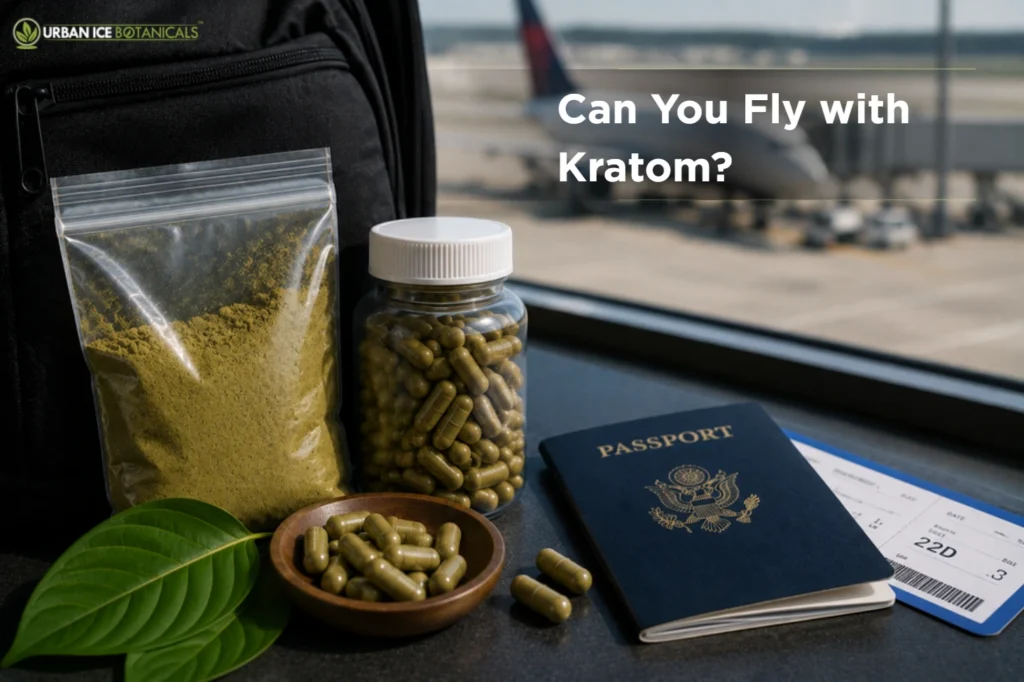
Yes, you can generally fly with traditional kratom within the United States, but you should verify that it is legal at your departure point, any layover locations, and your final destination, while also following TSA rules for powders and liquids. Keep kratom in its original, clearly labeled packaging and consider carrying the product’s batch-specific Certificate of Analysis (COA) so its ingredients and tested composition can be identified if questions arise during screening. A COA is not a TSA requirement, does not establish that the product is legal, and does not guarantee passage through airport security.
For carry-on baggage, kratom powder may need to be separated for additional screening, particularly when larger quantities obstruct X-ray screening. TSA may ask passengers to separate powders and other dense materials, and the TSA officer makes the final decision on whether an item passes the checkpoint. Liquid kratom extracts in carry-on baggage generally follow the 3-1-1 rule: each container must be 3.4 oz (100 mL) or less and fit within the permitted quart-sized liquids bag. International travel requires additional checks because kratom laws can differ in destination and transit countries. Travelers should also distinguish traditional botanical kratom from 7-OH, highly concentrated, modified, or synthetic products, which may be subject to different legal restrictions.
Is It Legal to Fly with Kratom in the United States?
Yes, you can generally pass through TSA screening and fly domestically with traditional botanical kratom because kratom itself is not federally scheduled under the Controlled Substances Act, provided possession is legal in the jurisdictions involved in your trip. TSA screening does not override state or local law, so travelers should check kratom restrictions at their departure point, layovers, and destination. TSA also states that the TSA officer makes the final decision on whether an item is permitted through a security checkpoint.
State and local restrictions remain important because kratom may be prohibited or regulated by age, sale, labeling, or product-composition requirements. For a broader state-by-state overview, check Kratom Legality to verify the current rules for each jurisdiction on your itinerary. Travelers should also distinguish botanical kratom from concentrated or synthetic 7-OH products. On July 1, 2026, the DEA filed its intent to temporarily place 7-OH above a specified threshold and three related substances in Schedule I, while stating that botanical kratom with naturally occurring 7-OH below the specified threshold is excluded from that action.
Can You Bring Kratom Through TSA?
Yes, you can generally bring legal kratom through TSA screening in powder, capsule, gummy, or liquid-extract form, but TSA does not specifically list kratom in its “What Can I Bring?” guidance and screening requirements depend on the product’s form. TSA may subject otherwise permitted items to additional screening, and the TSA officer makes the final decision on whether an item passes through the checkpoint.
TSA Packing Rules for Different Kratom Forms:
- Powders: Kratom powder in a carry-on exceeding 12 oz (350 mL) may need to be placed in a separate bin for X-ray screening and can require additional inspection or opening of the container. TSA recommends placing non-essential powders above this amount in checked baggage for convenience.
- Capsules and Gummies: Kratom capsules and solid gummies can generally be packed in carry-on or checked baggage and are not subject to TSA’s 3.4 oz liquid limit. TSA does not provide kratom-specific rules for these forms, so they remain subject to standard security screening and may require additional inspection if an officer cannot clearly identify the contents.
- Liquids and Extracts: Liquid kratom extracts in carry-on baggage must comply with TSA’s 3-1-1 liquids rule, limiting each container to 3.4 oz (100 mL) and requiring liquids to fit in one quart-sized bag. Generally, place larger liquid containers in checked baggage.
- Packaging: Keep kratom products in their original, clearly labeled packaging when possible. While TSA does not specifically require original packaging for kratom, clear labeling can make the product easier to identify if additional screening is required.
What TSA Rules Apply When Flying with Kratom?
TSA applies its standard screening rules to kratom based on product form. Carry-on powders over 12 oz (350 mL) require separate X-ray screening and may be opened for inspection. Liquid extracts and shots must follow the 3-1-1 rule, limiting containers to 3.4 oz (100 mL) in one quart-sized bag. Solid capsules and gummies are not subject to the liquid limit. Any item may receive additional screening, with the final checkpoint decision resting with the TSA officer.
Do Airlines Have Their Own Kratom Policies Beyond TSA?
Generally, U.S. airlines apply their standard baggage and restricted-item policies to kratom rather than publishing kratom-specific rules. For example, American Airlines maintains restricted-item requirements alongside TSA and FAA rules, and its current published list does not specifically identify kratom as prohibited. However, passing TSA screening does not automatically mean an item meets an airline’s baggage or onboard requirements. Airlines may impose additional carry-on, checked-baggage, hazardous-material, or aircraft-specific restrictions, so travelers should check their carrier’s current policy before departure.
How Do U.S. Kratom Laws Affect Domestic Flights?
U.S. kratom laws affect domestic flights by determining whether you can legally possess and carry your kratom at the departure point, during relevant stops, and after arriving at your destination. Traditional kratom is not controlled under the federal Controlled Substances Act, but the DEA notes that state regulations or prohibitions may apply. As a result, a product that is lawful where a trip begins may be restricted or prohibited elsewhere on the itinerary. Travelers should therefore check current state and applicable local possession laws for their departure, destination, and any layover where those laws could become relevant before flying.
The following checkpoints show where kratom laws may affect a domestic flight itinerary:
| Travel Point | How Kratom Laws Can Affect the Trip |
| Departure | Check state and local rules where the trip begins before bringing kratom to the airport. |
| Layover | A connecting airport can put the traveler in a jurisdiction with different kratom laws, so check applicable rules before travel. |
| Destination | Check the current state and local rules governing the kratom product you will possess after arrival. |
| Local jurisdiction | City or county requirements may add another legal consideration where applicable, so state-level status should not be the only check. |
Are 7-OH or Synthetic Kratom Products Treated Differently?
Yes, concentrated or synthetic 7-OH products are treated differently from traditional botanical kratom because they face FDA marketing restrictions and potential Schedule I control, while DEA’s 2026 scheduling action excludes botanical kratom containing naturally occurring 7-OH below the specified threshold. On July 1, 2026, DEA filed its intent to temporarily place 7-OH above that threshold and three related substances, mitragynine pseudoindoxyl, MGM-15, and MGM-16, in Schedule I.
FDA also distinguishes naturally occurring trace 7-OH in kratom leaf from products containing added or enhanced 7-OH. The agency states that 7-OH cannot lawfully be marketed as a dietary supplement or added to conventional foods. Travelers should therefore check their exact product composition and current applicable laws rather than treating concentrated or synthetic 7-OH products as equivalent to traditional botanical kratom.
How Should You Pack Different Kratom Products for a Flight?
Pack kratom products in sealed, clearly labeled containers and keep them accessible for TSA screening. Powders over 12 oz (350 mL) may require additional screening, while liquid extracts and shots must follow the 3-1-1 liquids rule in carry-on baggage. Capsules and gummies can undergo standard screening as solid items. Original packaging can support product identification, while a Certificate of Analysis can provide batch and testing information but does not replace TSA requirements.
How Should You Pack Kratom Powder for Air Travel?
You should pack kratom powder in a sealed, clearly labeled container that can be easily removed if TSA requests additional screening. Because TSA does not publish kratom-specific packing rules, its general guidance allows officers to separate powders that obstruct clear X-ray images. TSA also applies additional screening procedures to some powder-like substances over 12 oz (350 mL) in carry-on baggage. Travelers can consider placing larger, nonessential quantities in checked baggage, although checked baggage remains subject to TSA screening.
How Should You Pack Kratom Capsules for Air Travel?
You should pack kratom capsules in a closed, clearly labeled container, preferably somewhere accessible if TSA needs to inspect the contents. No kratom-specific rule is published for capsules, so they remain subject to standard baggage screening rather than a kratom-specific procedure. Kratom capsules remain subject to standard baggage screening and may require additional inspection if TSA officers cannot clear the item during screening. Keeping the labeled container accessible can make inspection easier if officers request it.
How Should You Pack Kratom Gummies for Air Travel?
You should pack kratom gummies in sealed, clearly identifiable packaging and keep them accessible during screening. TSA does not publish kratom-specific screening guidance for gummies. Kratom gummies remain subject to standard baggage screening and may require additional inspection if officers cannot clear the product during screening. Because gummies are solid, the standard 3-1-1 liquid limit does not ordinarily apply unless the particular product contains a liquid or gel component.
How Should You Pack Kratom Liquid Extracts and Shots?
Pack liquid kratom extracts and shots according to TSA’s 3-1-1 liquids rule when carrying them through airport security. TSA does not publish a kratom-specific liquid rule, but ordinary carry-on liquids are limited to 3.4 oz (100 mL) per container, with containers fitting into one quart-size clear plastic bag. Generally, place larger non-exempt liquids in checked baggage. Keep containers tightly closed to prevent leakage and accessible in case officers require additional screening.
Should You Keep Kratom in Its Original Packaging?
Yes, keeping kratom in its original or clearly labeled packaging is a practical choice, although TSA does not state that kratom must remain in its original container. Clear packaging makes the product easier to identify if an officer requests inspection, while an organized carry-on can help with X-ray screening. TSA advises travelers to pack properly, and notes that permitted items may still receive additional screening. Original packaging does not exempt kratom from TSA inspection or determine whether it can pass the checkpoint.
Should You Carry a Certificate of Analysis (COA) for Kratom?
Yes, carrying a Certificate of Analysis (COA) with your kratom can be useful, although TSA does not require one for airport screening. A batch-specific COA can provide supporting information about the product, including its identity, manufacturer or batch details, and laboratory-tested composition, which may help clarify what you are carrying if questions arise. However, a COA does not establish that kratom is legal, exempt it from TSA screening, or guarantee passage through security. TSA may still inspect any item that triggers an alarm or raises a security concern.
How Should You Store Kratom During Air Travel?
You should store kratom during air travel in tightly sealed containers and protect the product from moisture, excessive heat, direct sunlight, crushing, leakage, and contamination. Pack each product according to its form and limit unnecessary exposure when opening luggage.
Follow these storage practices to keep kratom in suitable condition during air travel:
- Keep kratom powder sealed and dry to limit moisture exposure, contamination, and spills.
- Store kratom capsules or gummies in a rigid container to reduce crushing during baggage handling.
- Close liquid extract and kratom shot caps tightly and place bottles in a separate leak-resistant bag to contain spills.
- Keep kratom away from direct sunlight and prolonged heat exposure, such as conditions inside a hot vehicle.
- Separate kratom from toiletries, beverages, and other liquids that could leak and contaminate the product.
Can You Fly Internationally with Kratom?
You can fly internationally with kratom only when your specific product is permitted under the laws and import rules of your destination and every relevant transit country, including countries where you only change planes. International travel requires checking customs and import restrictions and how the country regulates kratom (Mitragyna speciosa), mitragynine, and 7-hydroxymitragynine (7-OH). Although these substances are not controlled under the UN drug conventions, individual countries can impose their own prohibitions or restrictions.
Before departure, verify the current rules through official government, customs, embassy, or consular sources for every country on your itinerary. Do not rely on U.S. legality, TSA screening rules, or legal U.S. sale as evidence that kratom can cross an international border. Violating a foreign country’s customs or possession laws can result in product confiscation, fines, detention, or arrest.
Which Countries Ban or Restrict Kratom?
Kratom is banned or heavily restricted in numerous countries worldwide, including Australia, Singapore, Malaysia, France, and several other European and Asian jurisdictions. Restrictions vary by country and may apply to kratom itself, its active compounds, possession, importation, sale, or products intended for human consumption. Travelers should therefore check the current legal status and customs requirements of both their destination and any transit countries before carrying kratom internationally.
- Countries with Bans or Strong Controls: Singapore, Malaysia, Japan, Australia, France, Denmark, Finland, Poland, Romania, the United Kingdom, and Israel each apply legal controls affecting kratom, its active compounds, possession, supply, or importation.
- Countries with Specific Restrictions: The United States has varying state and local laws, while New Zealand, Germany, and Canada apply specific controls involving importation, supply, sale, medicinal classification, or human consumption.
What Should You Do If TSA Questions Your Kratom?
If TSA questions your kratom, remain cooperative, answer the officer’s questions clearly, and allow any required screening or inspection to proceed. Keep the product accessible, and show its original packaging or a clear label if that helps identify it. TSA states that even generally permitted items may receive additional screening or be refused at the checkpoint if they trigger an alarm, appear tampered with, or raise another security concern. The TSA officer makes the final checkpoint decision.
Avoid making unsupported claims that TSA has specifically approved kratom, because TSA does not publish a kratom-specific entry. TSA screening is also distinct from law enforcement. TSA says its screening procedures focus on aviation security rather than searching for illegal drugs. However, if TSA discovers suspected illegal substances or evidence of unrelated criminal activity during screening, it can refer the matter to law enforcement.
What Are the Risks of Flying with Kratom?

The main risks of flying with kratom include changing jurisdictional laws, TSA screening delays, additional scrutiny, health effects, and customs or border enforcement. A product legal at departure may be restricted at a layover or destination. TSA may inspect powders or liquids, while international customs may enforce import restrictions. Travelers should verify applicable laws before departure.
Before traveling with kratom, consider how the following factors could affect your trip:
- Legality varies by jurisdiction
Kratom laws can change between your departure point, layover location, and destination. A kratom product that is lawful in one state or country may be restricted or prohibited in another. Travelers should verify state-level and local laws for every jurisdiction on the itinerary before carrying kratom.
- TSA screening can delay you
Airport security may require additional screening when powders, liquid extracts, packaging, or other product characteristics cannot be cleared during routine screening. TSA officers may inspect containers or conduct further examination when they can’t clear an item during routine screening. Clearly labeled and accessible packaging can simplify inspection, but additional screening may still occur.
- A legal product can still attract scrutiny
Legal possession does not exempt kratom products from airport security inspection. TSA officers may examine powders, liquids, containers, or other items when screening raises security concerns. Travelers should cooperate with inspection requests and avoid assuming that a product’s legal status prevents TSA from conducting additional screening.
- Health Risks During a Flight
Reported kratom effects can include nausea, dizziness, drowsiness, and changes in alertness, while combining kratom with other substances may introduce further health risks. Travelers should consider these effects before using kratom during a flight, particularly when medications or other substances are involved.
- Customs and Border Risks
International travel can expose kratom to customs and import restrictions that differ from U.S. rules. A destination or transit country may prohibit kratom, mitragynine, or related compounds. Carrying a prohibited product across a border can result in seizure, fines, denied entry, or other enforcement under local law.
What Should You Check Before Flying with Kratom?
Before flying with kratom, check destination legality, state and local kratom laws, layover rules, international customs requirements, product type, packaging, TSA liquid and powder rules, and supporting documentation. These checks help identify legal restrictions and airport screening requirements before departure.
Check the following requirements before deciding how to pack and carry kratom:
- Confirm legality at your destination
Verify that kratom possession is permitted at your final destination because legality can differ from your departure location. Check the current rules shortly before travel because restrictions can change. For international trips, confirm whether the destination regulates kratom itself, mitragynine, 7-hydroxymitragynine, or specific kratom products before placing them in your baggage.
- Destination-State and Local Kratom Laws
Check both state-level kratom laws and applicable city or county restrictions. A state may allow traditional kratom while specific municipalities impose separate local restrictions where legally permitted. Review rules that apply to possession and the particular product you carry rather than assuming statewide legality automatically means possession is permitted everywhere within that state.
- Layover or Transit Rules
Review laws at layover locations, particularly when your itinerary crosses jurisdictions with different kratom restrictions. A connecting flight can place you in a state or country where possession or importation is treated differently. Check each transit jurisdiction before departure, especially if you may leave the secure airport area, collect checked baggage, or pass through customs.
- International Customs Rules
Check official customs and government requirements for destination and transit countries before international travel. Customs rules may regulate the importation of kratom, Mitragyna speciosa, mitragynine, or related compounds separately from domestic possession. Determine whether the country prohibits importation, requires declaration, or applies another product classification before carrying kratom across an international border.
- Kratom Product Type
Identify whether you are carrying powder, capsules, gummies, liquid extracts, traditional kratom, or differently regulated products such as 7-OH. Product form determines which TSA screening requirements apply, while product composition can affect its regulatory status. Do not assume that rules covering traditional kratom leaf automatically apply to concentrated, modified, or 7-hydroxymitragynine products.
- Keep products in original packaging
Use original, labeled packaging to make the product easier to identify during airport security screening. Manufacturer-labeled packaging can show the product name, ingredients, quantity, and other identifying information during inspection. Original packaging does not make a prohibited product legal, so travelers must still confirm possession and destination legality separately before traveling with kratom.
- Follow the liquid rule
Keep carry-on liquid extracts in containers of 3.4 oz (100 mL) or less and follow TSA liquids-bag requirements. Place qualifying liquid kratom products with other permitted carry-on liquids in the required quart-size bag. Larger liquid containers generally belong in checked baggage unless an applicable TSA exception applies, and checked baggage remains subject to security screening.
- Prep powders over 12 oz
Powder-like substances over 12 oz (350 mL) in carry-on baggage may require separate X-ray screening and additional inspection. TSA may ask travelers to place larger powder containers in a separate bin, and officers may open containers when necessary for screening. Travelers can consider checked baggage for larger quantities, although checked bags are also subject to TSA inspection.
- Certificate of Analysis
A COA can provide product, batch, ingredient, and third-party testing information, but it does not establish legality. Keeping a Certificate of Analysis with the product may provide useful identifying information if questions arise about its contents. A COA does not replace TSA requirements, customs rules, or applicable kratom laws and should not be treated as travel authorization.
- Choose a travel-friendly format
Pre-measured capsules or gummies can reduce powder or leakage concerns, but product format does not override applicable legal restrictions. Solid, clearly labeled products may be easier to organize and identify than loose powder or liquid extracts during carry-on travel. Travelers must still check the ingredients, product classification, destination legality, and applicable screening requirements for the selected format.
Where can you buy Kratom Online?
You can buy kratom online from vendors that provide clear product labeling, batch-specific COAs, independent third-party testing, and transparent shipping restrictions. Before ordering, confirm that the seller publishes testing information that identifies the product and batch. For example, an online trusted kratom vendor provides batch testing information and states that it does not ship kratom to specified restricted locations. For travel preparation, keep the original labeled packaging and relevant COA, and separately check destination and transit laws.
Yes, you can generally fly with kratom on domestic flights within the United States because kratom is not federally banned, but travelers must still follow TSA screening procedures and comply with state, local, and international laws. Flying with kratom depends on several factors, including whether kratom is legal at your departure, layover, and destination locations, how the product is packaged, the type and quantity carried, and airline or airport security requirements. Travelers should also understand TSA powder screening rules, international travel risks, and the importance of carrying kratom in sealed, clearly labeled packaging with supporting documents such as a Certificate of Analysis (COA). Domestic and international flight restrictions, airport security procedures, packing methods for powders, gummies, extracts, and capsules, airline considerations, travel risks, and kratom consumer protection requirements can all affect whether you can legally and safely travel with kratom.