Skip to main content


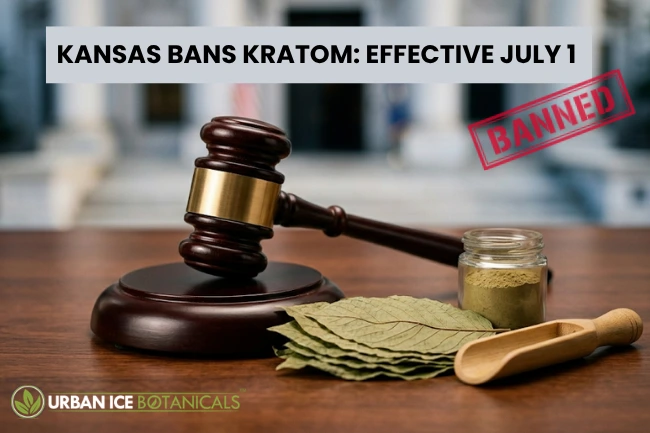
Kansas has officially banned kratom, assigning it the same drug status as heroin. On April 10, 2026, Governor Laura Kelly signed House Bill 2365, amending the Uniform Controlled Substances Act (CSA) to designate 7-hydroxymitragynine (7-OH) and kratom-related substances as Schedule I, the same classification as heroin, LSD, and ecstasy.
The ban on kratom will officially go into effect on July 1, 2026, making it illegal to possess, sell, or distribute kratom anywhere in the state. The Kansas Department of Health and Environment (KDHE) had already flagged these products in September 2025, warning that 7-OH products can be “extremely harmful.”
Why Kansas Banned Kratom?
Governor Laura Kelly pointed to the ongoing federal evaluation as the driving reason behind the signing, stating:
“The U.S. Food and Drug Administration is in the process of determining whether kratom is a safe and effective means of treating certain medical conditions. Until such a time as quality scientific reviews determine positive impacts and minimal health risks, it is wise to safeguard the health of Kansans.”
The bill passed with strong bipartisan support; representatives voted 76-49 in favor, and senators voted 34-5 before being sent to the Governor on March 27, 2026.
What Else Does House Bill 2365 Cover?
Beyond the kratom ban, HB 2365 makes additional updates to the Kansas Controlled Substances Act. The bill adds several other substances to Schedule I, including:
- 11 opioids or synthetic opioids
- Fentanyl-related substances not specifically exempted or listed in Schedules II through V
- Ethylphenidate, a stimulant
- Hexahydrocannabinol, a Delta-9 THC derivative
- CUMYL-PEGACLONE, a synthetic cannabinoid
The bill also updates Schedule IV to include Zuranolone, a prescription medication approved to treat postpartum depression.
What Kansas Kratom Businesses Must Do Before July 1, 2026?
With the July 1, 2026, deadline approaching, all kratom retailers, wholesalers, and distributors operating in Kansas must remove affected products from inventory and cease sales. Businesses must arrange for product return or compliant disposal.
Businesses should:
- Audit inventory for all kratom and 7-OH products
- Remove and isolate affected products from shelves immediately
- Arrange for product return or compliant disposal before July 1, 2026
Non-compliance after July 1 may result in fines, license penalties, or criminal charges under the Controlled Substances Act.
What Kansas Residents Need to Know?
After July 1, 2026, possession, sale, or distribution of kratom and related substances will be illegal across Kansas. Potential consequences include:
- Possession charges with fines or jail time
- Sale or distribution charges, which may reach felony level
- Bringing kratom across state lines into Kansas
Key Takeaways
- Governor Kelly signed House Bill 2365 on April 10, 2026
- Kratom and 7-OH are now Schedule I controlled substances in Kansas, the same as heroin
- The Kansas kratom ban takes effect July 1, 2026
- Businesses must remove all kratom products and cease sales before the effective date
- Non-compliance may result in criminal charges, fines, or license penalties