Skip to main content


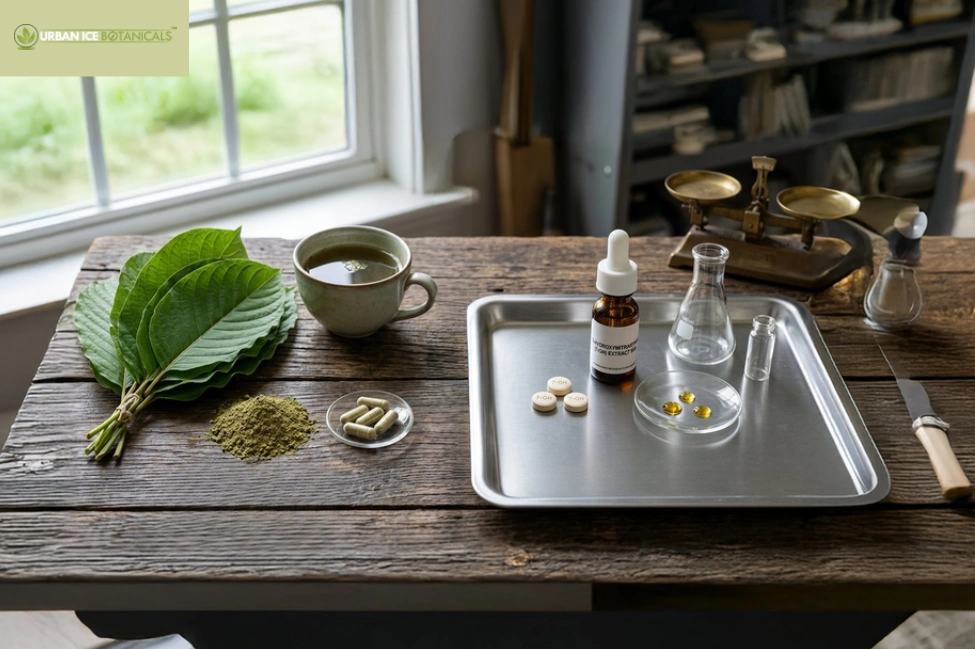
Kratom is a plant-based leaf substance containing multiple alkaloids, while 7-OH is a specific active alkaloid that occurs naturally in small amounts or appears in concentrated formulations. Kratom comes from the leaves of Mitragyna speciosa and contains more than 40 alkaloids, with mitragynine as the primary compound. In contrast, 7-OH represents a single alkaloid with stronger μ-opioid receptor activity and a more concentrated pharmacological profile.
The comparison between kratom and 7-OH involves differences in composition, potency, product forms, effects, dependence potential, withdrawal risks, and regulatory status. Whole-leaf kratom provides a broader alkaloid mixture that contributes to its dose-dependent effects, while concentrated 7-OH products deliver higher levels of one active compound. Both substances can interact with opioid pathways and may produce analgesic, sedating, or opioid-like effects.
However, concentrated 7-OH products raise greater concerns regarding tolerance, dependence, abuse potential, and regulatory scrutiny due to their higher concentration and receptor-focused activity. Their legal status continues to vary across federal, state, and local jurisdictions.
What is Kratom?
Kratom is a tropical evergreen tree (Mitragyna speciosa) native to Southeast Asia, where its leaves have been used in traditional practices for generations. Its dried leaves contain over 40 active alkaloids, primarily mitragynine, which makes up to 66% of the total alkaloid content (Eastlack et al., 2020). Available in powders, teas, and capsules, kratom produces unique biphasic effects. Lower doses interact with adrenergic receptors to boost energy, while higher doses engage mu-opioid receptors, producing sedating and pain-relieving effects.
While natural kratom leaf may cause nausea, physical dependence, and mild withdrawal symptoms, unstandardized commercial products can introduce additional risks because they may contain heavy metals, harmful bacteria, or inconsistent alkaloid concentrations. Mitragynine functions as a partial mu opioid receptor agonist with a preference for G protein signaling over β-arrestin recruitment, a pharmacological characteristic that may contribute to a lower risk of severe respiratory depression compared with classical opioids.
What is 7-Hydroxymitragynine(7-OH)?
7-Hydroxymitragynine (7-OH) is an active opioid-like alkaloid associated with the kratom plant, Mitragyna speciosa. It may occur naturally in trace amounts and can also form during the body’s metabolism of mitragynine or through mitragynine oxidation. In the human body, hepatic CYP3A4 enzymes metabolize ingested mitragynine into 7-OH, making this primary metabolite central to kratom’s therapeutic pain relief. In animal models, 7-OH exhibits up to 13 times the analgesic potency of morphine due to its high mu-opioid receptor binding affinity, while remaining a partial agonist (Eastlack et al., 2020).
Modern commercial markets now decouple 7-OH from whole-leaf plant matter through synthetic oxidation of mitragynine. Sold as concentrated tablets, shots, or gummies, these semi-synthetic formulations deliver doses far exceeding natural levels. By bypassing the natural plant profile, isolated 7-OH significantly narrows the safety margin, markedly increasing the potential for rapid tolerance, physical dependence, severe withdrawal, and respiratory depression.
What Are the Key Differences Between Kratom and 7-Hydroxymitragynine?
Kratom is associated with dose-dependent effects that range from stimulation to sedation due to its full-spectrum alkaloid content, whereas 7-hydroxymitragynine (7-OH) is associated with more concentrated and receptor-focused effects. Whole-leaf kratom combines mitragynine with over 40 compounds, engaging adrenergic pathways for energy before producing mild opioid-like relaxation. Conversely, isolated 7-OH acts as a high-affinity mu-opioid partial agonist with up to 13-fold greater preclinical potency than morphine. Bypassing hepatic CYP3A4 conversion, concentrated 7-OH delivers rapid analgesic and sedating effects without the plant matrix’s balancing influence.
Below are the key differences between Kratom and 7-Hydroxymitragynine:
| Attribute | Kratom | 7-Hydroxymitragynine (7-OH) |
| Source & Composition | Whole-leaf Mitragyna speciosa containing 40+ alkaloids, primarily mitragynine. | Single active alkaloid found naturally in trace amounts or produced in concentrated forms. |
| Potency | Moderate, dose-dependent effects moderated by multiple alkaloids. | Higher receptor activity with a more concentrated pharmacological profile. |
| Product Forms | Powder, tea, capsules, tablets, and full-spectrum extracts. | Tablets, gummies, shots, sublingual strips, and concentrated extracts. |
| Effects | Stimulating at lower amounts and sedating at higher amounts. | Primarily produces concentrated opioid-like analgesic and sedating effects. |
| Tolerance & Dependence | Tolerance develops gradually with repeated use. | Faster tolerance and physical dependence due to stronger receptor activation. |
| Addiction Risk | Lower abuse potential than concentrated 7-OH, but prolonged use may lead to dependence. | Higher addiction risk because of greater potency and concentrated exposure. |
| Withdrawal Symptoms | Usually mild to moderate, including anxiety, insomnia, and muscle aches. | Often more severe and resembles classical opioid withdrawal. |
| Legal Status | Federally unscheduled but restricted in several U.S. states and local jurisdictions. | Legal status is less defined, with many states regulating concentrated 7-OH products separately. |
| FDA Status | Not FDA-approved and subject to FDA safety warnings. | Not FDA-approved; FDA has issued warning letters and public health advisories targeting 7-OH products. |
Source & Composition
Kratom is derived from Mitragyna speciosa, a tropical tree native to Southeast Asia, particularly Thailand, Malaysia, and Indonesia. In contrast, 7-hydroxymitragynine (7-OH) is a minor alkaloid naturally present in trace amounts within the kratom leaf and can also form through mitragynine metabolism. Kratom contains a broad mixture of active alkaloids, including mitragynine, speciogynine, speciociliatine, and paynantheine. By comparison, 7-OH is a single receptor-active compound with a more concentrated pharmacological profile. As a result, kratom’s effects arise from multiple interacting alkaloids, while 7-OH primarily reflects the activity of one potent alkaloid.
Potency
Kratom produces moderate, dose-dependent effects because of its full-spectrum alkaloid composition. In contrast, isolated 7-hydroxymitragynine demonstrates substantially greater potency through selective activation of the μ-opioid receptor. Experimental studies have shown that 7-OH possesses significantly greater receptor affinity than mitragynine and exhibits approximately 13-fold greater analgesic potency than morphine in animal models (Matsumoto et al., 2004). Whole leaf kratom contains numerous minor alkaloids that contribute to its complex pharmacological profile, whereas isolated 7-OH delivers concentrated opioid receptor activation without the broader phytochemical matrix found in the natural leaf.
Product Forms
Kratom is commonly available as dried leaf powder, capsules, tea, and full-spectrum liquid extracts, while 7-hydroxymitragynine (7-OH) is marketed as concentrated tablets, gummies, extract shots, and sublingual strips. Whole-leaf kratom naturally contains only trace amounts of 7-OH, with mitragynine representing the predominant alkaloid. Commercial 7-OH products are typically produced through the chemical oxidation of extracted mitragynine, resulting in concentrated semisynthetic formulations that contain substantially higher amounts of 7-OH than those found in natural kratom leaves. Consequently, these products provide significantly greater exposure to the active alkaloid than traditional whole-leaf preparations, including standard kratom capsules made from natural leaf powder.
Effects
When comparing their effects, kratom produces dose-dependent responses that range from stimulation at lower amounts to relaxation and sedation at higher amounts, while 7-OH is associated with concentrated opioid-like effects. At low intake (1 to 3 grams), kratom’s interaction with α₂-adrenergic and adenosine receptors promotes physical alertness and focus. At higher intake (5 to 8+ grams), its μ-opioid pathways dominate, inducing sedation. In contrast, 7-OH bypasses adrenergic stimulation almost entirely, acting primarily as a potent μ-opioid partial agonist. Even at sub-milligram levels, it produces rapid, pronounced analgesia and sedation without the initial energetic baseline typical of raw leaf.
Tolerance and Dependence
Repeated kratom use may gradually lead to tolerance and physical dependence, whereas concentrated 7-hydroxymitragynine (7-OH) products are associated with a faster onset of tolerance because of their stronger interaction with mu opioid receptors. Research suggests that kratom’s natural alkaloid profile exhibits G protein-biased signaling with relatively limited β-arrestin-2 recruitment, which may help maintain receptor responsiveness over time. In contrast, repeated exposure to highly concentrated 7-OH may promote more rapid receptor desensitization and downregulation. As a result, users of high-potency 7-OH products may develop physiological tolerance within days to weeks, requiring progressively larger amounts to achieve effects that whole-leaf kratom users may reach over a longer period.
Addiction Risk
Regarding risks and side effects, kratom is associated with nausea, constipation, dizziness, and mild dependence. On the other hand, concentrated 7-OH presents an elevated safety and addiction risk profile. While fatal overdoses from unadulterated whole-leaf kratom alone remain exceptionally rare due to its intrinsic safety ceiling, high concentrations of semi-synthetic 7-OH increase the risk of classical opioid like toxicity, including dose-dependent respiratory depression. Furthermore, independent lab testing of commercial 7-OH products has revealed significant manufacturing inconsistencies, including dosage discrepancies exceeding 30% of labeled values and residual solvents from synthetic oxidation processes.
Withdrawal Symptoms
Stopping prolonged kratom use can cause mild-to-moderate withdrawal symptoms like anxiety, insomnia, runny nose, and muscle aches. However, withdrawal from concentrated 7-OH products can be markedly more intense. Clinical studies note that raw kratom withdrawal typically peaks within 3 to 4 days and is often compared in severity to mild caffeine or nicotine cessation. Conversely, 7-OH withdrawal onset occurs rapidly (often within 6 to 12 hours of the last dose) and mimics classical opioid withdrawal, characterized by severe abdominal cramping, intense cravings, profuse sweating, and elevated autonomic arousal, frequently requiring clinical taper protocols or medication-assisted treatment (MAT).
Legal Status
For legal status, kratom operates under a defined regulatory framework, whereas 7-hydroxymitragynine exists in a more volatile legal position because of its concentrated semisynthetic form. At the federal level in the United States, kratom remains unscheduled, although at least six states and numerous municipalities have banned it, while kratom legality continues to vary across individual states and local jurisdictions. In contrast, state legislatures and regulators are increasingly regulating isolated 7-OH separately. Several states that permit traditional kratom under Kratom Consumer Protection Acts (KCPAs) have established synthetic alkaloid limits, often prohibiting products in which 7-OH exceeds 1% to 2% of the total alkaloid content, effectively restricting standalone 7-OH tablets and shots.
FDA Status
Neither kratom nor 7-hydroxymitragynine has received FDA approval as a drug for treating any medical condition. However, the FDA has issued aggressive public health advisories and warning letters specifically targeting manufacturers of concentrated 7-OH products. The agency highlights that high-potency 7-OH preparations pose heightened risks of addiction, abuse, and dependence compared to traditional botanical formulations. Additionally, the FDA continues to penalize vendors marketing 7-OH with unapproved therapeutic claims (such as treating acute pain or opioid withdrawal), cautioning consumers against the consumption of isolated, non-standardized alkaloid extracts.
Key Similarities Between Kratom and 7-Hydroxymitragynine

Kratom and 7-hydroxymitragynine share the same botanical origin, interact with mu-opioid receptors, produce opioid-like effects, carry dependence risks, and face evolving regulatory oversight. Both originate from Mitragyna speciosa, although kratom contains multiple alkaloids, while 7-OH represents one active alkaloid found in trace amounts. Their receptor activity contributes to similar effects such as analgesia, relaxation, and sedation. Both substances may cause tolerance, withdrawal symptoms, and remain unapproved by the FDA for medical use.
The key similarities between kratom and 7-hydroxymitragynine include:
- Source
Both kratom and 7-hydroxymitragynine (7-OH) originate from Mitragyna speciosa, a tropical evergreen tree native to Southeast Asia. Raw kratom leaf contains more than 40 alkaloids, with mitragynine accounting for up to 66% of total alkaloid content (Eastlack et al., 2020; Tanna et al., 2022). In contrast, 7-OH occurs naturally in very low concentrations as a minor kratom alkaloid. Both remain biologically connected because 7-OH also forms as an active hepatic metabolite of mitragynine through CYP3A4-mediated oxidation after kratom consumption.
- Mechanism of Action
At a cellular level, kratom primarily, through mitragynine and 7-OH, produces physiological effects by targeting the human μ-opioid receptor (MOR). Both compounds act as atypical partial agonists with G-protein bias, favoring intracellular G-protein signaling over β-arrestin-2 recruitment. This mechanism differs from classical opioids like morphine that strongly activate pathways linked to respiratory depression and tolerance. However, 7-OH has a higher μ-opioid receptor binding affinity than mitragynine, resulting in stronger overall receptor activation.
- Common Effects
Due to their shared affinity for μ-opioid pathways, both whole-leaf kratom and 7-OH produce overlapping physiological and subjective effects. At moderate to high exposure levels, both substances may cause analgesia, physical relaxation, improved mood, and sedation. They can also produce common μ-opioid-related effects, including nausea, dizziness, dry mouth, pupil constriction, and constipation. The main differences are effect intensity and onset, as kratom’s secondary alkaloids moderate responses, whereas isolated 7-OH produces faster, stronger effects.
- Shared Risks
Prolonged or frequent exposure to kratom or 7-OH may lead to physiological tolerance, physical dependence, and withdrawal symptoms after abrupt discontinuation. Both substances interact with μ-opioid receptors, which can contribute to anxiety, insomnia, runny nose, muscle aches, and gastrointestinal discomfort during withdrawal. In addition, both kratom products and 7-OH formulations may present safety concerns due to inconsistent manufacturing, variable alkaloid content, possible heavy metal or bacterial contamination, and interactions with other central nervous system depressants.
- Regulatory Status
In the United States, whole-leaf kratom and 7-OH share a similar federal regulatory position because neither has received FDA approval as a drug, dietary supplement, or food additive. The FDA has issued safety advisories regarding both substances due to concerns about dependence, addiction, and limited standardized safety data. Both remain federally unscheduled but face restrictions in several states and municipalities. Some jurisdictions with Kratom Consumer Protection Acts require testing, contamination screening, and limits on synthetic alkaloid adulteration.
Which Is More Addictive: Kratom or 7-OH?
7-OH (7-hydroxymitragynine) is likely to present a greater addiction concern than traditional kratom because concentrated 7-OH products deliver a higher amount of a single active alkaloid with stronger opioid receptor activity. This concentrated exposure can increase the intensity of effects, reinforcement potential, and likelihood of tolerance and physical dependence compared with whole-leaf kratom. However, direct human studies comparing addiction rates between kratom and 7-OH remain limited, so risk differences should be interpreted cautiously.
Addiction, abuse liability, tolerance, and dependence describe different outcomes. Kratom can also produce dependence with repeated use, while concentrated 7-OH products may carry higher abuse liability because of their potency, product design, and faster onset of opioid-like effects. The risk depends on concentration, frequency of use, duration of exposure, and individual factors rather than the substance alone.
Is 7-Hydroxymitragynine Legal in the United States?
The legal status of 7-hydroxymitragynine (7-OH) in the United States remains complex because federal, state, and local regulations may differ. 7-OH has not received FDA approval as a drug, dietary supplement, or food additive, and the FDA has raised concerns about concentrated 7-OH products, including safety risks, abuse potential, dependence, and unapproved therapeutic claims. State and local regulations continue to vary, with some jurisdictions introducing restrictions on concentrated 7-OH formulations.
The legal status of 7-OH can be understood across three main areas:
- Federal Status
The federal legal status of 7-hydroxymitragynine (7-OH) remains under active regulatory review. Neither kratom nor 7-OH has been approved by the U.S. Food and Drug Administration (FDA) as a drug for treating any medical condition. The FDA has stated that 7-OH products are not lawful dietary supplements, food additives, or approved drug ingredients (U.S. Food and Drug Administration [FDA], 2025).
- FDA and DEA Actions
The FDA has issued warning letters to companies marketing concentrated 7-OH products, particularly those making unapproved therapeutic claims or selling products such as tablets, gummies, drink mixes, and shots. The agency has expressed concerns regarding the opioid-like effects, abuse potential, and dependence risks associated with high-potency 7-OH products (FDA, 2025). DEA involvement concerns potential federal scheduling decisions, but regulatory actions remain subject to formal federal processes.
- State-by-State Overview and Local Restrictions
State regulation of kratom and 7-OH varies widely across the United States. Some states regulate kratom through consumer protection laws, while others restrict or prohibit kratom products. Certain jurisdictions have introduced additional restrictions targeting concentrated or enhanced 7-OH products because of their higher alkaloid concentration and opioid-like activity (FDA, 2025). Local governments may also establish separate restrictions, creating a changing legal landscape.
Is 7-OH the Same as Kratom?
No, 7-hydroxymitragynine (7-OH) is not the same as kratom because kratom refers to the whole Mitragyna speciosa leaf containing multiple alkaloids, while 7-OH is only one specific alkaloid associated with the plant. Kratom contains more than 40 alkaloids, including mitragynine and trace amounts of 7-OH (Eastlack et al., 2020). 7-OH occurs naturally in small amounts and can also form through mitragynine metabolism in the body. The main difference is composition and potency, as whole-leaf kratom contains multiple interacting compounds, whereas concentrated 7-OH products contain higher amounts of one active alkaloid with stronger μ-opioid receptor activity (Kruegel & Grundmann, 2018).
Is 7-OH Naturally Present in Kratom?
Yes, 7-hydroxymitragynine (7-OH) is naturally present in kratom, but only as a minor trace alkaloid rather than a major component. In Mitragyna speciosa leaves, 7-OH occurs at very low concentrations, while mitragynine is the dominant alkaloid. Some evidence suggests that 7-OH may also form during leaf drying and processing through oxidation of mitragynine. The naturally occurring amount of 7-OH is far lower than the concentrations found in commercial concentrated 7-OH products. These enhanced products often contain artificially increased levels of 7-OH through chemical conversion of mitragynine, making them pharmacologically different from traditional whole-leaf kratom.
Is 7-OH Considered an Opioid?
Yes, 7-hydroxymitragynine (7-OH) is considered an opioid because it acts as a partial agonist at the μ opioid receptor, the same primary receptor involved in the effects of many opioid drugs. However, 7-OH is not a traditional pharmaceutical opioid like morphine or oxycodone; it is a kratom-derived alkaloid with a distinct chemical structure. Its strong opioid receptor activity contributes to analgesic and sedative effects, while its classification and regulatory status remain under discussion.
Which Should You Choose: Kratom or 7-Hydroxymitragynine
You should choose between kratom and 7-hydroxymitragynine based on risk factors, product composition, and individual health considerations because kratom and 7-hydroxymitragynine (7-OH) have different pharmacological profiles. Traditional whole-leaf kratom may present a lower risk profile than concentrated 7-OH products because it contains a broad mixture of alkaloids, including mitragynine, rather than a highly concentrated opioid-active compound.
Concentrated 7-OH products deliver higher amounts of a potent μ-opioid receptor-active alkaloid, which may increase concerns related to abuse potential, tolerance, and dependence (Kruegel & Grundmann, 2018). Current evidence does not establish 7-OH as a safer or superior alternative, and direct human comparisons remain limited. Regulatory agencies have raised specific concerns about high-potency 7-OH formulations due to safety and dependence risks.
Where Can You Buy Kratom Legally?
Kratom can be purchased legally only in areas where state and local regulations permit its sale, possession, and distribution. Before purchasing kratom products, consumers should verify current laws, age requirements, labeling standards, and applicable restrictions in their jurisdiction. A trusted kratom vendor should provide transparent product information, batch testing, certificates of analysis, and details about alkaloid content and manufacturing practices. Consumers should avoid products with unclear labeling or unsupported health claims because legal availability does not confirm FDA approval, safety, or product quality.