Skip to main content


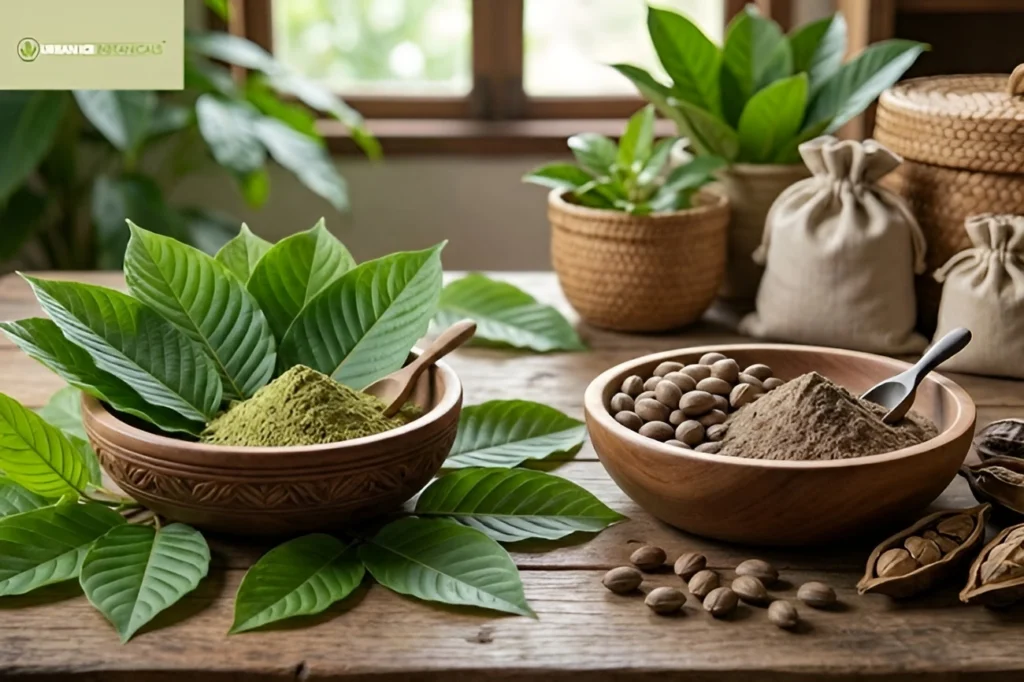
Akuamma differs from kratom mainly in its plant source, alkaloid profile, reported effects, potency, research availability, and commercial presence. Akuamma is derived from the fruit seeds of Picralima nitida, a West African tree belonging to the Apocynaceae family, whereas kratom is produced from the leaves of Mitragyna speciosa, a Southeast Asian tree in the Rubiaceae coffee family. Akuamma contains indole alkaloids such as akuammine and akuammicine, while kratom contains more than 40 identified alkaloids, including mitragynine and 7 hydroxymitragynine. These differences contribute to variations in traditional use, chemical activity, product forms, and reported experiences.
Kratom generally has stronger reported effects, wider availability, and more documented user experiences, whereas akuamma remains a less studied botanical with limited human research. Despite their differences, both are plant-derived products containing bioactive alkaloids, have histories of traditional use, are sold as powders, capsules, and extracts, and may vary by source and processing. Neither should be presented as a proven treatment without sufficient clinical evidence, and safety, legality, and product quality should be considered when comparing them.
What is Akuamma?
Akuamma is a West African tree scientifically known as Picralima nitida. Its seeds have been used in traditional medicine for pain and fever, and they contain several indole alkaloids, including akuammine, akuammidine, akuammicine, akuammigine, and pseudoakuammigine. Research has identified these compounds in P. nitida seeds and investigated their pharmacological properties. A 2021 study isolated six akuamma alkaloids and evaluated five against more than 40 central nervous system receptors, finding that opioid receptors were among their primary targets (Creed et al., 2021).
Research into its alkaloids has also prompted comparisons with kratom because several compounds interact with opioid receptors. Laboratory studies found varying activity at μ-, κ-, and δ-opioid receptors, although the compounds showed different binding profiles and effects. However, these findings come primarily from laboratory and animal research, while human clinical evidence remains limited.
How Does Akuamma Work?
Akuamma works through active plant chemicals called indole alkaloids, primarily akuammine, which interact with opioid receptors in the central nervous system. Traditionally, West African communities have used the crushed seeds of the Picralima nitida tree for concerns such as pain and fever. Laboratory research suggests that akuammine binds to the μ opioid receptor but shows relatively weak activity compared with conventional opioid agonists. Other alkaloids, including akuammicine, may interact differently with opioid receptors. However, these laboratory findings do not establish how strongly these compounds affect people or confirm reliable pain-relieving effects in humans.
What is Kratom?
Kratom is a tropical evergreen tree (Mitragyna speciosa) native to Southeast Asia, where its leaves have been used traditionally for generations. Its dried leaves contain more than 40 active alkaloids, with mitragynine serving as the primary compound and accounting for up to 66% of total alkaloid content (Eastlack et al., 2020). These naturally occurring compounds influence how kratom interacts with receptors in the body and contribute to its reported effects.
Traditionally, the leaves have been chewed or brewed as tea, while modern products are commonly sold as dried powders, capsules, teas, and concentrated liquid extracts. Reported effects can vary with the amount consumed, with stimulant-like effects associated with lower amounts and opioid-like effects occurring at higher amounts. Overall, kratom has a complex alkaloid profile that contributes to its varied reported effects and ongoing scientific interest.
How Does Kratom Work?
Kratom (Mitragyna speciosa) works as a dose-dependent, atypical opioid because its active compounds bind to the brain’s opioid receptors while simultaneously interacting with stimulant pathways. Among its more than 40 alkaloids, mitragynine plays a major role in producing these effects. Lower amounts of 1 to 2 g may produce stimulant-like effects, including increased alertness, while higher amounts of 4 to 6 g may cause more sedating or opioid-like effects. However, further human research is needed to clarify its safety, effectiveness, and potential medical applications.
What Are the Key Differences Between Akuamma and Kratom?
Akuamma and kratom differ primarily in their botanical origin, alkaloid composition, effects, potency, safety profile, and availability, with akuamma generally being a less studied seed-based botanical and kratom a more widely researched leaf-based product. Akuamma comes from Picralima nitida and contains alkaloids such as akuammine, while kratom comes from Mitragyna speciosa and contains more than 40 alkaloids, including mitragynine. Kratom typically produces stronger reported effects and has broader commercial availability, whereas akuamma remains less researched with limited human data.
The key differences between akuamma and kratom are summarized across the following features:
| Feature | Akuamma | Kratom |
| Botanical Origin | Picralima nitida tree from West and Central Africa; primarily uses seeds | Mitragyna speciosa tree from Southeast Asia; primarily uses leaves |
| Primary Alkaloids | Akuammine, akuammicine, and other indole alkaloids | Mitragynine, 7-hydroxymitragynine, and 40+ identified alkaloids |
| Potency | Generally described as milder, with limited human research | More pronounced reported effects with dose-dependent responses |
| Effects | Traditionally associated with calming and pain-related uses | Reported stimulant-like effects at lower amounts and sedating effects at higher amounts |
| Taste | Sharp, intensely bitter, seed-like flavor | Bitter, earthy, herbal leaf flavor |
| Safety Research | Limited human safety data available | More documented reports of side effects, dependence, and withdrawal |
| Legal Status | Fewer specifically documented restrictions | Greater regulatory attention with varying state and local laws |
| Forms Available | Seeds, seed powder, capsules, extracts | Leaf powder, capsules, teas, extracts, beverages, and other products |
Botanical Origin
Akuamma comes from Picralima nitida, a tropical tree native to West and Central Africa, whereas kratom comes from Mitragyna speciosa, an evergreen tree indigenous to Southeast Asia. Akuamma belongs to the Apocynaceae family, with its seeds serving as the primary traditionally used plant part. A review of P. nitida documented the traditional medicinal use of its seeds and other plant parts for conditions including fever, malaria, and pain. Kratom belongs to the Rubiaceae family and is primarily valued for its leaves, which contain its major pharmacologically studied alkaloids. These different botanical origins contribute to distinct alkaloid compositions, traditional practices, preparation methods, and chemical properties.
Alkaloid Profile and Chemical Composition
Akuamma has a smaller characterized alkaloid profile centered on compounds such as akuammine and akuammicine, whereas kratom contains more than 40 identified alkaloids dominated by mitragynine. Mitragynine accounts for approximately 66% of kratom’s total alkaloid content, while 7-hydroxymitragynine occurs at much lower concentrations (Eastlack et al., 2020). A 2021 study isolated six akuamma alkaloids and evaluated five across more than 40 central nervous system receptors, identifying opioid receptors as their primary targets (Creed et al., 2021). Although alkaloids from both botanicals interact with opioid receptors, they differ considerably in chemical structure, concentration, composition, and specific receptor activity.
Potency and Strength
Stronger and more noticeable effects are generally reported with kratom than akuamma, although direct human evidence comparing their potency remains limited. Kratom’s effects can vary with consumption, ranging from stimulant-like effects to greater relaxation and sedation. In a U.S. survey of 8,049 kratom users, adverse effects were more common among those reporting doses of 5 g or more and at least 22 doses per week (Grundmann, 2017). Akuamma is generally described as milder, but human research remains limited. For both botanicals, potency can vary with alkaloid concentration, processing, extract strength, product consistency, amount consumed, and individual response.
Effects and Experience
Reported effects from kratom span a broader range of stimulant and sedating experiences, while akuamma is more commonly associated with subtler calming and pain-related effects. Lower amounts of kratom are often linked with alertness and energy, while larger amounts may produce greater relaxation and sedation. In a U.S. online survey, 68% of respondents reported using kratom for pain and 66% for emotional or mental conditions (Grundmann, 2017). Akuamma has a history of traditional use for pain-related purposes, although its human effects remain poorly studied (Creed et al., 2021). Experiences with either botanical can vary according to product composition, amount consumed, tolerance, and individual physiology.
Taste and Flavor Comparison
Akuamma generally has a sharper, intensely bitter seed taste compared with kratom’s bitter, earthy, and more distinctly herbal flavor. This difference reflects their plant sources, since akuamma products are primarily made from seeds, while kratom products typically come from leaves. Akuamma powder tends to have a strong, lingering bitterness, whereas kratom powder has a more earthy, grassy taste and aroma. Both botanicals are also available in capsules, which largely minimize direct exposure to their flavors. When consumed as powders or teas, juices, sweeteners, and other flavored drinks can help mask their bitterness without changing their underlying properties or making consumption inherently safer.
Safety and Side Effects
Kratom has a better documented safety and side effect profile than akuamma, for which human safety research remains considerably more limited. In one survey, 20.93% (1652 out of 7893) of kratom users reported negative effects, primarily nausea (12.75%), constipation (9.17%), dizziness, or drowsiness (4.81%), with most effects becoming more common at higher doses and frequencies (Grundmann, 2017). Kratom has also been associated with dependence and withdrawal, particularly with frequent use. Akuamma may present adverse effects and interaction risks, but their frequency and severity remain uncertain. For both botanicals, concentrated extracts, inconsistent product composition, medications, and combined substance use can introduce additional safety concerns beyond those associated with raw plant material.
Legality and Regulatory Status
Kratom faces more legal restrictions and regulatory scrutiny than akuamma, although the status of both botanicals varies by jurisdiction. In the United States, kratom remains outside federal controlled-substance scheduling, but kratom-specific state laws include prohibitions, age limits, labeling requirements, and product standards. Regulation is also increasingly distinguishing natural kratom from concentrated 7-OH products: in July 2026, DEA began a temporary-scheduling process targeting 7-OH above a specified threshold and three synthetic derivatives rather than ordinary natural-leaf kratom. Akuamma faces fewer specifically documented restrictions. Because regulations change, current federal, state, and local requirements should always be verified.
Forms and Availability
Kratom is more widely available in diverse commercial formats, while akuamma remains a comparatively niche botanical product. Kratom is commonly sold as dried leaf powder, capsules, teas, extracts, beverages, and other formulations. A 2022 ecological momentary assessment of 357 U.S. kratom consumers found that loose powder accounted for 55.8% of reported product use events and encapsulated powder for 26.8%, while extracts were used less frequently (Smith et al., 2024). Akuamma products are typically available as whole seeds, ground seed powder, capsules, and extracts (Akuamma alkaloid research). Availability varies according to regional regulations, consumer demand, and vendor practices. Product format also matters because extracts and concentrated preparations can differ considerably from minimally processed plant material in strength and consistency.
Key Similarities Between : Akuamma and Kratom
Akuamma and kratom are both plant-derived botanical products containing bioactive alkaloids and have histories of traditional use. Both are available as powders, capsules, and extracts, are commonly described as bitter, and may vary by plant source, processing, and batch consistency. Neither has the standardized quality of approved medicines, and both require consideration of safety risks, interactions, legal status, and the lack of sufficient clinical evidence supporting them as proven treatments.
10 Key similarities of Akuamma and Kratom are:
- Plant-derived botanicals: Both akuamma and kratom originate from naturally occurring plants rather than synthetic compounds.
- Bioactive alkaloids: Each contains naturally occurring alkaloids that interact with biological systems and contribute to their properties.
- Traditional use history: Historical traditional practices have included in both botanicals before their availability as modern botanical products.
- Available product forms: Both are commonly sold as powders, capsules, and extracts, although the plant parts used differ.
- Bitter taste profile: Strong bitter flavors are commonly associated with these botanicals and may be masked through preparation methods.
- Product variability: Their alkaloid content and characteristics may vary depending on plant source, cultivation, processing, and batch quality.
- Limited medical standardization: Neither product has the consistency, regulatory approval, or clinical evidence expected from established medicines.
- Safety considerations: Both may present potential risks, including interactions with medications or other substances.
- Legal considerations: The regulatory status of both products can vary depending on country, state, or local laws.
- Evidence limitations: Neither akuamma nor kratom should be presented as a proven medical treatment without sufficient clinical evidence.
Which Should You Choose: Akuamma or Kratom?
The choice between akuamma and kratom depends on individual preferences, goals, tolerance, and the level of available research. Kratom has a broader history of use, a more established product market, and more documented user experiences, while akuamma is a lesser-known botanical with limited human research. Neither option should be considered a medically proven treatment, and factors such as safety, legality, product quality, and personal response should be considered before making a decision.
- When Kratom May Be Preferred?
Kratom may be considered by individuals seeking a more widely available botanical product with a broader range of reported effects and more established consumer use. Its different product forms, including powders, capsules, teas, and extracts, provide more options for preparation. However, its stronger reported effects and greater risk of dependence or withdrawal make careful consideration of frequency, amount consumed, and individual circumstances important.
- When Akuamma May Be Preferred?
Akuamma may appeal to individuals interested in a less common botanical product derived from Picralima nitida seeds. It has a history of traditional use and contains alkaloids such as akuammine and akuammicine, but human research remains limited compared with kratom. Because evidence on its effects, safety, and long-term use is less established, users should approach it with greater awareness of uncertainty and product variability.
- Which Option Is Better Based on Your Needs?
There is no universally better choice between akuamma and kratom because they differ in chemistry, availability, reported effects, research coverage, and safety considerations. Kratom may offer more documented information and product variety, while akuamma may interest those looking for a different botanical profile. The more appropriate option depends on personal priorities, legal requirements, health factors, and the willingness to consider the limitations of current scientific evidence.
Where Can You Buy Kratom Legally?
Kratom can be purchased legally in locations where its sale and possession are permitted under current federal, state, or local regulations. In the United States, kratom remains unscheduled at the federal level, but certain states and municipalities have implemented restrictions, bans, age requirements, or product regulations. Because laws can change, consumers should verify the current legal status in their specific location before purchasing kratom products.
When buying kratom, choosing an Online trusted kratom vendor can help consumers access products with clearer labeling, quality information, and available testing documentation. Reputable sellers may provide details about product sourcing, manufacturing practices, and laboratory analysis. However, consumers should still evaluate product quality, understand applicable regulations, and consider safety factors before using any kratom product.